By Volta Electric Inc. | Licensed Electrical Contractor Serving Pasadena & the San Gabriel Valley
Bringing an electric vehicle home often leads to the same practical question: Can my home’s electrical system handle a Level 2 EV charger?
For some Pasadena homes, installing a charger is relatively straightforward. For others—particularly older properties—the electrician may find that the existing panel, service capacity, circuit configuration, or wiring needs evaluation before installing the charger.
That does not mean every older Pasadena home needs a panel upgrade.
The correct answer depends on the home’s existing electrical load, available capacity, charger specifications, and planned future electrical equipment.
For homeowners researching EV charger installation in Pasadena, the best place to start is an electrical assessment. A qualified electrician in Pasadena can determine whether your existing system can support the charger, whether you need a dedicated circuit, and whether a panel or service upgrade is necessary.
Quick Answer: Do I Need a Panel Upgrade for an EV Charger?
Not necessarily.
Many homes can accommodate a Level 2 charger without upgrading the main electrical service. Others may need additional electrical work.
The electrician should evaluate:
- The home’s service rating
- Existing electrical loads
- Available circuit capacity
- Proposed EV charger output
- Electrical panel condition
- Existing wiring
- Planned additions such as another EV, heat pump, or electric appliances
A Level 2 charger normally operates from a 240-volt residential circuit, but charger output varies. The U.S. Department of Energy’s Alternative Fuels Data Center notes that residential Level 2 charging equipment can operate across a range of power outputs, and charging performance depends on both the equipment and the vehicle.
The important point is that charger installation is an electrical-load question, not simply a panel-amp question.
Why Pasadena Homes Can Require More Planning
Pasadena includes a broad range of housing ages and architectural styles.
The city has numerous historic properties and designated historic districts, while other neighborhoods contain newer construction and extensively remodeled homes.
That creates very different electrical conditions from one property to another.
An older home may have a 60- or 100-amp service, while a remodeled property may already have a modern 200-amp electrical system. Even two homes with the same service rating can have very different available capacity depending on HVAC systems, appliances, pool equipment, solar, battery storage, and other loads.
Pasadena also has its own municipal electric utility, Pasadena Water & Power (PWP). PWP maintains its own utility-service requirements and provides a residential EV-charger incentive program.
That makes local knowledge useful when an EV charger requires more than a straightforward branch-circuit installation.
What Is Panel Capacity?
Your electrical panel distributes electricity to the home’s branch circuits.
When you install a Level 2 charger, the charger becomes another electrical load that must be considered alongside everything else in the home.
Think about the equipment that could be operating around the same time:
- Air conditioning
- Refrigerator and freezer
- Electric range or oven
- Electric water heater
- Laundry equipment
- Pool equipment
- Heat pump
- Home office equipment
- Existing EV charger
- Proposed new EV charger
A panel’s main breaker rating doesn’t tell the whole story.
For example, a 200-amp electrical panel does not mean that every home can simply add unlimited electrical equipment. Likewise, a 100-amp service doesn’t automatically mean an EV charger is impossible.
The appropriate approach is a load calculation based on the home’s electrical system and expected usage.
How Much Electrical Power Does a Level 2 Charger Need?
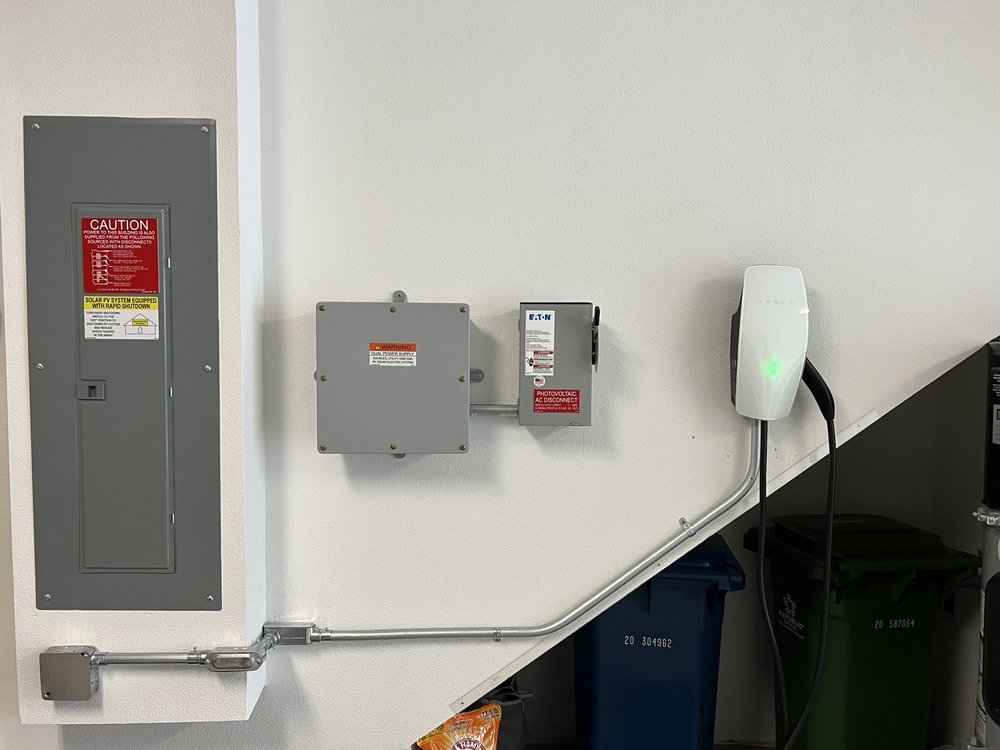
Level 2 chargers vary considerably in output.
The U.S. Department of Energy’s Alternative Fuels Data Center identifies Level 2 charging as typically using 208 or 240 volts and notes that Level 2 equipment can range from approximately 2.9 kW to 19.2 kW.
A common residential configuration is around 7.2 kW, but higher-powered equipment is also available.
The circuit size must be selected according to the charger’s actual electrical requirements and the applicable electrical code.
For example, the DOE notes that a typical 30-amp Level 2 charger uses a dedicated 40-amp circuit. Higher-output equipment can require larger circuits.
This is why homeowners should select the charger and circuit together, rather than purchasing the highest-output charger available and figuring out the electrical requirements afterward.
Available Breaker Space Is Not the Same as Available Electrical Capacity
An electrical panel has physical space for breakers, but available breaker slots do not necessarily tell you whether the service can support a new EV charger.
A Level 2 installation may require a dedicated two-pole circuit depending on the equipment and configuration.
If the panel has no appropriate space, the electrician may need to determine whether:
- The existing equipment can be reconfigured
- A different listed panel arrangement is possible
- A subpanel is appropriate
- Load management can be used
- The panel should be replaced
More importantly, the home’s electrical load still has to be evaluated. A panel with an empty breaker slot can still have insufficient overall service capacity.
What Happens If You Have a 100-Amp Panel?
This is one of the most common questions older homeowners ask.
A 100-amp service does not automatically prevent EV charging.
The electrician needs to calculate the home’s existing demand and compare it with the proposed charger load.
A home with modest electrical usage may have enough capacity.
Another home with central air conditioning, electric cooking, electric water heating, pool equipment, and other loads may have much less available capacity.
The same reasoning applies to 60-amp services and other older electrical systems.
Rather than telling every homeowner to upgrade to 200 amps, a professional assessment determines whether the existing service is adequate and what options are available.
When a Panel Upgrade May Make Sense
A panel or service upgrade may become appropriate when the home’s calculated electrical demand leaves insufficient capacity for the proposed charger.
It may also make sense when the existing panel is damaged, outdated, poorly configured, or unsuitable for the planned electrical work.
An upgrade can be particularly worth evaluating when the homeowner is combining several projects, such as:
- EV charger + heat pump
- EV charger + electric water heater
- EV charger + kitchen electrification
- EV charger + second EV
- EV charger + home addition
Planning several electrical projects together can sometimes avoid performing separate upgrades at different times.
EV Charger Installation in Older Pasadena Homes
Older homes can present additional challenges that have little to do with the EV charger itself.
An electrician may encounter:
- Older electrical panels
- Limited service capacity
- Older wiring
- Difficult attic or crawl-space access
- Detached garages
- Long conductor runs
- Previous remodeling work
- Historic-property considerations
A detached garage, for example, may require extending electrical infrastructure from the home’s main electrical system to the garage. The appropriate design depends on distance, existing equipment, conductor requirements, trenching, and the applicable code.
An older house makes an initial assessment more important, but it doesn’t automatically mean the project will be complicated.
Detached Garage EV Charger Installation

Many Pasadena homes have garages that are separated from the main living structure or located some distance from the electrical panel.
Installing a charger in a detached garage may require underground conduit and appropriately sized conductors.
The electrician should determine:
- Distance from the source panel
- Conduit route
- Required burial and protection
- Circuit requirements
- Garage electrical capacity
- Whether a subpanel is appropriate
- Charger location
The longer the electrical route, the more installation material and labor may be required.
This is another reason a quote based only on the charger’s purchase price will not accurately represent the finished project.
Hardwired Charger vs. Plug-In Charger
Residential Level 2 chargers can be installed using different configurations, depending on the equipment and electrical design.
- A hardwired charger is permanently connected to the electrical circuit.
- A plug-in charger uses an appropriate receptacle.
The correct option depends on the charger manufacturer’s instructions, circuit design, installation conditions, and homeowner preferences.
Pasadena’s current residential EV incentive program has specific eligibility rules. PWP states that eligible Level 2 chargers must be new, wall-mounted, and use an approved connector; its requirements distinguish qualifying charger installations from simply installing or using a 240V receptacle.
Does EV Charger Installation Require a Permit in Pasadena?
Yes, depending on the installation configuration and electrical work involved.
PWP currently states that a City of Pasadena electrical permit is required for a hardwired EV charger or a new/modified 240V power socket.
The permit and inspection process is important because it verifies that the installation complies with applicable electrical requirements.
PWP’s current service-upgrade process also requires coordination when an EV project involves changes to the home’s electric service. PWP says projects involving service upgrades begin with a meter-spot request, followed by utility review and an electrical permit.
Pasadena Water & Power EV Charger Rebates
This is an especially useful local consideration for Pasadena homeowners.
PWP currently offers a residential incentive of:
$600 for a qualifying Wi-Fi-enabled or internet-connected Level 2 EV charger.
$200 for a qualifying standard Level 2 EV charger without Wi-Fi or internet connectivity.
PWP limits charger incentives to qualifying new Level 2 equipment and has additional requirements for installation, permitting, connectors, wall mounting, documentation, and eligibility.
The program currently allows up to two charger incentives per residential address. PWP also states that an application must be submitted within 180 days of purchase, with required documentation including the charger invoice, an image of the installed charger, and the electrical permit inspection sign-off.
Because incentive requirements can change, homeowners should verify the current rules before purchasing equipment.
What Does EV Charger Installation Cost in Pasadena?
There is no accurate universal price. Project cost can vary based on:
- Charger equipment: Different chargers have different purchase prices and capabilities.
- Electrical panel: A panel upgrade adds substantial scope compared with a simple circuit installation.
- Circuit distance: A charger installed directly beside the electrical panel is usually a different project from one located at the far end of a detached garage.
- Conduit and wiring: Longer or more difficult routes require additional material and labor.
- Existing electrical capacity: If the system requires modification, load management, or a service upgrade, the project becomes more complex.
- Permits and inspections: Required permitting forms part of the installation process.
- Historic-property conditions: Some exterior installations may require additional planning or review.
The best way to establish the cost is an on-site assessment followed by an itemized proposal.
How the EV Charger Installation Process Works

1. Property Assessment
The electrician evaluates the electrical panel, service capacity, proposed charger location, and wiring route.
2. Load Evaluation
Existing and planned electrical loads are considered to determine whether the charger can be added safely.
3. Charger Selection
The homeowner and electrician select equipment compatible with the vehicle and electrical system.
4. Permit Planning
Required Pasadena permits are identified and prepared.
5. Electrical Installation
The dedicated circuit, conduit, wiring, and charger are installed according to the approved design and equipment requirements.
6. Testing
The charger and associated electrical equipment are tested before the installation is completed.
7. Inspection
Required City and utility inspections are completed where applicable.
8. Rebate Documentation
For homeowners participating in PWP’s current incentive program, the required invoice, charger image, and permit inspection documentation should be retained and submitted according to PWP’s application requirements.
Common EV Charger Installation Mistakes
Buying the Charger Before Checking the Electrical System
The charger should be selected after understanding the home’s electrical capacity and the vehicle’s requirements.
Assuming 200 Amps Automatically Solves Everything
A larger service provides more capacity, but the home’s actual electrical load still needs to be evaluated.
Assuming 100 Amps Automatically Means “No EV Charger”
Some 100-amp services can support an EV charger depending on the home’s calculated demand.
Ignoring the Installation Distance
A detached garage or distant parking area can substantially change the amount of electrical work required.
Skipping Permits
PWP specifically requires a Pasadena electrical permit for hardwired EV chargers and new or modified 240V sockets.
Choosing a Charger Based Only on Maximum Output
A higher-output charger isn’t automatically better. The appropriate charging rate depends on the vehicle, daily driving requirements, electrical capacity, and installation cost.
How Much Charging Do You Actually Need?
The highest-output charger available may not be necessary for an overnight commuter.
The DOE explains that Level 2 charging can provide approximately 25 miles of range per hour under a representative 6.6-kW configuration, while actual range added depends on vehicle efficiency, charger power, battery state, and other factors.
That makes daily driving habits more important than simply asking for the fastest charger.
For someone who drives a moderate daily distance and charges overnight, a lower-output Level 2 system may provide plenty of energy.
Someone with a long commute or multiple EVs may have different requirements.
Is Home Charging Cheaper Than Public Charging?
Home charging can often be more convenient and potentially less expensive than public charging, but the exact cost depends on the electricity rate, charging time, vehicle efficiency, and public charging price.
PWP publishes its current residential electricity rates and rate options separately.
Because rates change, this article should not promise a specific annual savings amount or compare home charging with a fixed public-charging price.
Homeowners interested in minimizing charging costs should review PWP’s current rate structure and consider scheduling charging during periods that fit the applicable rate plan.
Frequently Asked Questions
Not necessarily. A load calculation determines whether the existing service has enough capacity for the proposed charger.
Possibly. The answer depends on existing electrical loads, charger output, service capacity, and the applicable electrical requirements.
The circuit size depends on the charger’s rated electrical load. A typical residential Level 2 charger may use a 40-amp circuit, while higher-output equipment can require larger circuits.
PWP states that a City of Pasadena electrical permit is required for a hardwired EV charger or a new or modified 240V receptacle.
Yes. PWP currently lists a $600 incentive for qualifying Wi-Fi/internet-connected Level 2 chargers and $200 for qualifying standard Level 2 chargers, subject to program requirements.
Yes, but the electrical route and equipment requirements may make the installation more involved. The electrician should evaluate the distance, conduit route, circuit capacity, and garage electrical infrastructure.
Cost depends on the charger, circuit size, panel capacity, wiring distance, installation location, permitting, and whether additional electrical work is required. An onsite assessment provides a more accurate estimate than a generic online price.
EV Charger Installation in Pasadena by Volta Electric
Installing an EV charger should begin with the electrical system—not with the charger purchase.
For some Pasadena homes, the process may simply involve installing a dedicated Level 2 circuit and charger. For others, the assessment may identify limited panel capacity, wiring concerns, a longer garage-to-panel route, or the need for additional electrical work.
Pasadena homeowners also have a local utility to consider. Pasadena Water & Power currently offers residential EV-charger incentives and maintains specific requirements for service upgrades and EV charging installations.
Volta Electric provides EV charger installation, electrical panel upgrades, wiring, troubleshooting, and other electrical services in Pasadena. Its Pasadena service page specifically lists EV charger setup and panel upgrades among its residential electrical services.