By Volta Electric Inc. | Licensed Electrical Contractor Serving Moorpark & Ventura County
Power interruptions can be especially disruptive when they last for many hours or extend into multiple days.
Moorpark has experienced repeated Public Safety Power Shutoff (PSPS) events since Southern California Edison began using the program. The City of Moorpark documents PSPS impacts every year from 2019 through 2025, and notes that the community has experienced outages lasting multiple days. One of the largest documented events occurred from January 19–21, 2021, when SCE de-energized six of Moorpark’s ten circuits, leaving approximately 8,362 customers without power for up to 40 consecutive hours.
That makes backup power a practical consideration for some Moorpark homeowners.
A standby generator can automatically provide electricity when utility power is interrupted. But choosing the right generator involves more than selecting a kilowatt rating. The electrical load, fuel source, transfer equipment, generator location, permits, and property conditions all need to be evaluated.
Quick Answer: Is a Standby Generator Worth Considering in Moorpark?
A standby generator may make sense for a Moorpark home where maintaining power during an outage matters.
This can include homes that need backup power for:
- Refrigerators and freezers
- HVAC equipment
- Medical equipment
- Security systems
- Internet and networking equipment
- Garage doors
- Selected lighting and receptacles
- Pool equipment
- EV charging
- Other essential electrical loads
A generator does not prevent wildfires, eliminate the need for evacuation, or guarantee that every electrical device can run at the same time.
Its purpose is narrower: provide backup electricity when normal utility power is unavailable.
Why Moorpark Homeowners Pay Attention to PSPS Events
Moorpark’s experience with PSPS is well documented by the City.
The City says five of its ten SCE circuits have historically been most subject to PSPS events: Brennan, Gabbert, Morganstein, Strathern, and Zone. Enchanted has also been de-energized multiple times, while the Anton circuit serves a smaller portion of Moorpark and has also experienced shutoffs.
Moorpark’s 2022 annual report recorded two PSPS events affecting the Morganstein, Brennan, and Anton circuits, with an average outage duration of approximately 9.5 hours.
The City also notes that extreme weather in Moorpark is commonly associated with hot, dry, high-wind conditions, particularly Santa Ana wind events. Its General Plan identifies portions of northern and eastern Moorpark and areas around Tierra Rejada Road within Very High Fire Hazard Severity Zones.
A generator can therefore be part of a household’s power-resilience plan, especially when prolonged outages would create significant disruption.
Standby Generator vs. Portable Generator
The two systems solve the same basic problem in very different ways.
Portable Generators
Portable generators generally require the homeowner to:
- Move or position the unit
- Start it manually
- Connect appliances or approved transfer equipment
- Monitor operation
- Refuel as necessary
They can be useful for temporary backup, particularly when a homeowner only needs to operate a limited number of appliances.
The major safety consideration is carbon monoxide.
The U.S. Consumer Product Safety Commission says portable generators should never be operated inside a home, garage, basement, shed, or other enclosed space. CPSC currently recommends placing a portable generator at least 20 feet from the home, with exhaust directed away from the building.
Standby Generators
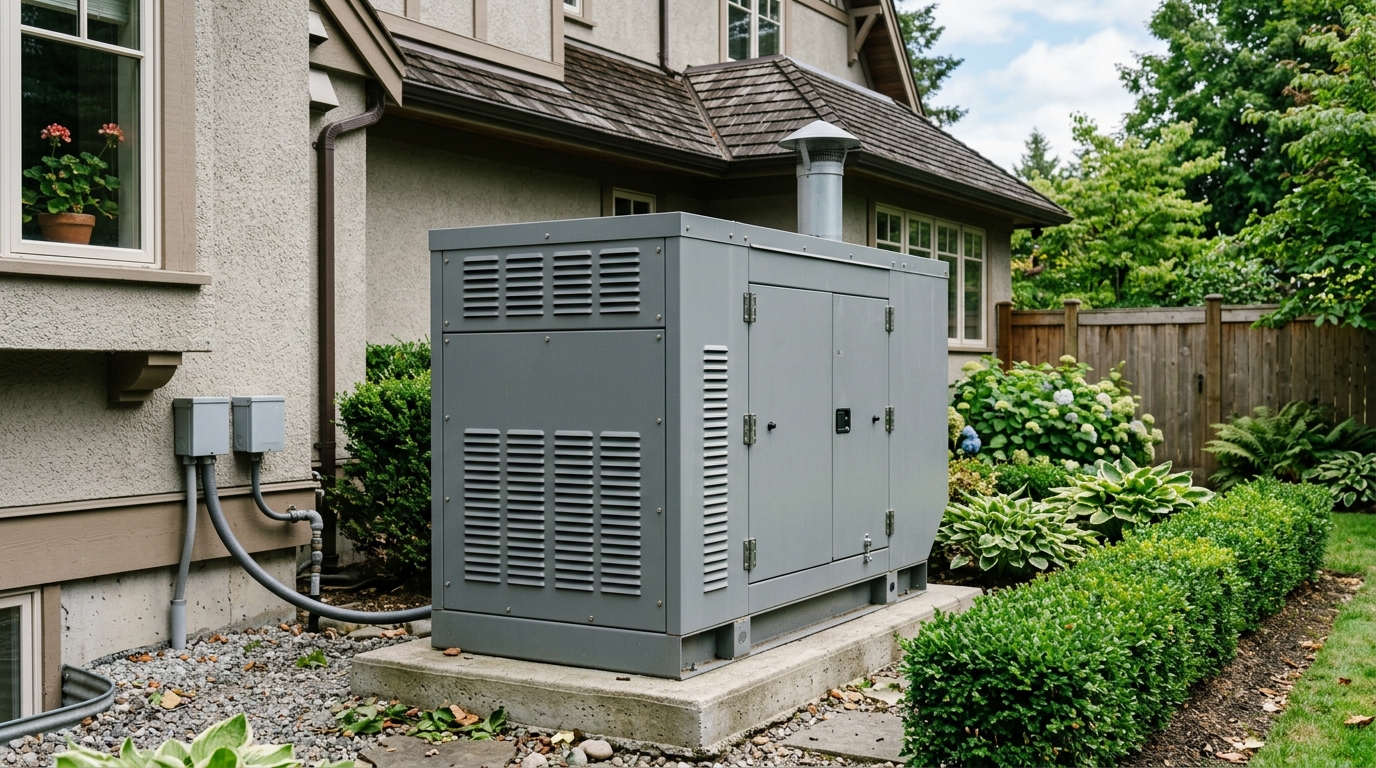
A standby generator is permanently installed outside the home and connected to the electrical system through transfer equipment.
The transfer switch separates the home’s electrical system from utility power and lets the generator supply designated loads when utility service is unavailable. OSHA also warns that a generator should never be connected directly to a building’s electrical system without a properly installed transfer switch because improper connections can create dangerous backfeed onto utility lines.
For homeowners who want automatic operation and a more permanent backup solution, a standby generator is generally the system category to evaluate.
How an Automatic Transfer Switch Works
The automatic transfer switch is one of the most important components of a standby system.
It monitors the normal utility supply. When the system detects a qualifying loss of utility power, the generator starts, and the transfer switch moves the designated electrical loads to the generator.
When normal utility service returns, the system transfers the loads back and the generator shuts down after its programmed cooldown sequence.
That is why it is better to say “within seconds” than promise a universal 10-, 20-, or 30-second restoration time for every installation.
Whole-Home vs. Essential-Circuit Backup
Not every homeowner needs to power every circuit during an outage.
Essential-Circuit Backup
A generator can be configured to support selected loads such as:
- Refrigerator
- HVAC
- Medical equipment
- Lighting
- Internet equipment
- Garage door
- Selected kitchen circuits
This approach can reduce the required generator capacity.
Whole-Home Backup
A larger system can be designed to supply a much broader portion of the home’s electrical loads.
Whether a particular system can support the entire home depends on the generator capacity, transfer equipment, service configuration, and actual electrical load.
The important distinction is that “whole home” describes the intended coverage, not a universal generator size.
How Is a Generator Sized for a Moorpark Home?
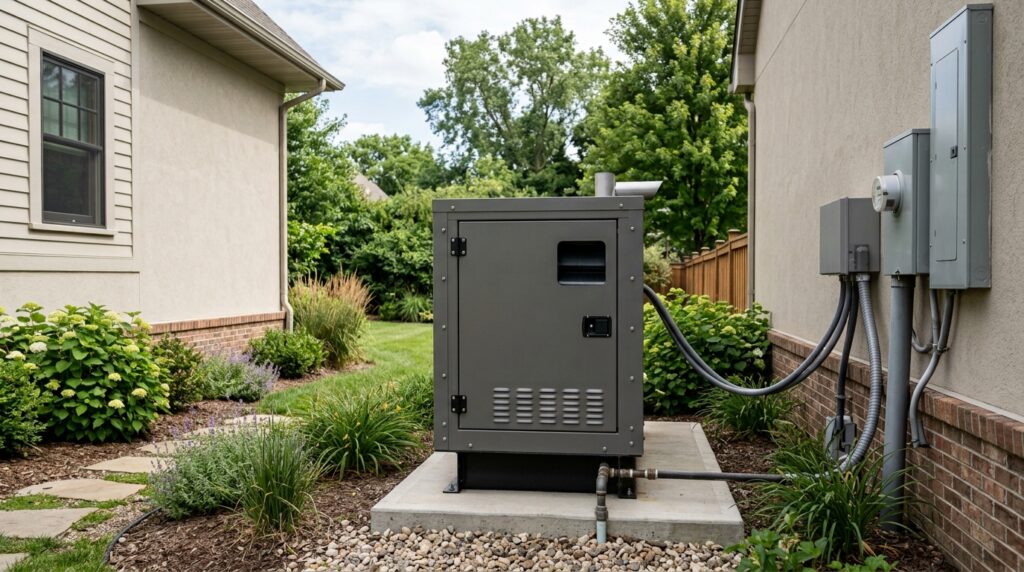
Generator sizing should be based on the electrical loads the system is expected to support.
Square footage alone isn’t enough.
An electrician in Moorpark may evaluate:
- Central air conditioning
- Heating equipment
- Kitchen appliances
- Electric water heating
- Pool and spa equipment
- Refrigeration
- Medical equipment
- EV charging
- Pumps and motors
- Lighting and receptacles
- Other significant electrical loads
Starting loads matter too.
Natural Gas or Propane?
Moorpark has access to both natural-gas and propane-based generator configurations, although availability depends on the individual property.
The City of Moorpark’s planning documents identify Southern California Gas Company (SoCalGas) as the natural-gas utility serving Moorpark.
Natural Gas
Natural gas may be convenient when a suitable gas connection is already available.
However, the generator needs enough fuel flow at the required pressure. The existing gas meter and piping must therefore be evaluated as part of the installation.
Homeowners should also avoid assuming that natural gas is guaranteed under every emergency condition.
Propane
Propane stores fuel onsite.
That can make it useful for properties without suitable natural-gas service or where the homeowner prefers an onsite fuel supply.
Runtime depends on:
- Tank capacity
- Generator fuel consumption
- Electrical load
- Operating conditions
Tank placement and fuel-system requirements must also comply with applicable requirements.
Moorpark provides a Fuel Gas Pipe Sizing and Installation handout through its Building & Safety resources, which is useful when planning gas-related work.
Where Can a Standby Generator Be Installed?
Generator placement requires a site-specific assessment.
The installation location may need to accommodate:
- Manufacturer clearances
- Exhaust requirements
- Service access
- Electrical conduit
- Fuel piping
- Property boundaries
- Windows and doors
- Other structures
- Local zoning or fire requirements
Moorpark’s current Building & Safety division reviews projects under the 2025 California Building Code, 2025 California Fire Code, 2025 National Electrical Code as adopted by California, 2025 California Plumbing Code, and other applicable codes.
The correct generator location should be based on equipment requirements and site conditions, not a generic distance from a blog post.
Does Generator Installation Require a Permit in Moorpark?
Electrical and other building-system work in Moorpark is subject to the City’s permitting requirements.
The City says its Building & Safety Division oversees permits and inspections for electrical, plumbing, and mechanical systems.
Because a standby generator installation can involve electrical work, equipment placement, and fuel-gas work, the exact permit package should be confirmed for the specific installation.
Moorpark currently accepts building permit applications and plan-check submissions through its SHOP online portal.
For complicated projects, the City also notes that multiple agencies or departments may need to review an application depending on scope.
What Does Standby Generator Installation Involve?
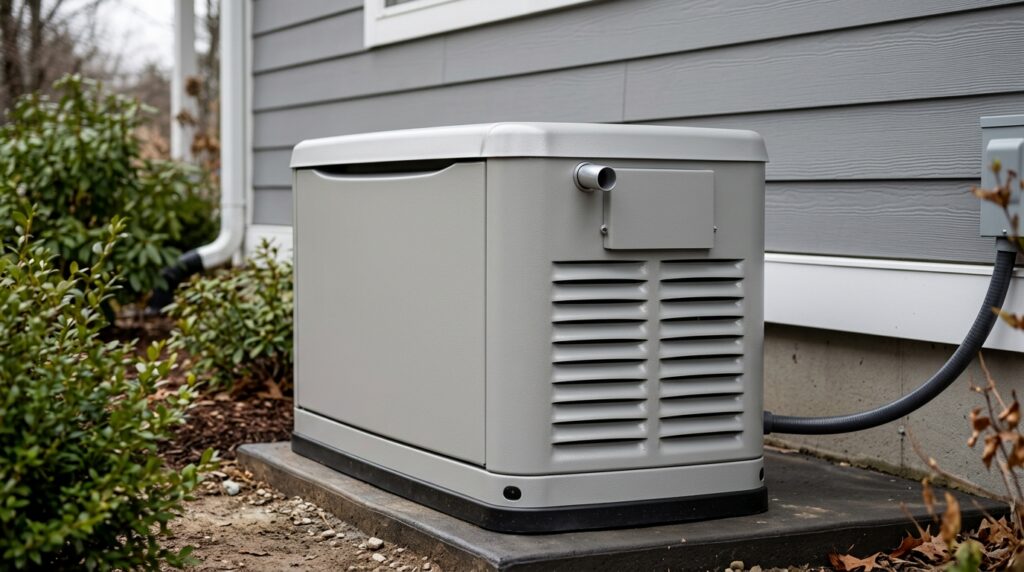
A professional installation generally follows a process like this.
1. Site Assessment
The electrician evaluates the home’s electrical panel, electrical service, proposed generator location, fuel supply, and physical installation route.
2. Load Calculation
The installer determines which loads will be backed up and calculates the generator capacity needed to handle them.
3. System and Equipment Selection
The generator, transfer equipment, and any load-management components are selected based on the design.
4. Permit and Plan Coordination
The required permit applications and supporting documents are prepared for the applicable authorities.
5. Pad and Site Preparation
The generator is installed on an appropriate base according to the equipment manufacturer’s installation requirements and approved project design.
6. Fuel-System Work
Natural-gas or propane connections are installed according to the applicable requirements.
7. Electrical Integration
The generator and automatic transfer equipment are connected to the home’s electrical system.
8. Commissioning
The completed system is tested, including generator startup, transfer operation, load performance, and return-to-utility operation.
9. Inspection
Required inspections are completed before the project is considered finished.
This process is considerably more involved than purchasing a portable generator and plugging in an appliance.
How Much Does a Standby Generator Installation Cost in Moorpark?
There is no reliable single price for every Moorpark property.
The total cost of generator installation can change based on:
- Generator capacity: Larger systems generally require larger supporting infrastructure.
- Electrical panel: An older or inadequate panel may need replacement or modification.
- Transfer equipment: The transfer arrangement depends on the electrical service and desired coverage.
- Fuel system: Gas piping, propane equipment, and routing affect the scope.
- Generator location: A short, accessible installation is different from a difficult property with long conduit or fuel runs.
- Site preparation: Grading, concrete work, access, or other site conditions can add to project scope.
- Permits and inspections: Applicable requirements vary according to the project.
- Load-management equipment: Some systems can use load management to control which larger loads operate simultaneously.
How Long Does Generator Installation Take?
The physical installation may be relatively quick once the equipment, permits, site preparation, and utility requirements are in place.
The overall project timeline can be considerably longer.
Factors include:
- Permit processing
- Equipment availability
- Concrete or site preparation
- Gas-line work
- Utility coordination where necessary
- Inspection scheduling
Moorpark currently operates an electronic plan-check and permit system, and the City states that applications may require review by multiple departments or outside agencies depending on scope.
That makes it difficult to support the original article’s blanket “two to three weeks” permit claim.
A contractor should give you a project-specific schedule once these requirements are understood.
Does an Older Electrical Panel Prevent Generator Installation?
Not necessarily.
The generator’s transfer equipment must be integrated safely with the home’s electrical system, so the panel and service equipment need to be evaluated.
Possible outcomes include:
- Existing panel is suitable
- Panel requires repair
- Panel should be replaced
- Generator powers only selected circuits
- Load-management equipment is added
- Electrical service capacity needs additional evaluation
A panel upgrade should therefore be treated as one possible part of generator installation, not an automatic requirement.
What About Solar and Battery Backup?
Solar and batteries can change the backup-power discussion.
A standard grid-tied solar photovoltaic system generally does not keep a home powered during an outage unless it is designed with appropriate islanding/backup equipment.
Battery storage can provide backup power without a combustion engine, while a generator can provide longer-duration backup when fuel remains available.
The right combination depends on the home’s electrical loads, solar system, battery capacity, generator configuration, and desired outage duration.
Homeowners considering multiple technologies should have the complete electrical system evaluated rather than adding each component independently.
Frequently Asked Questions
Generator size depends on the loads you want to operate during an outage. HVAC, pumps, electric water heating, EV charging, appliances, and motor-starting requirements can all affect the calculation.
It depends on the home’s electrical loads and the generator’s approved configuration. A 20 kW rating is not a universal whole-home size.
It can, provided the generator has an available fuel supply and remains within its operating requirements. Natural-gas and propane systems have different fuel arrangements, so actual runtime depends on the system.
Neither is universally better. Natural gas can be convenient when appropriate utility service is available; propane provides onsite fuel storage. The property and generator requirements determine which configuration fits.
Applicable electrical, mechanical, fuel-gas, building, and inspection requirements depend on the installation. Moorpark requires permits for building-system work and provides an online Building & Safety permit process.
Possibly. The panel and service equipment need to be evaluated to determine whether they are appropriate for the generator and intended loads.
A properly installed standby generator with automatic transfer equipment can automatically start when utility power is lost. Exact response time depends on the equipment and programmed settings.
Only with an appropriately designed and installed transfer arrangement and a generator capable of supplying the required loads. A portable generator should never be connected directly to a home’s electrical system.
The cost depends on generator size, fuel configuration, transfer equipment, electrical-panel condition, site access, permits, and additional work. A property assessment is needed for an accurate estimate.
The physical work may be completed relatively quickly once the project is ready, but permitting, equipment availability, site preparation, fuel work, utility coordination, and inspections can extend the overall schedule.
Standby Generator Installation in Moorpark
Moorpark’s history with PSPS events makes backup power a legitimate consideration for homeowners who depend on continuous electricity.
A good installation starts with a load calculation and site assessment. From there, the electrician can determine whether your home is better suited to essential-circuit backup or broader whole-home coverage, whether natural gas or propane is appropriate, whether your electrical panel can support the installation, and what permitting or utility coordination is required.
Volta Electric provides generator installation and electrical services for homeowners and businesses in Moorpark and surrounding Ventura County communities.