Introduction
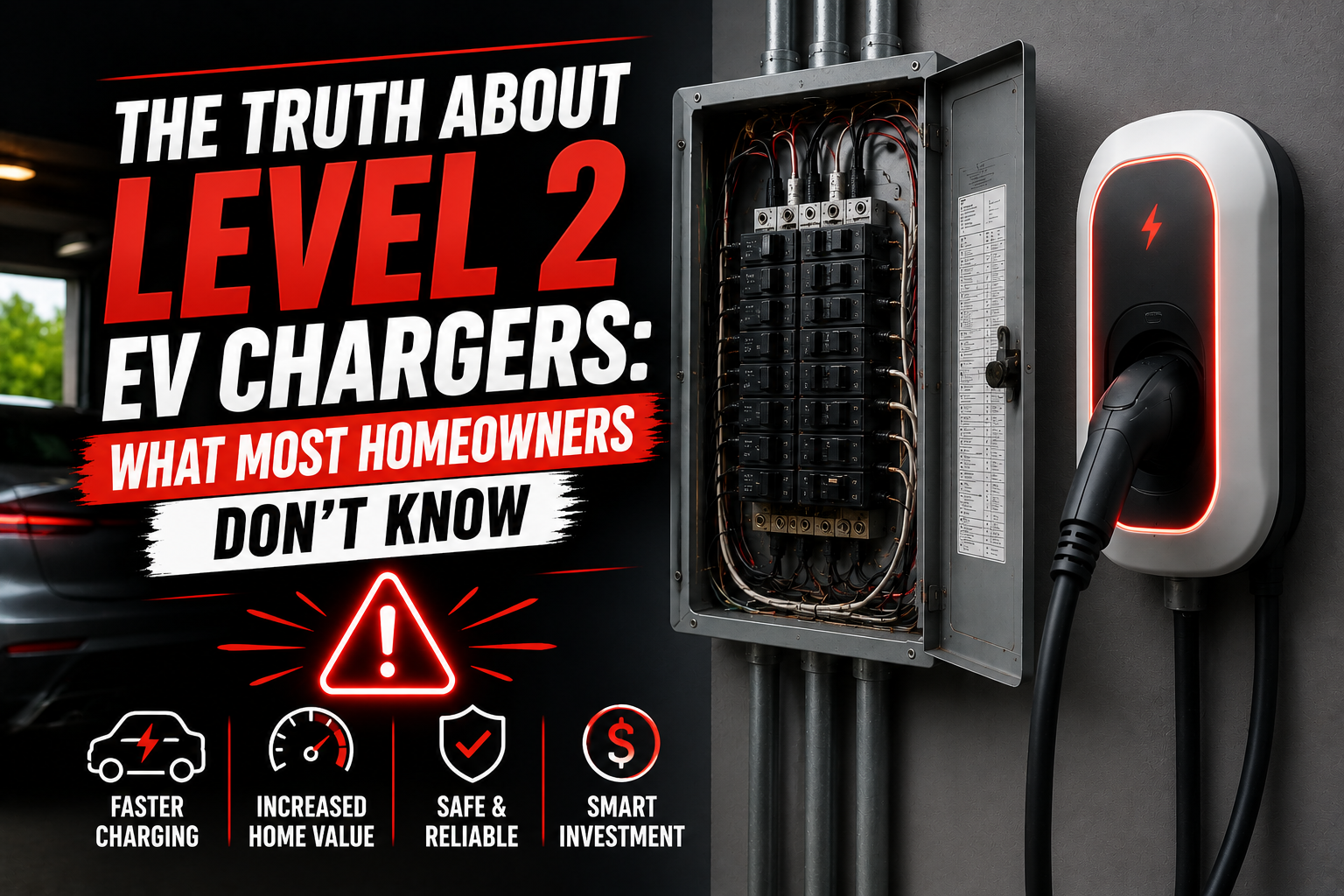
Faster charging comes with important electrical requirements — and most homeowners only discover this after they have already purchased their electric vehicle and are standing in their garage wondering why the installation quote is higher than expected.
The promise of a Level 2 home EV charger is straightforward and genuinely compelling. Instead of waiting 40 to 60 hours to fully charge your EV on a standard household outlet, a Level 2 charger can restore a full charge overnight in four to eight hours. For daily drivers, this difference is transformative. You plug in when you get home. You leave in the morning with a full battery. No charging anxiety, no detours to public stations, no waiting.
What the EV manufacturer brochure rarely explains in plain terms is what making that speed possible actually requires from your home’s electrical infrastructure. Level 2 charging operates on 240 volts at 32 to 50 amperes — the same voltage tier as your electric dryer or central air conditioning compressor, but often drawing more sustained current than either. Your existing wiring, your electrical panel, your service entrance, and even the distance between your panel and your garage all factor directly into whether a Level 2 charger installation is a straightforward afternoon project or a multi-phase electrical upgrade.
At Volta Electric, we install Level 2 EV chargers for homeowners and businesses across Los Angeles every week. We have seen every scenario — from simple dedicated circuit installations in homes that were already well-equipped to handle the load, to complete panel upgrades required before a single charger wire could be run. Understanding what you are actually dealing with before you commit to a charger model, a charging speed, or an installation contractor saves you money, time, and frustration. This article gives you that understanding in full.

What Separates Level 1, Level 2, and DC Fast Charging
Before getting into the specifics of what Level 2 installation requires, it helps be clear about what distinguishes the three charging levels and why Level 2 is the sweet spot for residential use.
Level 1 charging uses a standard 120-volt household outlet — the same type used for lamps, phone chargers, and small appliances. Every electric vehicle comes with a Level 1 charging cable as standard equipment, and the appeal is obvious: you can technically charge anywhere there is an outlet. The limitation is speed. Level 1 charging typically delivers somewhere between 3 and 5 miles of range per hour of charging. For a vehicle with a 300-mile range battery, a full charge from empty takes 60 hours or more. For plug-in hybrid owners with smaller batteries, Level 1 is workable. For pure battery electric vehicle owners who drive more than 30 to 40 miles daily, it is inadequate.
DC fast charging — also called Level 3 charging — is the technology deployed at public charging stations like Electrify America and Tesla Supercharger networks. It bypasses the vehicle’s onboard charger entirely and delivers direct current at very high power levels, enabling 100 to 200 miles of range in 20 to 30 minutes. DC fast chargers require three-phase commercial power infrastructure and cost tens of thousands of dollars to install. They are designed for commercial and public installation — not homes.
Level 2 charging operates at 240 volts and delivers between 10 and 30 miles of range per hour depending on charger output and vehicle acceptance rate. For the vast majority of EV owners, this is exactly the performance needed: enough speed to fully charge a typical EV battery overnight from a reasonable state of depletion. Level 2 is the universal residential standard, the target for every homeowner who wants practical, daily-use charging without relying on public infrastructure.
The performance gain over Level 1 is real and significant. The electrical requirements to deliver that performance are equally real and significant — and that is where most homeowners encounter their first surprises.
The Electrical Requirements Most Homeowners Underestimate
Dedicated 240-Volt Circuit
A Level 2 EV charger requires its own dedicated 240-volt circuit. This is not optional, and it is not a recommendation that can be worked around with an adapter or an extension cord. A dedicated circuit means that the charger is the only device connected to that circuit — there are no other outlets, no shared loads, no other devices drawing from the same breaker.
The reason for this requirement is sustained load. Most household appliances cycle on and off throughout the day. A refrigerator compressor runs for a few minutes and then rests. A microwave operates for a minute or two and stops. An EV charger, by contrast, can draw near its full rated current continuously for four to eight hours every night. Sustained loads of this type must be on dedicated circuits with appropriately rated wiring and breakers to maintain safe operating conditions throughout the charge session.
A 32-amp Level 2 charger — one of the most common residential configurations — requires a 40-amp dedicated circuit, following the National Electrical Code requirement that continuous loads not exceed 80 percent of circuit capacity. A 48-amp charger, which represents the upper tier of residential charging speed, requires a 60-amp dedicated circuit. The circuit breaker, the wire gauge, and every connection in that circuit must be rated accordingly.
Panel Capacity and Available Space
The dedicated circuit for your EV charger originates at your electrical panel. This means your panel must have the available capacity — both amperage headroom and physical breaker space — to accommodate the new circuit.
This is where homeowners with older homes or panels that have been progressively loaded over the years frequently encounter a problem. A 100-amp service panel that is already supporting an HVAC system, a water heater, kitchen appliances, laundry equipment, and general household circuits may have very little remaining capacity for a 40 or 60-amp EV charging circuit. Adding a circuit that large to an already heavily loaded panel risks exceeding the service capacity under peak demand conditions — a situation that can cause nuisance tripping of the main breaker or, in worse cases, sustained overloading of the service entrance conductors.
If your panel does not have adequate capacity or available breaker spaces, a panel upgrade becomes a prerequisite to EV charger installation. At Volta Electric, we perform a load calculation before every EV charger installation to determine whether the existing panel can support the new circuit or whether an upgrade is required. This assessment is not optional — it is the responsible starting point for any honest installation quote.
Wire Gauge and Run Length
The wire connecting your electrical panel to your EV charger must be sized correctly for the circuit amperage and the length of the run. For a 40-amp circuit serving a 32-amp charger, the minimum wire gauge under NEC guidelines is typically 8 AWG copper. For a 60-amp circuit serving a 48-amp charger, 6 AWG copper is required. Using undersized wire creates resistance, generates heat, and creates a fire hazard — regardless of whether the breaker is correctly rated.
Run length matters because wire resistance increases with distance. Very long runs — in homes where the electrical panel is on the opposite side of the house from the garage, or where the garage is detached — may require a larger wire gauge than the minimum to maintain safe voltage drop within acceptable limits. A detached garage often also requires conduit installation and may involve underground wiring, which adds both material and labor cost to the project.
Understanding the actual wire run required for your specific property is essential to accurate project pricing. A quote that does not account for a difficult or long wire run is not a complete quote.
Choosing the Right Level 2 Charger for Your Home
The EV charger market has expanded dramatically over the past several years, and the range of products available — at price points from under $200 to over $1,000 before installation — can make the selection process confusing. Understanding what the specifications actually mean helps homeowners make choices that match their vehicle, their electrical infrastructure, and their budget.
Amperage and Charging Speed
The output amperage of a Level 2 charger determines its charging speed, but only up to the limit that your vehicle’s onboard charger can accept. Every EV has an onboard AC charging limit — the maximum rate at which it can accept Level 2 power. Common limits include 7.2 kW (approximately 32 amps at 240 volts), 11.5 kW (approximately 48 amps), and 19.2 kW (approximately 80 amps) for high-end configurations in newer vehicles.
Installing a 48-amp charger on a vehicle with a 32-amp onboard limit will not charge the vehicle faster than a 32-amp charger would — the vehicle simply will not accept the additional power. Conversely, installing a 32-amp charger on a vehicle capable of accepting 48 amps leaves performance on the table that you have already paid for in the vehicle purchase. Matching charger output to vehicle capability is a fundamental step that an experienced EV charger installation professional will confirm before recommending specific hardware.
That said, there is a legitimate argument for installing a charger and circuit rated slightly above your current vehicle’s needs if you plan to own additional EVs or upgrade your vehicle in the future. Installing a 60-amp circuit now, even if your current vehicle only uses 40 amps of it, eliminates the cost of circuit replacement when a future vehicle can benefit from the full capacity.
Hardwired Versus Plug-In Chargers
Level 2 chargers are available in two connection formats: hardwired units that are permanently connected to your electrical circuit, and plug-in units that connect via a NEMA 14-50 or NEMA 6-50 outlet. Each approach has genuine advantages and tradeoffs.
Hardwired installations are typically cleaner in appearance, may qualify for slightly higher charging speeds in some configurations, and are generally preferred by electricians and building inspectors because the installation leaves no accessible outlet that could be used with other equipment. The disadvantage is that the charger cannot be moved without additional electrical work.
Plug-in installations using a NEMA 14-50 outlet offer portability — if you move to a new home, you can take the charger with you and only need a matching outlet at the new location. NEMA 14-50 outlets also provide flexibility if you ever want to use the circuit for other 240-volt equipment. The tradeoff is an exposed outlet that technically creates a potential for misuse and that some jurisdictions require additional weatherproofing for in outdoor or garage locations.
Volta Electric installs both configurations and advises clients based on their specific situation — vehicle type, garage setup, plans for future EVs, and local permit requirements.
Smart Charger Features Worth Paying For
The mid-range and upper tier of the residential Level 2 charger market includes smart charging features that are genuinely useful rather than just marketing additions. WiFi connectivity allows the charger to be monitored and controlled via smartphone app, including the ability to set scheduled charging times. This scheduling capability is directly relevant to electricity cost management.
Under time-of-use rate plans — which most Los Angeles area utilities now offer or require for EV owners — programming your charger to operate during off-peak or super-off-peak hours can meaningfully reduce the cost of charging. Southern California Edison’s TOU-EV-1 rate plan, for instance, offers dramatically lower rates during overnight hours specifically to incentivize off-peak EV charging. A smart charger that can be programmed to charge only between 11 PM and 6 AM, for example, can cut your per-charge electricity cost by 50 percent or more compared to unscheduled charging during peak hours.
Some smart chargers also integrate with home energy management systems and solar inverters, enabling solar-prioritized charging that draws from panel generation before pulling from the grid. For homeowners with existing solar installations or those planning to add solar with battery storage, this integration capability is a meaningful long-term value consideration.
Common Mistakes Homeowners Make With EV Charger Installation
The enthusiasm surrounding electric vehicles sometimes leads homeowners to make installation decisions they later regret. Several patterns come up repeatedly in our work across Los Angeles.
The most common mistake is purchasing a charger before obtaining a proper electrical assessment. Many homeowners select a charger model based on reviews, price, or vehicle manufacturer recommendation, then discover that their electrical panel cannot support it without a significant upgrade. In some cases, the charger they purchased is not the right choice for their vehicle’s charging capability in the first place. The sequence should always be assessment first, hardware selection second.
A related mistake is hiring an unqualified contractor to save money on installation. EV charger installation in California requires a licensed electrical contractor, proper permits, and inspection. An unpermitted installation creates real risks — not only safety risks from potentially substandard work, but insurance risks if a charging-related incident occurs, and transaction risks if the unpermitted installation is discovered during a future property sale. A permit is not bureaucratic overhead. It is the mechanism through which an independent inspector confirms that the work was done correctly.
Underestimating the total project cost is another common issue. An online search for EV charger installation costs will return a wide range of figures, and the lower end of that range typically reflects simple installations in homes with panels that already have capacity and with the garage located close to the panel. Homes that require panel upgrades, long wire runs, conduit installation, subpanel addition, or underground wiring to a detached garage face higher total project costs. Getting an accurate assessment of your specific situation before budgeting is essential.
Finally, many homeowners overlook utility rebates and incentives that can meaningfully offset installation costs. Southern California Edison’s Charge Ready Home program and similar offerings from other utilities provide rebates for qualifying Level 2 charger installations. The federal Alternative Fuel Vehicle Refueling Property Credit covers 30 percent of EV charger hardware and installation costs for residential installations, subject to annual limits. Volta Electric’s team identifies applicable incentives for every client and helps ensure that installations are completed in a manner that qualifies for available programs.
EV Charger Installation for Multi-Unit and Commercial Properties
The conversation around Level 2 EV chargers extends well beyond single-family homes. Apartment buildings, condominium complexes, HOA communities, office buildings, retail centers, and parking structures are all actively working through the challenges and opportunities of commercial EV charger installation.
California law has created specific requirements and protections in this space. California Civil Code Section 1947.6 requires landlords to permit tenants to install EV chargers in their designated parking spaces under certain conditions. The California Permit Streamlining Act limits the ability of local authorities to impose unreasonable conditions on EV charger installations. For commercial property owners, California’s CALGreen building code requirements mandate EV-ready parking spaces in new construction and major renovations.
Beyond compliance, commercial EV charger installation is increasingly a competitive amenity. Tenants selecting office space, apartment residents choosing between buildings, and retail customers making decisions about where to shop are all increasingly factoring EV charging availability into their choices. Commercial property owners who invest in workplace or customer-facing EV charger infrastructure position their properties favorably in a market where EV adoption is accelerating year over year.
The electrical infrastructure requirements for commercial installations are more complex than residential. Multiple Level 2 chargers operating simultaneously create substantial demand, and managing that load without triggering prohibitive demand charges requires careful system design. Load management systems — sometimes called smart load balancing or dynamic load management — distribute available electrical capacity across multiple chargers intelligently, maximizing the number of vehicles that can charge simultaneously without exceeding the building’s service capacity.
Volta Electric designs and installs commercial EV charging systems throughout Los Angeles, working with property owners, property managers, HOAs, and commercial tenants to develop solutions that meet current needs and scale as EV adoption among tenants and customers continues to grow.
Cost and Investment Reality for Los Angeles Homeowners
Providing a single number for EV charger installation cost without knowing the specifics of a property is not meaningful — the range is simply too wide. What is useful is understanding the factors that determine where a specific project falls within that range.
A straightforward installation — Level 2 charger in an attached garage, panel with adequate capacity and available breaker space, short wire run, no significant access challenges — typically falls in the $500 to $1,200 range for labor and materials, not including the charger hardware itself. Quality residential Level 2 charger hardware from reputable manufacturers ranges from approximately $300 to $700 for most residential applications.
Projects requiring a panel upgrade add $1,500 to $3,500 to the total, depending on the current panel configuration and the required upgrade scope. Long wire runs, conduit installation through finished walls, underground runs to detached garages, and subpanel additions each add cost that is specific to the property and the route available for wiring.
After available federal tax credits and utility rebates, total project costs for many straightforward residential installations come down meaningfully. The federal 30 percent tax credit applies to both hardware and installation costs and can represent a substantial offset. California utility rebate programs vary by utility and program funding availability, so current eligibility should be confirmed at the time of your project.
When evaluating the investment, the comparison point is not simply the installation cost — it is the ongoing operational savings versus public charging. Public Level 2 charging at commercial stations in Los Angeles typically costs between $0.25 and $0.45 per kWh. Home charging under a favorable TOU rate plan can cost as little as $0.09 to $0.13 per kWh during off-peak hours. For a vehicle that consumes 4,000 to 5,000 kWh annually, the difference between home and public charging costs represents several hundred to over a thousand dollars in annual savings. The installation investment typically pays back within one to three years for active daily drivers.
What to Expect From the Installation Process
Knowing what the installation process looks like helps homeowners plan appropriately and evaluate whether a contractor’s process is complete and professional.
The process begins with an on-site assessment. A qualified electrician evaluates your panel capacity, identifies the optimal circuit route from panel to charging location, confirms the appropriate charger specifications for your vehicle, and discusses any upgrades required before the charger can be installed. This assessment should always precede any binding quote.
Permit application follows. In the City of Los Angeles and throughout Los Angeles County, EV charger installation requires an electrical permit. The permit application includes the circuit specifications, charger model, and installation details. Processing time varies by jurisdiction but is typically one to two weeks for standard residential applications.
Installation day involves running the dedicated circuit from the panel to the charging location, installing the charger hardware, making all connections, and completing any conduit or mounting work required by the installation environment. A straightforward installation typically takes three to six hours. More complex projects involving panel upgrades or difficult wire runs take longer.
Inspection follows installation. A building inspector from the local authority having jurisdiction visits the property to confirm that the installation meets permit specifications and applicable electrical codes. Passing inspection closes out the permit and creates a permanent record of the compliant installation. Volta Electric coordinates all inspection scheduling and is present at the inspection to address any questions the inspector raises.
The Future of Home EV Charging
The residential EV charging landscape is evolving quickly, and several developments in progress will expand what home charging systems can do over the next five to ten years.
Bidirectional charging — vehicle-to-home (V2H) and vehicle-to-grid (V2G) technology — allows an EV battery to discharge back into the home during peak hours or grid outages, effectively using the vehicle as a large mobile battery storage system. Several automakers including Ford, GM, and Nissan already offer bidirectional capability on select models, and the technology is moving toward broader adoption. Homes with bidirectional-capable chargers and compatible vehicles gain a backup power resource with far more capacity than most residential battery storage systems.
Managed charging programs offered by utilities — programs in which the utility can temporarily reduce or pause EV charging during grid stress events in exchange for bill credits — are expanding throughout California. Smart chargers with utility communication capability will increasingly be able to participate in these programs automatically, providing financial benefits to participating homeowners while supporting grid stability.
Solar-integrated charging, in which a hybrid solar inverter coordinates EV charging with solar generation and battery storage to maximize self-consumption and minimize grid purchases, is becoming more accessible and more sophisticated. For homeowners with existing solar or those planning solar installations, designing the EV charging system with solar integration in mind from the outset creates the most cost-efficient long-term energy configuration.
Planning your EV charger installation with these future capabilities in mind — installing a circuit with adequate capacity for higher-power bidirectional chargers, choosing hardware with open communication standards, and coordinating with your overall home energy system design — positions you to take full advantage of these developments as they arrive.
Frequently Asked Questions
Do I really need a dedicated circuit for a Level 2 EV charger?
Yes, without exception. A Level 2 EV charger draws sustained current for hours at a time, which requires a dedicated circuit rated for continuous load operation. Sharing a circuit with other devices creates overloading risk and is not permitted under the National Electrical Code. Any legitimate installation contractor will confirm this requirement and design the circuit accordingly.
Can my existing electrical panel handle a Level 2 EV charger?
It depends on your panel’s current capacity, service size, and the loads already connected to it. Many modern 200-amp panels have adequate headroom. Older 100-amp panels or fully loaded panels of any size may require an upgrade before a Level 2 charger circuit can be safely added. A load calculation performed by a licensed electrician is the only reliable way to answer this question for your specific property.
What is the best Level 2 charger for home use?
There is no single best charger for all situations. The right charger depends on your vehicle’s onboard charging limit, whether you want smart scheduling features, whether you prefer hardwired or plug-in installation, and your budget. Reputable manufacturers for residential Level 2 chargers include ChargePoint, Wallbox, Emporia, Grizzl-E, and Enel X JuiceBox, among others. An installation professional familiar with your vehicle and your electrical setup can provide a specific recommendation.
How long does a Level 2 EV charger installation take?
The installation itself typically takes three to six hours for a straightforward project. Projects involving panel upgrades, long wire runs, or detached garages take longer. The overall timeline from initial assessment to completed installation — including permitting and inspection — typically spans two to four weeks.
Will installing a Level 2 charger increase my electricity bill significantly?
Your electricity bill will increase in proportion to how much you charge, but the per-mile cost of home charging is dramatically lower than gasoline or public charging. Under a time-of-use rate plan that takes advantage of off-peak rates, most EV owners in Los Angeles find that home charging costs the equivalent of approximately $0.75 to $1.25 per gallon of gasoline equivalent — a substantial reduction in transportation fuel costs.
Is a permit required for EV charger installation in Los Angeles?
Yes. EV charger installation in Los Angeles requires an electrical permit and inspection. Unpermitted installations create insurance, safety, and property transaction risks. Any contractor who suggests skipping the permit process to save time or money is not operating legally or in your best interest.
Can I install a Level 2 charger in an apartment or rental property?
California law provides tenants the right to install EV chargers in their designated parking spaces under certain conditions, including agreement with the landlord on reasonable terms. For landlords, California law also limits the ability to unreasonably deny tenant EV charger installation requests. The practical details depend on the property’s electrical infrastructure, parking configuration, and the terms negotiated between landlord and tenant.
What federal incentives are available for home EV charger installation?
The federal Alternative Fuel Vehicle Refueling Property Credit provides a tax credit equal to 30 percent of the cost of EV charger hardware and installation for residential installations, subject to a per-year maximum. Income and location qualifications apply under the Inflation Reduction Act framework. California utility rebate programs provide additional incentives for qualifying installations. Confirming current program terms with your installation contractor and tax advisor is recommended, as program details and funding availability change over time.
What is the difference between a NEMA 14-50 outlet and a hardwired charger installation?
A NEMA 14-50 outlet is a 240-volt, 50-amp outlet — the same type used for electric ranges and some dryers — that can be installed as a receptacle for a plug-in Level 2 charger. A hardwired installation connects the charger directly to the electrical circuit without an intermediate outlet. Hardwired installations are often preferred for permanent residential use and are required by some charger manufacturers for their highest output configurations. NEMA 14-50 installations offer portability. Both require the same dedicated 240-volt circuit and proper permitting.
Conclusion
Level 2 EV charging is one of the most practical upgrades a homeowner can make in response to EV ownership — but it is not a simple plug-and-play addition to your home. The electrical requirements are real, the installation details matter, and the decisions made during the planning phase determine whether the project delivers the seamless daily charging experience you are investing in or creates ongoing complications.
The homeowners who have the best experience with Level 2 charger installation are those who start with a professional electrical assessment, select hardware matched to their vehicle and infrastructure, obtain proper permits, and work with a licensed electrical contractor who understands both the technology and the local permitting environment. The homeowners who struggle are typically those who reverse that sequence — buying hardware first, hiring the cheapest available labor second, and discovering the electrical realities of their property after commitments have already been made.
EV charger installation is also not a decision made in isolation. It connects directly to your panel capacity, your utility rate plan, your solar or battery storage configuration if you have one, and your long-term plans for additional vehicles or expanded charging capability. Getting it right from the beginning saves money, time, and the frustration of revisiting decisions that could have been made correctly once.
Schedule Your EV Charger Installation With Volta Electric
Volta Electric installs Level 2 EV chargers for homeowners and businesses throughout Los Angeles with full permitting, professional installation, and honest guidance from assessment through final inspection. Whether your project is a straightforward dedicated circuit or a complete panel upgrade and charger installation, our licensed electricians handle every detail.
Contact Volta Electric today to schedule your EV charger assessment. We will evaluate your electrical infrastructure, identify any upgrade requirements, explain your hardware options, and provide a complete installation quote with no surprises. Get your home charging setup right the first time — and start every morning with a full battery.