By Volta Electric Inc. | Licensed Electrical Contractor Serving Glendale and Los Angeles County
Quick Answer
An electrical panel upgrade in Glendale, CA may be appropriate when an existing panel is damaged, outdated, lacks adequate capacity, has limited space for new circuits, or cannot safely support the home’s calculated electrical load.
A 200-amp upgrade is common, but it is not automatically required for every older Glendale home. The appropriate service size depends on the home’s electrical load, existing service equipment, planned additions such as EV chargers or electric appliances, and the requirements of Glendale Water & Power (GWP).
For electrical service upgrades in Glendale, homeowners and contractors must coordinate with the City of Glendale Building & Safety Division and, where the project affects the electric service, Glendale Water & Power. The City currently identifies separate permit categories for single-family electrical work and electrical new/upgrade service, and its permit guidance specifically instructs applicants to contact GWP Electrical Engineering before submitting an electrical new/upgrade-service permit.
Electrical Panel Upgrade Warning Signs for Glendale Homeowners
| What You Notice | What It May Indicate | Recommended Next Step |
| Older 60-amp or 100-amp service | Limited capacity for some modern electrical loads | Have the service and load evaluated |
| Frequent breaker trips | Overload, faulty equipment, wiring issue, or breaker problem | Schedule electrical troubleshooting |
| Flickering or dimming lights | Possible connection, voltage, circuit or equipment issue | Have the condition professionally assessed |
| Burning odor or visible scorching | Potential overheating or electrical fault | Stop using the affected equipment and obtain prompt professional help |
| Corrosion or water intrusion at panel | Possible deterioration of electrical equipment | Arrange an inspection |
| Federal Pacific or Zinsco equipment | Older equipment associated with documented safety concerns | Have the panel evaluated |
| Planning an EV charger | Additional electrical demand | Perform a load calculation first |
| Planning solar or battery storage | Additional equipment and utility interconnection requirements | Review service and interconnection requirements |
| Adding an ADU or major addition | Increased electrical load | Evaluate service capacity before construction |
| Few available breaker spaces | Limited room for additional circuits | Ask an electrician about panel or subpanel options |
| Remodeling an older home | Existing wiring and service may not match the new scope | Obtain an electrical assessment before work begins |
Being old does not automatically mean a panel is unsafe, and having 100-amp service does not automatically mean it must be upgraded to 200 amps electrical panel. The home’s actual electrical condition and calculated load should drive the recommendation.
Why Electrical Panel Upgrades Matter in Glendale
Glendale has a broad range of housing ages and architectural styles. According to the City of Glendale’s current demographic information, the majority of Glendale’s housing units were built between 1960 and 1979. At the same time, neighborhoods such as Rossmoyne and Cottage Grove contain substantially older homes and historic resources.
That means electrical systems can vary considerably from property to property.
One house may have had its electrical service upgraded during a previous remodel. Another may still have portions of its original electrical infrastructure. A third may have a newer panel but older branch-circuit wiring elsewhere in the property.
The important question is therefore not simply:
“How old is the house?”
It is:
“What electrical equipment does the house have today, what condition is it in, and what electrical load does the property need to support?”
That’s what a professional electrical assessment is designed to determine.
Glendale’s Older Neighborhoods and Electrical Infrastructure

Adams Hill
The City of Glendale describes Adams Hill as a neighborhood whose housing stock developed predominantly during the first half of the 20th century, with a mixture of original buildings and architectural styles.
Older properties can have electrical systems that have been modified repeatedly over decades. Previous additions, remodels, garage conversions, and appliance replacements may have changed the electrical load without a corresponding service upgrade.
That makes a panel and service assessment particularly useful before adding substantial new electrical loads.
Rossmoyne
Rossmoyne is Glendale’s largest designated historic district and contains 503 homes. The district began development in 1923 and was largely built out by 1950.
For homeowners in historic districts, electrical work should be evaluated not only from an electrical standpoint but also for any applicable historic-preservation requirements. Glendale explains that projects in designated historic districts may be reviewed by the Historic Preservation Commission, depending on the proposed work.
Interior electrical upgrades may follow a different review pathway than exterior alterations, so confirm requirements for the specific project.
Verdugo Woodlands and Other Established Areas
Glendale’s historic-preservation program identifies multiple designated historic districts, including Niodrara Drive in the Verdugo Woodlands neighborhood, where the historic district contains 32 single-family homes representing development from 1912 through 1962.
For older properties, an electrical assessment can identify whether the current panel, service equipment, grounding, branch circuits, and available capacity are appropriate for planned improvements.
Do You Automatically Need a 200-Amp Panel in Glendale?
No.
This is one of the most important corrections to the original article.
A 200-amp service provides more capacity than a smaller service, but the right service size depends on the property’s electrical needs.
For example, a homeowner with a 100-amp service who wants an EV charger installation might or might not need a service upgrade. Glendale’s own EV charging guidance states that an electrical contractor should examine the property and electrical system and prepare an electrical load calculation to determine whether the EV charger can be supported by the existing meter and main-panel service.
The same principle applies to other major electrical additions.
A service upgrade may be appropriate when:
- Existing calculated load is too high
- Existing service equipment is damaged or obsolete
- There is insufficient capacity for planned electrical equipment
- The property needs additional circuits, and the existing configuration cannot accommodate them
- Utility requirements call for changes to the service
- A remodel or ADU substantially increases the electrical demand
In other cases, the existing service may be sufficient.
What Does a 200-Amp Panel Upgrade Actually Include?
The phrase “panel upgrade” can refer to several different projects.
Panel replacement
The existing panel is replaced with a new panel while the service capacity may remain unchanged.
Service upgrade
The electrical service capacity is increased, such as from 100 amps to 200 amps.
Panel and service upgrade
The project includes replacing the panel while also upgrading service equipment, conductors, or other components required to support the new service.
These projects should not be treated as interchangeable.
A larger breaker installed on a panel does not, by itself, create a properly upgraded electrical service. The complete system—including service equipment, conductors, grounding, panel rating, and utility requirements—must be appropriate for the installation.
What Your Electrical Panel Does

An electrical panel distributes electricity from the home’s service to individual branch circuits.
The panel contains overcurrent protective devices such as circuit breakers. Each breaker is designed to interrupt current when conditions exceed the protection provided for that circuit.
The panel’s ampere rating and the home’s calculated electrical load are related, but the number printed on the main breaker is not a substitute for a full load assessment.
A home may have:
- 60-amp service
- 100-amp service
- 125-amp service
- 150-amp service
- 200-amp service
- Larger service for properties with greater electrical demand
The correct configuration depends on the property.
Why Older Panels Can Become a Problem
Electrical systems age over time.
Components can experience:
- Mechanical wear
- Corrosion
- Heat exposure
- Loose connections
- Physical damage
- Deteriorated insulation
- Breaker deterioration
- Previous alterations
- Water intrusion
Older homes may also have electrical components that were appropriate when installed but are less suited to today’s electrical loads.
The National Fire Protection Association has reported that electrical failures or malfunctions were involved in an estimated average of 46,700 U.S. home fires per year from 2015 through 2019. Electrical distribution, lighting, and power-transfer equipment accounted for approximately half of those fires.
That statistic is national rather than Glendale-specific, but it illustrates why electrical-system condition deserves attention.
EV Charger Installation and Electrical Panel Capacity
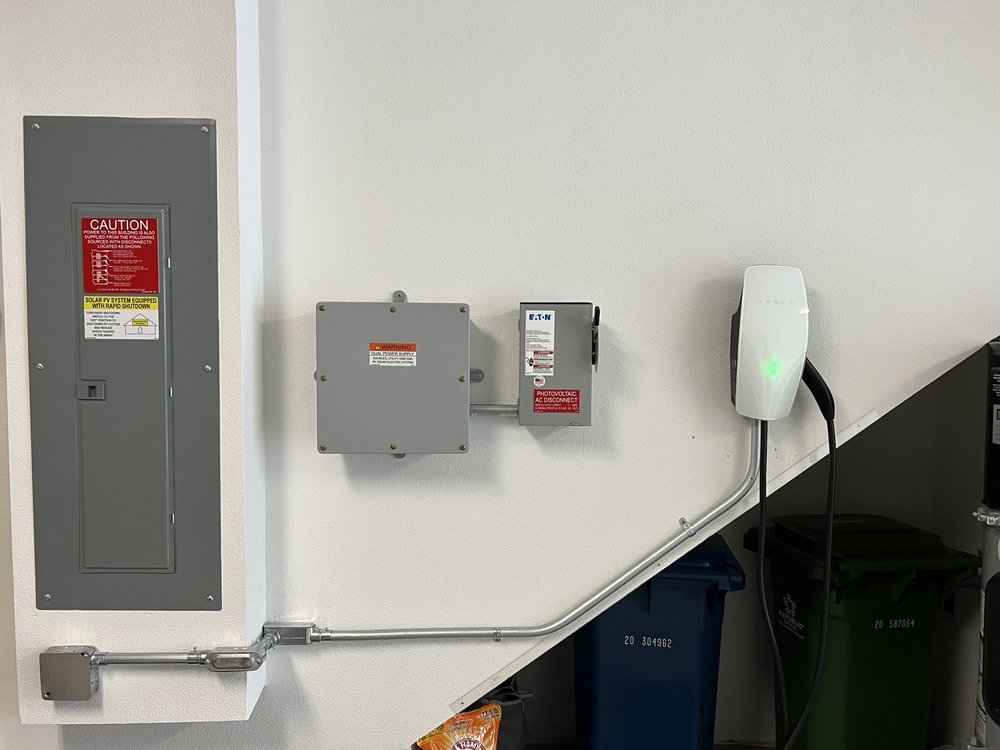
EV charging is an increasingly common reason Glendale homeowners investigate their electrical service.
Glendale Water & Power currently offers a residential EV charging rebate program, and the City maintains an expedited residential EV-charger permitting process.
But installing an EV charger does not automatically mean the homeowner needs 200-amp service.
Glendale’s EV guidance specifically states that:
- The electrical contractor should examine the home’s electrical system.
- An electrical load calculation determines whether the existing capacity can support the EV charger.
- A separate electric-service-upgrade permit is required when a service upgrade becomes necessary.
- GWP should be contacted for service-upgrade requirements.
- The main panel must be rated for the additional demand.
- The installation must comply with the applicable California Electrical Code and GWP requirements.
Solar and Battery Storage in Glendale
Solar should also be handled carefully.
The original draft stated that a solar inverter interconnection requires a 200-amp main panel. That is too broad and should not be published.
Glendale Water & Power operates its own solar interconnection and Net Energy Metering program. GWP’s current documentation describes specific application, system-size, and interconnection requirements, including requirements for the electrical equipment and system design.
GWP currently continues to make NEM available to customers installing solar PV systems, with a revised interconnection agreement effective January 19, 2026.
Whether a panel or service upgrade is necessary depends on the existing electrical equipment and the proposed solar/battery system.
A solar or battery project should therefore begin with an assessment of:
- Existing service size
- Panel rating
- Busbar configuration
- Available breaker capacity
- Existing electrical loads
- Proposed PV system
- Proposed battery system
- Interconnection method
- GWP requirements
California’s 2025 Electrical Code and Glendale
As of January 1, 2026, projects submitted to the City of Glendale must comply with the 2025 California Building Standards Code and Glendale’s local amendments, which the City refers to as the 2026 Glendale Building and Safety Code.
The California Electrical Code is Title 24, Part 3. California’s Department of General Services explains that the CEC establishes electrical design and construction standards and incorporates the National Electrical Code with California-specific amendments.
This matters because an article published in 2026 should not tell Glendale homeowners that electrical work is governed by the old 2022 code cycle without qualification.
The exact requirements applicable to an existing panel upgrade depend on the project’s scope, the property, and the specific work being performed.
Does an Electrical Panel Upgrade Require a Permit in Glendale?
For the types of work discussed in this article, homeowners should expect permitting to be part of the process.
The City of Glendale’s current permit guidance lists:
- Electrical — Single Family Residential
- Electrical — Single Family Residential — New/Upgrade Service
- Electrical — Single Family Residential — EV Charging Station
The City also specifically instructs applicants performing electrical new/upgrade or temporary service work to contact GWP Electrical Engineering before submitting the electrical permit application.
Glendale’s 2026 Building Safety Month guidance also identifies electrical upgrades as common projects that require permits and recommends hiring qualified, licensed professionals.
How an Electrical Panel Upgrade Works in Glendale
Every project is different, but a typical service upgrade may follow this sequence.
Step 1: Electrical Assessment
The electrician examines:
- Existing panel
- Main breaker
- Service equipment
- Meter equipment
- Grounding and bonding
- Service conductors
- Branch circuits
- Available spaces
- Existing electrical loads
- Planned future loads
A load calculation is then used to determine the appropriate service and equipment.
Step 2: GWP Service Requirements
For new or upgraded electrical service, Glendale instructs applicants to contact GWP Electrical Engineering before submitting the electrical permit application.
GWP maintains its own Electrical Service Requirements Manual, covering service configurations, metering equipment, switchboards, and distributed energy resources.
This utility-specific step is one of the biggest differences between doing electrical work in Glendale and assuming that requirements are identical across Los Angeles County.
Step 3: Electrical Permit
The contractor submits the appropriate electrical permit through the Glendale permitting system.
For service upgrades, Glendale has a dedicated Electrical — New/Upgrade Service permit category.
Step 4: Utility Disconnect, When Required
If the work requires disconnecting the utility service, coordinate with GWP.
The precise procedure depends on the service configuration and scope of work. The contractor should coordinate the utility disconnect rather than working on energized utility-side equipment.
Step 5: Panel and Service Equipment Installation
The electrician installs the new equipment according to the approved scope.
This may include:
- New service panel
- Main breaker
- Service conductors
- Meter equipment
- Grounding and bonding components
- Breakers
- AFCI/GFCI protection where applicable
- New or modified branch circuits
The existing wiring should also be evaluated, not simply transferred into a new panel without inspection.
Step 6: City Inspection
The City inspects the completed work according to the applicable permit and inspection process.
Glendale’s permitting documentation also states that installations must comply with current California and Glendale requirements.
Step 7: GWP Coordination and Reconnection
Where utility service has been disconnected, the contractor coordinates the required steps with GWP after city inspection and completion of applicable utility requirements.
The exact sequence varies depending on the project.
Step 8: Final Electrical Checks
The electrician should verify:
- Circuit operation
- Breaker sizing
- Panel labeling
- Grounding and bonding
- Required protective devices
- Equipment installation
- Proper operation of the completed system
The homeowner should also receive information about the completed work and permit documentation.
Historic Homes: An Extra Consideration in Glendale
Glendale has a substantial collection of designated historic districts and historic resources. The City explains that historic districts are intended to preserve neighborhood character and that the Historic Preservation Commission can review proposed work.
This does not mean homeowners cannot modernize the electrical system.
Instead, homeowners should determine whether their property has a historic designation and whether the proposed electrical work affects exterior features or other elements subject to preservation requirements.
This is particularly relevant when installing exterior EV charging equipment, relocating equipment, or performing electrical work that changes a building’s exterior.
Glendale’s residential EV guidance specifically notes that properties designated as historic buildings or located in historic districts may need to comply with additional historic requirements, particularly for exterior EV equipment.
Glendale’s Electrification Trend
Glendale is also adapting its local building policies to the increasing use of heat-pump technology.
The City states that an AC-to-heat-pump Reach Code was adopted in fall 2025, applying to certain single-family homes, duplexes, and townhomes when specified air-conditioning systems are installed, replaced, or altered. The City notes that the ordinance requires state review and approval before taking effect.
For homeowners, the practical electrical takeaway is straightforward:
Replacing gas equipment or adding major electric equipment can change the property’s electrical load.
That makes it useful to evaluate the panel before installing several high-demand systems at once.
Commercial Electrical Panel Upgrades in Glendale
The same principles apply to commercial properties, but commercial electrical systems can be substantially more complex.
Commercial panel and service projects may involve:
- Higher service capacities
- Three-phase systems
- Larger HVAC loads
- Tenant improvements
- Specialized equipment
- Load calculations
- Utility coordination
- Larger distribution equipment
Glendale’s permit system has separate electrical permit categories for multifamily, condominium, and commercial properties, including new or upgraded electrical service.
Volta Electric provides both residential and commercial electrical services and lists panel upgrades, three-phase installations, circuit expansion, and commercial electrical work among its services.
Choosing an Electrical Contractor for a Glendale Panel Upgrade
A panel or service upgrade can involve more than installing a new metal enclosure.
Homeowners should look for a contractor who can explain:
- What service size does my home actually need?
- What does the load calculation show?
- Does the meter or service equipment need to change?
- Does GWP need to approve the service configuration?
- What permit is required?
- What additional work is required to complete the project?
- Which parts of the existing electrical system can remain?
California’s Contractors State License Board identifies C-10 — Electrical Contractor as the classification covering contractors who install or connect electrical wires, fixtures, appliances, apparatus, raceways, conduits, and related electrical equipment.
Volta Electric Inc. lists California C-10 contractor license #1100197 and identifies itself as licensed, bonded, and insured on its Glendale service page.

Frequently Asked Questions
A 200-amp service may be appropriate when the home’s calculated electrical load and planned equipment require additional capacity. You should not upgrade a 100-amp service solely because of the home’s age.
No. The condition and configuration of the specific installation matter. An older panel may be perfectly serviceable, while another panel of the same age may have serious defects.
Not necessarily. Glendale requires an electrical system evaluation and uses load calculations to determine whether the existing capacity can support the EV charger.
Not as a universal rule. GWP has specific solar interconnection requirements, and whether you need an electrical service upgrade depends on your existing service and proposed system.
Glendale handles electrical upgrades and new/upgraded service through its electrical permitting system. The City specifically lists an Electrical — Single Family Residential — New/Upgrade Service permit category.
Yes, when the project involves new or upgraded electrical service. Glendale specifically instructs applicants to contact GWP Electrical Engineering before submitting an electrical new/upgrade-service permit.
Federal Pacific Stab-Lok equipment has longstanding safety concerns, but it is inaccurate to say that the CPSC determined every FPE breaker to be dangerous. The CPSC closed its investigation without determining that the breakers presented a serious consumer risk. A qualified electrician should evaluate the specific equipment.
Additional preservation requirements may apply depending on the property and the proposed work. Glendale’s historic-district rules should be checked before exterior alterations or installations.
Yes. Evaluating both projects at the same time can help determine the home’s total electrical requirements and avoid designing the panel upgrade without considering planned future loads. Glendale itself requires load calculations for EV charging installations.
Get an Electrical Panel Upgrade Assessment in Glendale
An electrical panel should support the electrical system your home has today—not the system it had when the panel was originally installed.
If you’re experiencing frequent breaker trips, flickering lights, visible panel damage, limited breaker space, or you’re planning an EV charger, heat pump, electric appliances, solar, battery storage, an ADU, or a major remodel, start with an electrical assessment.
Volta Electric Inc. provides panel upgrades, panel replacements, EV charger installation, wiring, troubleshooting, and other electrical services in Glendale and surrounding Los Angeles County communities.