By Volta Electric Inc. | Licensed Electrical Contractor Serving Burbank & Los Angeles County
EV charger installation in Burbank usually involves more than mounting a charging unit on a wall. The project may require an electrical load assessment, a properly sized branch circuit, panel or service modifications, an appropriate wiring route, permitting, and inspection.
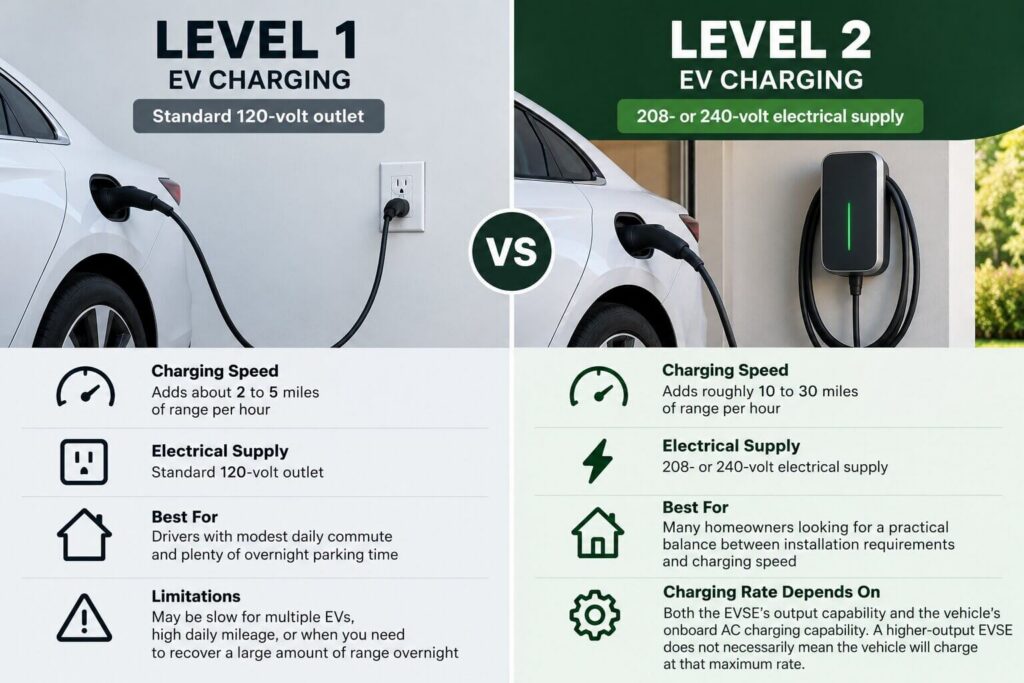
For home charging, Level 1 equipment uses a standard 120-volt connection and typically adds about 2 to 5 miles of range per hour. Level 2 equipment typically operates at 208 or 240 volts and adds about 10 to 30 miles of range per hour, depending on the equipment and vehicle.
Burbank has an important local difference: Burbank Water & Power, a community-owned utility, serves the city rather than Southern California Edison or LADWP. BWP maintains its own EV programs, rates, and service requirements.
The City of Burbank also maintains a dedicated EVSE permitting checklist covering single-family, multifamily, condominium, commercial, mixed-use, and public-right-of-way installations. The checklist asks for information including the EVSE rating, existing service rating, panel rating, EVSE circuit rating, and the existing connected, calculated, or documented demand load.
That means the right charger for a Burbank property depends on the vehicle, desired charging speed, existing electrical capacity, charger location, and property type.
Why EV Charger Installation in Burbank Is Different
Burbank is officially described by the City as the “Media Capital of the World” and is home to more than 1,000 media and entertainment companies, including major studios and entertainment businesses.
But the city’s EV-charging considerations have less to do with the entertainment industry itself and more with Burbank’s mature housing stock, varied property configurations, and locally operated electric utility.
Burbank’s housing inventory includes a substantial number of older units. City housing documents using 2014–2018 ACS data reported that approximately 74.7% of occupied housing units were built before 1980. The City notes that older properties can require modernization, including electrical improvements, although age alone does not establish that a particular electrical system is unsafe or inadequate.
That matters because an EV charger is an additional electrical load.
A newer property with a convenient electrical panel near the garage may have a relatively straightforward installation.
An older home with a detached garage, limited panel capacity, or a complicated wiring path may require a different approach.
The starting question should therefore be:
What does this specific property need to charge the vehicle safely and conveniently?
Burbank Water & Power: The Utility Matters
Burbank Water & Power (BWP), owned by Burbank residents, provides electric service within the city.
For EV owners, that means Burbank-specific utility information matters when planning an installation.
BWP currently offers:
- Residential EV charging rebates
- Commercial and multifamily EV charging rebates
- An EV-specific time-of-use rate
- Electric service planning
- Utility coordination for certain service upgrades
BWP’s current residential EV charging program advertises rebates of up to $1,500, depending on the charger, panel upgrade, and customer eligibility. The program is available to residential customers, including renters, while multifamily building owners use the commercial EV charging rebate program.
For projects that require a new electrical panel or service-related work, BWP instructs customers to contact Service Planning so the utility can determine whether its infrastructure also needs an upgrade.
This is one of the most important differences between installing an EV charger in Burbank and assuming the process is the same as it is in neighboring jurisdictions.
Burbank’s EV Charging Incentives
Residential EV Charger Rebates
BWP currently advertises rebates for residential customers installing qualifying EV charging stations.
The current program provides different amounts for standard and smart chargers and adds an additional panel-upgrade rebate when the applicable requirements are met. The maximum advertised program benefit is up to $1,500 for qualifying installations.
BWP also states that:
- Residential customers, including renters, may be eligible.
- Up to two charging stations may be covered under the program.
- A licensed electrician should assess the existing panel and circuits.
- If a new panel is needed, BWP Service Planning should be contacted.
- Required permits and a successful inspection are part of the application documentation.
Because rebates and program terms can change, homeowners should verify current eligibility and funding before assuming a particular rebate applies.
Burbank’s EV Time-of-Use Rate
BWP also operates a time-of-use option specifically for EV owners.
BWP currently identifies 11 p.m. to 8 a.m. on weekdays as the off-peak period, and its EV information explains that charging during that period provides access to the lowest energy-cost period under the TOU structure. BWP also states that EV charger rebate recipients are enrolled in the TOU rate for one year after approval.
For a homeowner who normally charges overnight, a smart charger with scheduling can make it easier to take advantage of that lower-cost period.
The exact financial benefit will depend on the household’s electricity use and applicable rate terms.
Burbank Housing Stock and EV Charger Planning
The City of Burbank’s housing documents provide a useful reminder that the city’s residential inventory is mature.
Based on 2014–2018 ACS data cited by the City, approximately:
| Construction period | Share of Burbank occupied housing units |
| 2010 or later | 0.8% |
| 2000–2009 | 6.6% |
| 1980–1999 | 17.9% |
| 1960–1979 | 22.5% |
| 1940–1959 | 39.2% |
| 1939 or earlier | 13.0% |
In total, approximately 74.7% were built before 1980. These figures are historical ACS data rather than a 2026 census estimate, but they demonstrate why electrical-system conditions can vary significantly across Burbank properties.
An older home does not automatically need a panel upgrade. Instead, the electrician should evaluate the existing service, panel, circuits, and electrical demand before deciding what the EV charger installation requires.
Level 1 vs. Level 2 EV Charging
Level 1 Charging
Level 1 charging uses a standard 120-volt connection.
The U.S. Department of Energy’s Alternative Fuels Data Center estimates that Level 1 charging generally adds around 2 to 5 miles of range per hour.
Level 1 can be adequate for some drivers who:
- Drive relatively few miles each day
- Have many hours available for overnight charging
- Have a suitable outlet near the parking location
- Do not need rapid recovery of range
It is therefore inaccurate to say that Level 1 is always inadequate.
For a driver who adds 20 miles during the day and has 10 to 12 hours of parking overnight, Level 1 may provide enough energy.
For a household with higher daily mileage or multiple EVs, however, Level 2 may be more convenient.
Level 2 Charging
Level 2 charging typically uses 208- or 240-volt AC power. The U.S. Department of Energy estimates approximately 10 to 30 miles of range per hour, depending on the equipment and vehicle.
Level 2 charging is commonly used for home charging because it can replenish a substantial amount of driving range during overnight parking.
A 32-amp charger operating at approximately 240 volts provides:
32A × 240V = 7.68 kW
A 48-amp charger at approximately 240 volts provides:
48A × 240V = 11.52 kW
Those calculations describe electrical power available to the EVSE; actual vehicle charging and range added will vary with the vehicle, charging losses, and other factors.
How Much Electrical Capacity Does an EV Charger Need?
This is one of the most important questions in any Burbank EV charger installation. The charger’s output is only one part of the calculation. The electrician also needs to consider the home’s existing electrical loads.
For example, a property may already have significant demand from:
- Multiple HVAC systems
- Electric water heating
- Electric cooking
- Pool equipment
- Spa equipment
- Laundry equipment
- Heat pumps
- Workshop equipment
- Other large electrical appliances
A 200-amp electrical panel does not mean all 200 amps are available for EV charging. Likewise, a 100-amp service does not automatically mean an EV charger cannot be installed. The actual load and system configuration need to be evaluated.
Does a 100-Amp Panel Support an EV Charger?
It may.
A 100-amp service can potentially support a Level 2 EV charger when the property’s existing electrical demand leaves sufficient capacity for the new load. A different 100-amp property may already be operating close to its calculated capacity.
The correct determination comes from an electrical assessment and load calculation rather than a rule such as:
“100 amps = no EV charger.”
or:
“200 amps = any EV charger is fine.”
Burbank’s current EVSE checklist specifically asks for the existing service rating, the panel supplying the EVSE, the EVSE circuit rating, and the existing connected, calculated, or documented demand load.
How Burbank’s EVSE Checklist Handles Load Calculations
Burbank’s current EVSE checklist is unusually useful for understanding what the local permitting authority wants to know.
The checklist covers:
- Single-family properties
- Multifamily apartments
- Condominiums
- Commercial properties
- Mixed-use properties
- Public-right-of-way installations
For the electrical system, it asks applicants to identify items such as:
- Existing main service rating
- Panel rating supplying the EVSE
- EVSE circuit rating
- EVSE nameplate rating
- Existing connected load
- Existing calculated load
- Documented demand load
- Total load after adding the EVSE
The checklist also calculates EVSE conductor minimum ampacity by multiplying the EVSE rating by 1.25.
EV Charger Circuit Requirements

A typical Level 2 installation is supplied by an individual branch circuit sized for the EVSE.
For example:
32-amp EVSE → commonly paired with a 40-amp circuit
48-amp EVSE → commonly paired with a 60-amp circuit
The exact circuit, conductor, and overcurrent-protection requirements must be determined from the charger’s specifications, installation method, and applicable electrical code.
Burbank’s current EVSE checklist specifically requires the EVSE rating, circuit rating, and conductor ampacity information as part of the permitting process.
The important point is that homeowners should not select wire size solely from a generic internet chart.
The installation method, conductor type, terminals, ambient conditions, distance, and equipment instructions can all affect the final design.
One EV, Two EVs or Three EVs: Multi-Charger Planning
A household with several EVs needs to consider the combined load, not just each charger individually.
For example, three 32-amp chargers at approximately 240 volts represent:
3 × 32A × 240V = 23.04 kW
Three 48-amp chargers represent:
3 × 48A × 240V = 34.56 kW
Those numbers do not automatically mean the property needs a major service upgrade.
They demonstrate why multiple-EV installations should be evaluated as a system.
A load-management system may control the combined charging demand so multiple vehicles share available electrical capacity, rather than every charger operating at maximum output simultaneously.
The appropriate configuration depends on the building’s electrical service and the specific equipment being installed.
EV Charger Load Management
Load management can be particularly useful in Burbank homes and multifamily properties where the existing electrical infrastructure is adequate for charging but lacks enough spare capacity to run every charger at maximum output at the same time.
For example, suppose a property can safely dedicate a certain amount of capacity to EV charging but has multiple vehicles that may be plugged in overnight.
A properly designed charging-management system can prioritize or distribute available capacity rather than simply turning every charger on at maximum output.
The result can be a more efficient use of the existing electrical infrastructure. However, load management should not be sold as a guarantee that every vehicle will be fully charged every morning. The outcome depends on:
- Battery size
- Energy required
- Charger output
- Time available
- Number of vehicles
- Building electrical demand
- Load-management settings
EV Charger Installation for Burbank Single-Family Homes
Single-family homes generally have the simplest EV charging configurations, but the exact installation still depends on the property.
Attached Garage
When the electrical panel is in or near the garage, the wiring route may be relatively short.
The electrician can generally evaluate:
- Panel capacity
- Available circuit space
- Service rating
- Charger location
- Circuit requirements
- Mounting method
This may lead to a straightforward installation, but the panel should still be assessed before adding the circuit.
Detached Garage
Detached garages require more planning.
A detached garage might have:
- An existing electrical feeder
- A small subpanel
- No electrical service
- An older electrical system
- A long distance between the garage and the main panel
Depending on the property, the project may require new conductors, conduit, underground raceway, trenching, or modifications to the existing feeder.
The City of Burbank’s EVSE checklist specifically distinguishes different installation locations and requires site-plan information for certain installations.
So there is no reason to assume every detached-garage project has the same installation cost or design.
Carport and Outdoor EV Charging
Not every Burbank home has an enclosed garage.
An EV charger may instead be installed at:
- A carport
- A driveway
- An outdoor wall
- A parking pad
- A pedestal
- Another permitted parking location
The U.S. Department of Energy states that outdoor EV charging can be safe, provided outdoor-rated equipment is used.
Burbank’s EVSE checklist adds an important local consideration: for a single-family installation other than on the interior wall of a garage, a site plan is required to verify parking, access, and setback conditions, and Planning Division review is required before permit issuance.
That makes outdoor installation somewhat different from simply installing a charger inside a garage.
When Does a Burbank EV Charger Installation Need a Site Plan?
Burbank’s current EVSE checklist provides specific local requirements.
For single-family installations other than an interior garage wall, a site plan is required to verify that the charger does not interfere with:
- Required parking space
- Parking access
- Required setbacks
The City states that the site plan must be reviewed and approved by the Planning Division before issuance.
For Level II and Level III chargers at nonresidential properties, the checklist requires site plans and specifications, with Building and Planning review before issuance.
This is one of the local details that generic California EV charger articles often miss.
What If the EV Charger Requires a Service Upgrade?
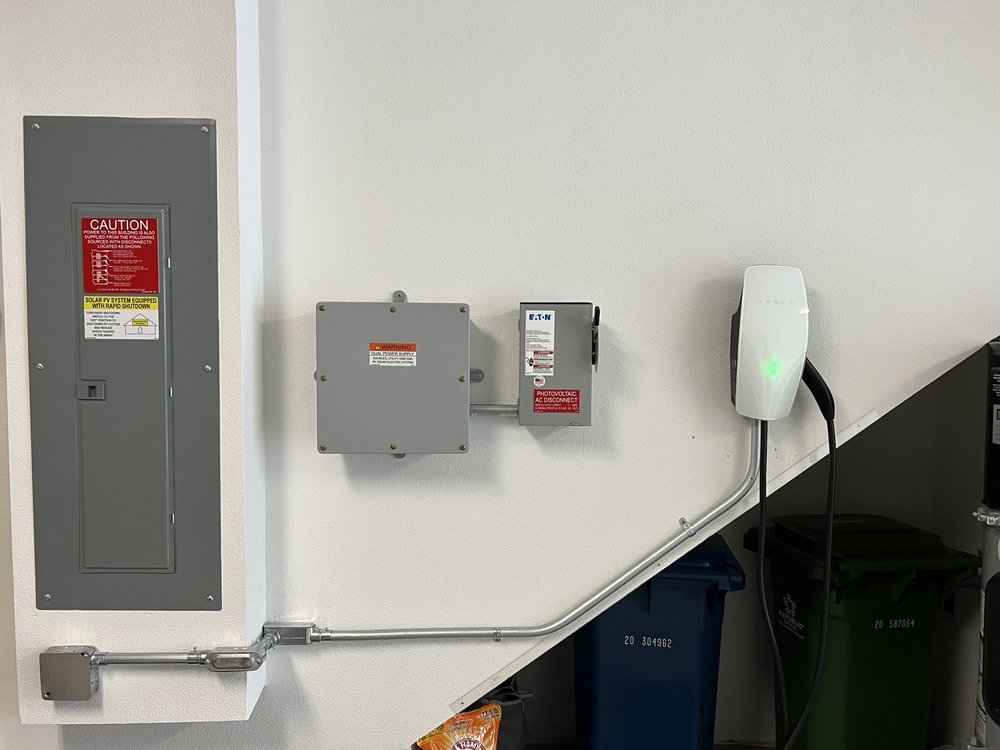
A charger installation may reveal that the property needs more than a new branch circuit.
Possible solutions can include:
- Adjusting charger output
- Load-management equipment
- Panel modification
- Panel replacement
- Service upgrade
- New feeder or subpanel
- Utility infrastructure work
Burbank’s EVSE checklist states that when an electrical service upgrade is needed, the applicant should obtain a meter spot from Burbank Water & Power before submitting the application to Building Division.
BWP’s residential rebate information similarly instructs customers whose electrician determines that a new panel is needed to contact BWP Service Planning so the utility can evaluate whether an upgrade to the electric infrastructure serving the property is also required.
That utility step should be considered before promising a homeowner a simple installation timeline.
EV Charger Brands: What Should Burbank Homeowners Look For?
The charger brand should come after the electrical requirements are understood.
Useful factors include:
- Maximum charging output
- Vehicle compatibility
- Hardwired vs. plug-in configuration
- Indoor vs. outdoor rating
- Wi-Fi or network connectivity
- Scheduling
- Energy monitoring
- Load sharing
- Integration with home-energy systems
- Manufacturer support
- Warranty
- Long-term software support
Current products from manufacturers such as Tesla, ChargePoint, and Wallbox provide different charging outputs and configurations. Select the right model based on the vehicle and property, rather than a blanket claim that one brand is universally best.
Smart Charging Features for Burbank Homes
Modern EVSE can offer features that are especially useful when household electricity use needs to be coordinated.
Charging Schedules
A charger can schedule charging for periods when the homeowner wants the vehicle to charge.
For BWP EV customers, scheduling overnight charging can help take advantage of the utility’s current off-peak period of 11 p.m. to 8 a.m.
Load Sharing
Multiple compatible chargers may be configured so that their combined demand stays within a defined electrical limit.
Energy Monitoring
Some smart chargers provide app-based visibility into charging sessions and energy consumption.
Solar Integration
Certain charger and energy-management systems can coordinate EV charging with solar production. Compatibility depends on the equipment.
The important distinction is that these are equipment-specific features, not features every charger automatically supports.
EV Charging in Burbank Multifamily Properties
Multifamily EV charging is different from single-family charging because the electrical infrastructure and ownership arrangement are shared.
An apartment or condominium property may have:
- Individual dwelling-unit meters
- Common-area electrical service
- Shared parking
- Assigned parking
- Detached parking structures
- HOA-controlled infrastructure
- Property-management-controlled electrical systems
BWP specifically recognizes this distinction.
Its residential EV rebate page states that multifamily building owners installing chargers for tenants should use BWP’s commercial EV charging rebate program. It also notes that in some cases an individual charging station cannot be connected directly to the tenant’s home meter, meaning a commercial electrical infrastructure upgrade may be needed, and building management or an HOA may need to manage the installation.
Multi-Tenant EV Charging and Electrical Load Management
Suppose an apartment property has ten EV-owning residents.
Ten independent 40-amp circuits represent 400 amps of branch-circuit rating before considering the building’s other electrical loads. That does not automatically mean the building needs a 400-amp service increase.
It means the building needs a charging strategy.
A properly designed multifamily charging system may use:
- Shared electrical infrastructure
- Networked chargers
- Load management
- Individual energy metering
- Dedicated EV distribution
- A combination of these
The goal is to match charging infrastructure to the building’s capacity and residents’ charging needs.
Commercial and Multifamily EV Charger Rebates in Burbank
BWP currently offers a separate Commercial EV Charging Station Rebate Program.
For multifamily properties, BWP currently advertises the following Level 2 rebate amounts:
| Installation | Level 2 rebate |
| Without utility infrastructure upgrade | $4,000 per charge port |
| With utility infrastructure upgrade | $7,500 per charge port |
BWP also lists separate amounts for smart outlets, DC fast chargers, publicly accessible chargers, and other eligible locations. Program caps and eligibility conditions apply.
For commercial projects, BWP’s application materials also state that completed applications require post-deployment documentation and final City permit approval, while the utility offers a reservation process in qualifying circumstances.
This makes utility-program planning worth considering before a multifamily or commercial project is fully designed.
What Electrical Code Applies in Burbank?
Burbank’s Building & Safety Division currently states that applications submitted on or after January 1, 2026 are subject to the 2025 California Building Standards Code and local amendments.
The City also maintains an EVSE-specific checklist, which provides local installation and permitting information beyond the general California code framework.
The exact requirements for a specific EV charging project depend on the project scope, property type, and equipment being installed.
Does EV Charger Installation Require a Permit in Burbank?
Yes, homeowners and property owners should expect electrical permitting for EV charger installations.
Burbank’s Building & Safety Division states that permits are required for electrical construction, alterations, repairs, and maintenance work, and the City maintains a dedicated EVSE checklist to accompany the building permit process.
The current EVSE checklist covers residential and nonresidential properties and provides additional requirements based on the installation type.
Burbank’s 2026 permit records also show EV charger installations being issued under the City’s Electrical permit category, including Level 2 installations at single-family homes and EV charger installations at condominium properties.
What Burbank’s Permit Process Can Look Like
The exact process depends on the project, but a typical installation may follow this sequence.
Step 1: Site and Electrical Assessment
The electrician evaluates:
- Electrical service
- Main panel
- Existing demand
- Charger location
- Parking arrangement
- Wiring route
- Existing feeder or subpanel
- Indoor or outdoor conditions
- Future charging needs
Step 2: Load Calculation
The electrical load is evaluated to determine whether the existing system can accommodate the planned EVSE.
Burbank’s EVSE checklist specifically requests existing and EV-related load information.
Step 3: Charger Selection
The charger is selected based on the vehicle, desired charging speed, and electrical system.
Step 4: Utility Coordination When Required
When a service upgrade is needed, Burbank’s checklist requires the appropriate BWP meter-spot process before permit submission.
Step 5: Permit Application
The appropriate electrical permit and supporting documentation are submitted to the City.
Step 6: Electrical Installation
The electrician installs the required circuit, conductors, raceway, panel equipment, and EVSE.
Step 7: Inspection
The completed installation is inspected by the City.
Step 8: Commissioning
The charger is configured and tested according to the equipment and project requirements.
How Long Does EV Charger Installation Take in Burbank?
There should not be one universal installation time published for every Burbank home.
A straightforward installation with:
- Attached garage
- Nearby panel
- Adequate existing capacity
- Short wiring route
- No panel modification
can be substantially simpler than an installation involving:
- Detached garage
- Long conduit run
- Trenching
- Panel modification
- Service upgrade
- Multiple chargers
- HOA approval
- Multifamily infrastructure
The best way to provide a realistic schedule is to inspect the property first.
This is also why Burbank’s permit process can differ considerably between a simple residential installation and a multifamily or commercial project.
Choosing an EV Charger Installation Contractor in Burbank
An EV charger installation is electrical work, so homeowners should verify the contractor’s qualifications.
The California Contractors State License Board identifies C-10 — Electrical Contractor as the classification covering contractors who install or connect electrical wires, fixtures, appliances, raceways, conduits, and related equipment that utilize electrical energy.
CSLB also provides an official online license-checking tool that allows homeowners to verify contractor information before hiring.
For a Burbank EV project, ask:
- What does the load calculation show?
- How much power will my charger actually use?
- Does my panel have adequate capacity?
- Will I need a panel or service upgrade?
- Where will the wiring run?
- Does the location require a site plan?
- Does BWP need to be involved?
- Does my HOA or property manager need to approve the installation?
- Which permits are required?
- What happens if I add another EV later?
These questions are far more useful than choosing a charger solely because it advertises the highest amperage.
Why Planning for a Second EV Can Matter
A homeowner buying one EV today may own two in a few years. That does not necessarily mean installing two chargers immediately. But it can make sense to consider future charging requirements during the initial electrical design.
For example, the electrician may evaluate whether the existing system could eventually support:
- Two chargers
- Load-managed charging
- A larger feeder
- A future subpanel
- Additional electrical appliances
Planning ahead can help prevent the homeowner from designing one installation today and then completely redesigning the electrical infrastructure later.
Frequently Asked Questions
Possibly. The answer depends on the existing electrical demand and the charger configuration. Burbank’s EVSE permitting materials specifically require load information before the installation is approved.
Not automatically. A 200-amp service may provide more capacity, but the correct service size depends on the property’s electrical load and planned equipment.
There is no universal number. The answer depends on the home’s electrical service, existing demand, charger output, and whether load-management technology is used.
Yes. Burbank maintains an EVSE-specific permitting checklist, and its Building & Safety Division requires permits for applicable electrical work.
Potentially. BWP involvement is especially important when an installation requires an electrical service upgrade or utility infrastructure changes. Burbank’s EVSE checklist specifically requires a BWP meter spot when a service upgrade is needed.
Yes. BWP currently advertises a residential EV charging rebate program worth up to $1,500 for qualifying installations, with the exact amount dependent on charger and project details.
Covered residential tenants have protections under California Civil Code §1947.6, but the installation must satisfy the statutory conditions, landlord approval process, and applicable electrical requirements.
California Civil Code §4745 generally prevents an HOA from effectively prohibiting or unreasonably restricting qualifying EV charging installations in an owner’s unit or designated parking space, while allowing reasonable restrictions and requiring compliance with applicable law.
Outdoor installations require equipment and installation methods appropriate for outdoor exposure. Burbank also has site-plan requirements for certain outdoor or non-garage residential installations.
Yes, compatible equipment can be designed to manage combined charging demand. The specific solution depends on the electrical system and the capabilities of the EVSE. Burbank’s permitting materials recognize multiple EVSE configurations and require load information as part of the application.
Yes, provided the electrical system and installation can support it. Depending on the property, the project may require new wiring, conduit, trenching, a feeder, or other infrastructure.
There is no universal best charger. The appropriate model depends on the vehicle, desired charging output, electrical capacity, installation location, smart features, and long-term support.
Get Your Burbank EV Charger Installation Assessment
Home EV charging should fit the property rather than forcing the property to fit the charger.
Whether you’re installing your first Level 2 charger, preparing a detached garage for EV charging, adding a second vehicle, upgrading an older electrical panel, or planning charging infrastructure for a multifamily property, the process should begin with an assessment of the electrical system and the charging requirements.
Volta Electric Inc. provides EV charger installation and related electrical services in Burbank, including electrical panel upgrades, wiring, and other electrical work. Volta’s website lists California contractor license #1100197, and homeowners can verify current license information through CSLB.