
Introduction
Walk through almost any established neighborhood in Los Angeles, from the craftsman bungalows of Highland Park to the Spanish revivals of Hancock Park, and you are looking at housing stock that was wired for a completely different era of electrical demand. Aging infrastructure creates unique challenges, and those challenges do not announce themselves the way a cracked foundation or a leaking roof does. Electrical problems live behind the walls, inside the panel, and underneath decades of paint and drywall, which means most homeowners have no idea their system is outdated until something fails, a permit application stalls, or an electrician Los Angeles homeowners called for a routine repair delivers unwelcome news.
This is not a minor issue affecting a handful of historic properties. A significant share of homes across Los Angeles County were built before modern electrical codes existed, and many have only received partial updates over the decades rather than a comprehensive modernization. Understanding why these homes require a different, more specialized approach than newer construction is the first step toward protecting your property, your family, and your investment.

The Unique Electrical Profile of Older Los Angeles Homes
Older homes were not built with today’s electrical loads in mind. A house wired in the 1940s or 1950s was designed around a handful of light fixtures, a radio, and maybe a refrigerator. Today, that same home is expected to run central air conditioning, multiple televisions, a home office with several monitors, kitchen appliances that draw significant current, and increasingly, an EV charger installation in the garage. The gap between what these systems were designed for and what they are now asked to do is the root of most electrical issues in legacy housing.
This gap shows up differently depending on the construction era. Homes built before the 1960s frequently still have original knob-and-tube wiring in at least part of the structure, even if later renovations added modern circuits elsewhere. Homes built during the late 1960s and early 1970s copper shortage may have aluminum branch wiring, which behaves very differently than copper at connection points and requires specific expertise to handle safely. Homes from the 1980s and 1990s are usually in better shape structurally but often still carry panels that are undersized by current standards, simply because nobody anticipated how much electrical demand a modern household would generate.
Why a Generic Approach Falls Short
A licensed electrician Los Angeles homeowners trust for older properties needs to recognize these era-specific patterns immediately, rather than treating every service call the same way. Diagnosing a tripped breaker in a 1920s Spanish revival is a fundamentally different task than diagnosing the same symptom in a home built in 2005, because the underlying causes, and the safe methods for correcting them, are not interchangeable. Electrical troubleshooting in older homes requires an understanding of legacy materials, outdated grounding methods, and wiring configurations that have not been standard practice for half a century.
Knob-and-Tube Wiring: Still More Common Than Most Homeowners Realize
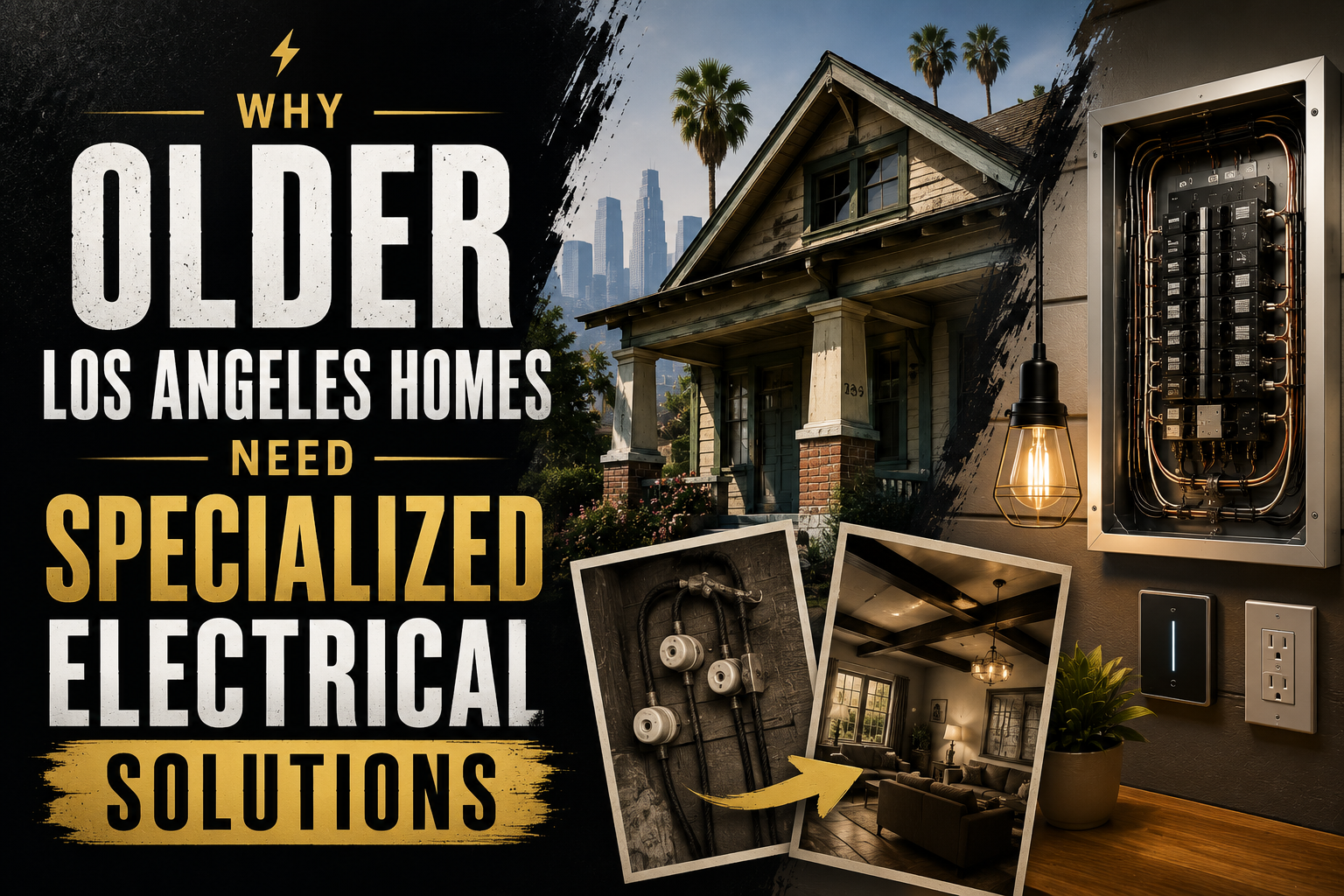
Knob-and-tube wiring was the standard method of electrical distribution in the United States roughly from the 1880s through the 1940s, and it remains present in a meaningful number of older Los Angeles homes, particularly in areas that have not undergone full rewiring. This system used individual conductors run through ceramic knobs and tubes rather than the sheathed cable used today, and while it was sound engineering for its time, it was never designed to handle modern loads or to be safely insulated with the materials often layered on top of it during later renovations, such as blown-in attic insulation.
The core issue with knob-and-tube wiring today is not that it fails immediately, but that it was never designed to be enclosed the way modern homes are insulated and finished, and it lacks a grounding conductor entirely. This creates both a fire risk when covered improperly and a compatibility issue with modern three-prong appliances and surge-sensitive electronics. Many insurance carriers in California will not renew a policy, or will require remediation, when knob-and-tube wiring is discovered during an inspection, which makes this one of the more urgent issues for owners of older homes to address proactively rather than waiting for a lender or insurer to force the issue.
Aluminum Wiring: A Quiet Risk From the Copper Shortage Era
Between roughly 1965 and 1973, copper prices spiked sharply enough that many builders switched to aluminum wiring for branch circuits, and a portion of Los Angeles homes built during this window still carry that original wiring today. Aluminum expands and contracts at a different rate than copper, and it oxidizes in a way that increases resistance at connection points over time. In practice, this means outlets and switches connected to aluminum wiring can loosen gradually, generating heat at the connection point long before any visible symptom appears.
The solution is not necessarily full replacement in every case. In many situations, a licensed electrician can address the risk through approved copper pigtail connections at each outlet, switch, and fixture, using connectors specifically rated for aluminum-to-copper transitions. This is a case where experience matters enormously, since improperly executed aluminum wiring repairs are arguably more dangerous than leaving the wiring untouched, and it is not a project suited to general handyman work or DIY correction.
Undersized Electrical Panels: The Most Common Constraint
Even in homes that have had partial updates over the years, an undersized panel is often the bottleneck that limits everything else. A panel upgrade becomes necessary when a home’s electrical service, commonly still at 60 or 100 amps in older Los Angeles properties, cannot support the combined load of central HVAC, modern kitchen appliances, a home office, and any future additions like a home EV charger installation. An electrical panel upgrade in Los Angeles is frequently the first recommendation when a homeowner in an older property calls about recurring tripped breakers, flickering lights during appliance use, or an inability to run certain circuits simultaneously.
Panel age matters as much as amperage. Certain panel brands manufactured decades ago have documented histories of breaker failure, where breakers fail to trip during an overload condition, which defeats the entire purpose of the panel’s safety function. An electrical panel replacement addresses both the capacity limitation and this kind of latent safety risk simultaneously, and it is one of the more cost-effective ways to modernize an older home’s entire electrical foundation in a single, well-planned project.
Grounding and GFCI Gaps in Legacy Homes
Many older Los Angeles homes have outlets that were never grounded to begin with, or that were later fitted with three-prong outlets without actually running a ground wire back to the panel, a shortcut sometimes used during past renovations to pass a quick inspection without addressing the underlying issue. This creates a false sense of safety, since the outlet looks modern but does not actually provide the protection a grounded outlet is supposed to offer.
GFCI outlet installation is equally important in older homes, particularly in kitchens, bathrooms, garages, and any exterior circuits, since these areas carry the highest risk of shock in the presence of moisture. Many older homes predate GFCI requirements entirely, meaning wet-area outlets may have never been updated since the code changes that made this protection mandatory. Electrical outlet installation and GFCI upgrades are relatively affordable compared to panel work or rewiring, but they address some of the most immediate safety gaps in a legacy electrical system.
Common Problems and Solutions in Older Los Angeles Homes
Homeowners in older properties tend to encounter a recurring set of issues, and recognizing the pattern early leads to better outcomes than waiting for a failure.
Frequent breaker trips are usually a sign of an overloaded circuit or an aging breaker that has become unreliable, and the fix ranges from redistributing circuit loads to a full panel upgrade depending on severity. Flickering or dimming lights when large appliances start, such as an air conditioner or a washing machine, often point to loose connections or undersized wiring gauge for the load being carried, and this is a case where electrical troubleshooting by a qualified professional should happen promptly, since loose connections generate heat over time. Warm or discolored outlet covers indicate a connection problem that has already progressed and should be treated as urgent rather than cosmetic.
A persistent burning smell with no obvious source, buzzing sounds from the panel, or a panel that feels warm to the touch are all signs that warrant an immediate emergency electrician visit rather than a scheduled appointment, since these symptoms can precede an electrical fire. On the less urgent end, outlets that no longer grip plugs firmly, or a home that seems to be perpetually short on available circuits for new devices, are strong indicators that a broader electrical services assessment is overdue, even without an acute safety concern driving the call.
Benefits of Specialized Electrical Work for Older Homes
Addressing these issues with a contractor who understands legacy housing stock delivers benefits well beyond simply fixing what is broken. Safety improves immediately once outdated wiring, ungrounded circuits, and unreliable panels are addressed, reducing fire risk and shock hazards that accumulate silently over decades. Insurance eligibility often improves as well, since many carriers in California now request documentation of electrical updates before renewing policies on older homes, particularly once they learn a property still has original wiring from a pre-1960s construction era.
Property value benefits too, and not just at the point of sale. A home with a modernized electrical system supports higher appliance loads, EV charging, and smart home technology without the constant troubleshooting that undersized or aging systems require, which improves daily livability for the current owner as much as it improves marketability down the line. Comfort also improves in ways homeowners do not always anticipate going in, since a properly sized panel eliminates the small daily frustrations of tripped breakers and inconsistent power delivery that many owners of older homes have simply learned to work around.
Cost and Investment Considerations
Electrical modernization in an older home is rarely a single project, and understanding how the pieces fit together helps homeowners plan a realistic budget rather than being surprised by scope creep partway through. A panel upgrade is typically the anchor project, since it establishes the capacity for everything else, including any future EV charger installation or home rewiring services. Addressing aluminum wiring connections or targeted knob-and-tube replacement in high-risk areas can often be phased alongside the panel work without requiring a full-home rewire immediately, which helps homeowners spread costs over a more manageable timeline.
Cost varies significantly based on the home’s age, square footage, and the extent of legacy wiring still in place, and an accurate estimate requires an in-person assessment rather than a phone quote. What is consistent across most older properties is that addressing electrical issues proactively, rather than reactively after a failure or a failed inspection, tends to cost less overall, since emergency repairs and forced last-minute corrections rarely come at the most favorable price point. Homeowners who treat electrical modernization as a phased, planned investment generally get better outcomes than those who wait for a crisis to force the decision.
Expert Recommendations
For owners of older Los Angeles homes, the first practical step is a comprehensive electrical assessment from a licensed electrician who has specific experience with legacy wiring systems, not just general residential work. This assessment should document the home’s current panel capacity, wiring type throughout the structure, grounding status, and any GFCI gaps, giving the homeowner a clear roadmap rather than a list of individual symptoms.
From there, prioritization matters. Safety-critical issues, including active knob-and-tube wiring in living spaces, aluminum wiring showing signs of connection deterioration, or a panel with a history of breaker failure, should be addressed first regardless of budget constraints. Capacity and convenience upgrades, such as adding circuits for a home office or preparing for a home EV charger installation, can follow once the safety foundation is solid.
Homeowners should also insist on permitted work for any panel upgrade, rewiring, or major electrical repair services, even when it adds time to the project. Permitted work protects the homeowner legally, supports insurance claims if anything does go wrong, and creates a documented history that benefits the property at resale, since buyers and their agents increasingly ask for this kind of documentation directly.
Local Relevance for Los Angeles
Los Angeles presents an unusually wide range of construction eras within a relatively compact geographic area, which is part of what makes electrical work here more specialized than in newer suburban markets elsewhere in the country. Neighborhoods with concentrations of pre-1960s construction see the highest rates of knob-and-tube and early aluminum wiring, while pockets of mid-century development carry the aluminum wiring risks specific to that construction window. An electrician Los Angeles homeowners call for one property might encounter an entirely different set of legacy issues at a home just a few blocks away, depending on when that particular block was developed.
This variability extends across the broader region as well. Pasadena and Glendale share similar construction-era patterns to much of central Los Angeles, with panel upgrades in Pasadena frequently needed for the same reasons seen closer to downtown. Santa Monica’s older beach-adjacent housing stock carries its own set of legacy wiring concerns, compounded by coastal moisture that accelerates corrosion at outdoor and garage electrical connections. Torrance and Long Beach, with a mix of post-war development and later infill construction, see a similarly broad range of electrical conditions depending on the specific era a given property was built. Inland communities like Westlake Village tend to skew newer overall, but still include enough older ranch-style construction that a general assumption of “newer means updated” does not always hold.
Given this variability, homeowners across the region benefit from working with an electrical contractor who evaluates each property individually rather than applying a one-size-fits-all approach based on the home’s general age or neighborhood reputation.
Future Trends and Industry Insights
As Los Angeles continues to densify and modernize its housing stock, electrical demands on older homes are only going to increase. EV adoption continues climbing, and homeowners without adequate panel capacity will increasingly find themselves needing an upgrade simply to keep pace with a vehicle purchase decision rather than as a standalone electrical project. Smart home technology, home battery backup, and increasingly sophisticated HVAC systems are adding further load to panels that, in many older homes, are already operating near their practical limits.
There is also a growing intersection between electrical modernization and renewable energy adoption. Homeowners upgrading an older home’s panel are increasingly pairing that work with Solar Inverters or Hybrid Solar Inverters to reduce long-term utility costs, and in some cases adding Lithium Batteries or broader Energy Storage Systems for resilience during grid outages, which have become more frequent during California’s public safety power shutoff events. For properties with larger lots, Solar Water Pumps and Solar Street Lights are becoming more common additions during a broader electrical modernization project, since the same contractor handling panel capacity and wiring assessments is well positioned to evaluate these additions at the same time. Homeowners who approach an older home’s electrical needs holistically, rather than addressing each issue in isolation as it arises, tend to end up with systems that are both safer and more cost-effective over the following decade.
Panel technology itself is evolving as well, with smart panels offering circuit-level monitoring becoming more accessible and increasingly relevant for older homes where understanding actual load distribution helps homeowners make informed decisions about future upgrades rather than guessing at capacity needs.
Frequently Asked Questions
How do I know if my Los Angeles home still has knob-and-tube wiring?
A licensed electrician can typically identify knob-and-tube wiring during an inspection of accessible areas like the attic and basement, though a full assessment may be needed to determine how much of the home’s original wiring remains active versus already replaced.
Is aluminum wiring dangerous, or can it be safely repaired?
Aluminum wiring itself is not inherently dangerous, but connection points require specific hardware and technique to remain safe over time. A qualified electrician can address these connections using approved methods without requiring full replacement in most cases.
Do I need a panel upgrade if my home has not had any electrical problems?
Not necessarily, but an aging panel without visible symptoms can still be undersized for modern loads or carry a known reliability issue with certain breaker brands, so a professional assessment is worthwhile even in the absence of obvious problems.
How much does it cost to update an older home’s electrical system in Los Angeles?
Costs vary widely based on the home’s age, size, and existing wiring condition, and an accurate estimate requires an in-person evaluation from a licensed electrical contractor rather than a general estimate.
Can I add GFCI outlets myself in an older home?
This is not recommended without proper licensing, since older homes often have wiring configurations, such as missing ground wires, that complicate GFCI installation and require professional judgment to address safely.
Will insurance companies require electrical updates in older homes?
Many insurers in California now ask about wiring type and panel age during underwriting, and some require remediation of knob-and-tube wiring or outdated panels before issuing or renewing a policy.
How urgent is it to address aluminum wiring if I am not experiencing problems?
Aluminum wiring connections can deteriorate gradually without obvious warning signs, so proactive inspection and correction is generally recommended rather than waiting for a visible symptom to appear.
Can I add an EV charger to an older home’s electrical system?
In most cases yes, though it typically requires a panel capacity assessment first, and many older homes need a panel upgrade before a home EV charger installation can be added safely.
Conclusion
Older Los Angeles homes carry a specific set of electrical challenges that newer construction simply does not have, from knob-and-tube wiring and aluminum branch circuits to undersized panels and missing grounding. Aging infrastructure creates unique challenges, and addressing them requires more than a general electrician; it requires a contractor with specific experience diagnosing and correcting the wiring realities of homes built across nearly a century of changing electrical standards. Proactive assessment and phased modernization protect both the safety and the long-term value of these properties, and homeowners who address these issues before they become emergencies consistently see better outcomes, both financially and in day-to-day livability.
Work With Volta Electric on Your Older Home
If you own an older home anywhere in the Los Angeles area and want a clear picture of what your electrical system actually needs, Volta Electric specializes in exactly this kind of work. Our licensed electricians understand the wiring realities of homes built across every era of Los Angeles construction, from knob-and-tube and aluminum wiring to undersized panels and outdated grounding, and we handle every project with proper permits and documentation. Contact Volta Electric today to schedule a comprehensive electrical assessment and get a clear, prioritized plan for modernizing your home safely.

