
Introduction
Your electricity bill has probably told you everything you need to know about the direction Arizona’s energy market is heading. Across Phoenix, Scottsdale, Tucson, and every sun-drenched suburb in between, homeowners are opening their monthly statements and confronting a reality that keeps getting harder to ignore: utility rates are rising faster than almost anywhere else in the country, and the traditional model of simply buying power from the grid is starting to feel like a losing proposition.
That frustration is driving one of the most significant shifts in residential energy in Arizona’s history. Hybrid solar inverters — a technology that has matured considerably over the past few years — are now at the center of conversations happening on driveways, at dinner tables, and in contractor meeting rooms across the state. Unlike standard solar setups that send excess power back to the grid with no guarantee of when you’ll need it most, hybrid systems let homeowners store energy locally, manage consumption intelligently, and operate with a level of independence that simply wasn’t achievable at this price point even three years ago.
This isn’t a trend driven by environmental enthusiasm alone, though that certainly factors in for many families. It is primarily being driven by dollars and cents. The economics of hybrid solar in Arizona in 2026 have reached a tipping point, and the homeowners who understand the technology — not just the marketing — are the ones making decisions they won’t regret.
What a Hybrid Solar Inverter Actually Does
Before getting into the financial and practical arguments, it helps to understand what separates a hybrid inverter from the equipment most people are still using in their older solar installations.
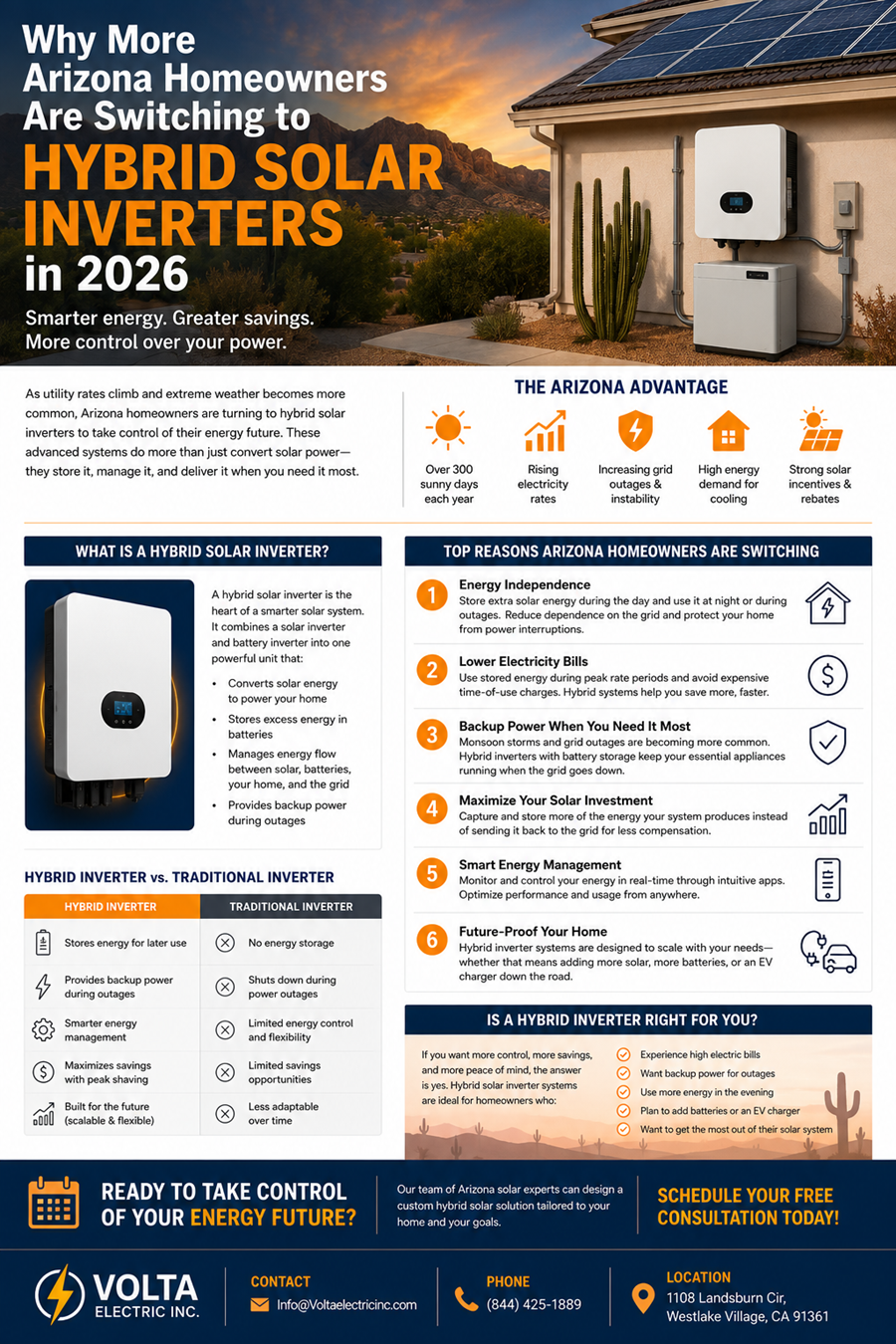
A conventional solar inverter does one thing: it converts the direct current your panels generate into the alternating current your home uses. Any power your panels produce beyond what you’re consuming in that moment gets pushed onto the utility grid. You receive a credit for it — sometimes — under net metering policies that vary significantly by utility and continue to be revised, often not in your favor.
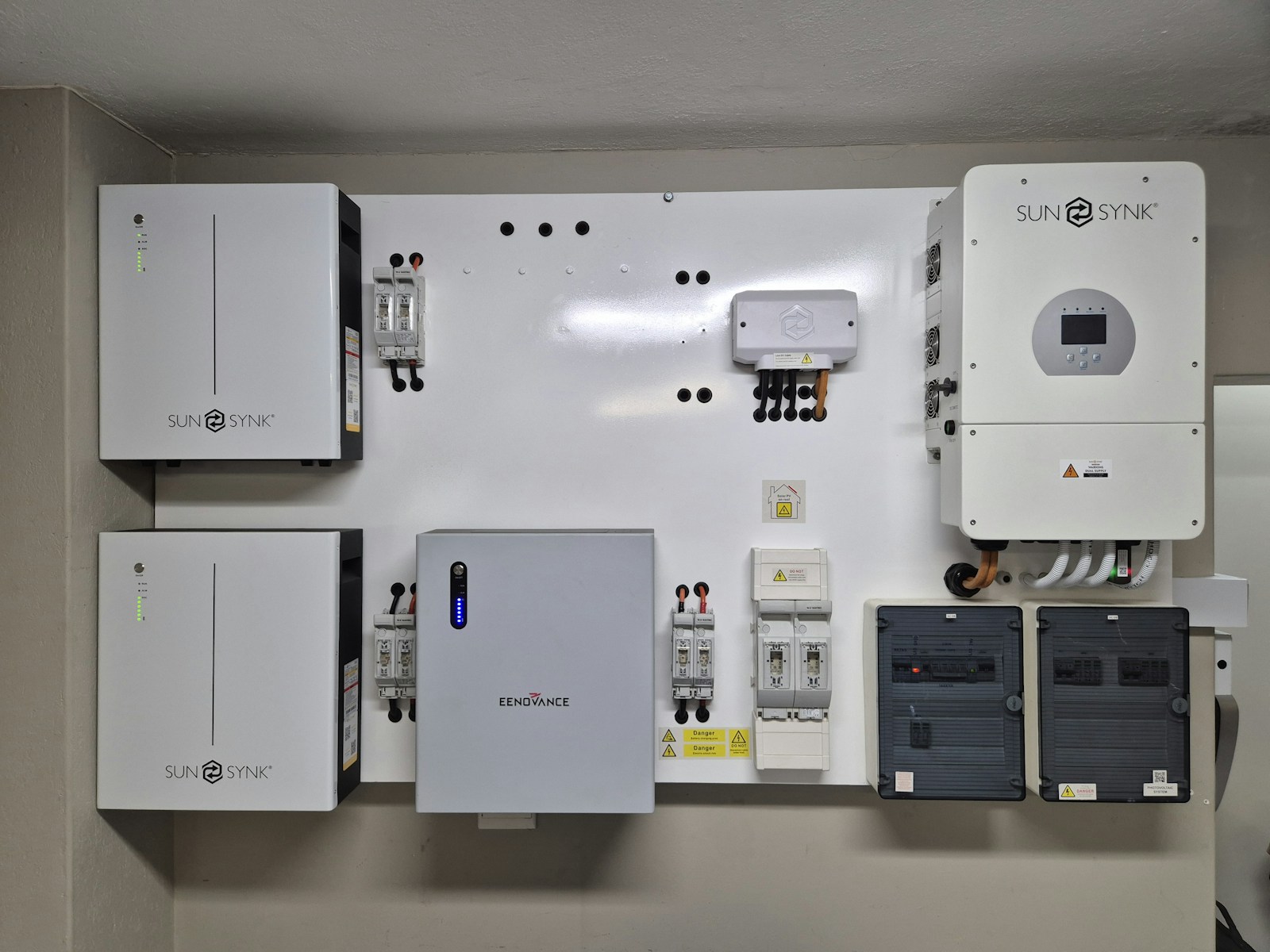
A hybrid solar inverter does considerably more. It manages the relationship between your solar panels, your battery storage system, your home’s electrical loads, and the grid simultaneously. When your panels are generating more than you’re using, the hybrid inverter directs that surplus into your batteries instead of exporting it. When the sun goes down or clouds roll in, it draws from storage before pulling from the grid. And during a grid outage — increasingly common in Arizona during monsoon season and extreme heat events — it can keep your home running from stored energy entirely.
The sophistication of modern hybrid inverters extends well beyond simple switching logic. Today’s systems include monitoring platforms that track energy flows in real time, smart load management that can prioritize critical circuits during an outage, and communication capabilities that allow integration with time-of-use rate scheduling. If your utility charges peak rates between 3 PM and 8 PM, a well-configured hybrid system will have already shifted your consumption pattern to minimize what you pull from the grid during those expensive hours.
The Arizona Rate Environment in 2026
The context matters here. Arizona utilities have implemented significant rate increases over the past several years, and the structure of those increases has changed in ways that particularly disadvantage conventional solar users.
Arizona Public Service and Tucson Electric Power have both moved aggressively toward time-of-use rate structures that charge premium prices during afternoon and evening hours — precisely when residential demand peaks in a state where air conditioning is not optional from May through September. Net metering compensation rates have also been reduced in recent rate cases, meaning the credits you earn for exporting midday solar power are worth less than what you pay to import evening power. That spread, between what you get for export and what you pay for import, is where standard solar systems quietly lose money.
The math has flipped. A homeowner running a conventional grid-tied solar system in 2026 may find that the economics they were sold on five years ago no longer hold. Energy generated at noon and exported to the grid earns a fraction of what that same household spends pulling power back at 7 PM.
A hybrid inverter with adequate battery storage closes that gap completely. The noon solar surplus charges your batteries, and those batteries power your home during the expensive evening hours. The grid becomes a backup rather than a trading partner, and your exposure to rate volatility shrinks dramatically.
Energy Storage: The Component That Makes It Work
A hybrid inverter without battery storage is something of a compromise. The inverter provides the architecture and control logic, but the battery storage system is what delivers the independence. This is why the simultaneous drop in lithium battery prices has been so consequential for Arizona homeowners considering the switch.
Lithium iron phosphate batteries, which have become the dominant chemistry in residential energy storage, have seen significant cost reductions and substantial improvements in cycle life over the past few years. A quality lithium battery bank today will perform reliably through four thousand or more charge cycles with minimal degradation — meaning it can last fifteen to twenty years in a typical residential application. When you amortize that cost across the battery’s operational life, the per-kilowatt-hour cost of stored electricity becomes genuinely competitive with peak grid rates, particularly in a high-rate environment like Arizona’s.
The integration between modern hybrid inverters and lithium batteries has also improved. Purpose-built systems from established manufacturers communicate directly between the inverter and battery management system, optimizing charging parameters, protecting battery health, and providing homeowners with clear visibility into their system’s performance. Installers who have been through several product generations know which pairings perform best and which integration quirks cause headaches down the line.
Battery backup systems are particularly compelling in Arizona given the state’s grid reliability challenges. The extreme heat that drives peak demand is the same condition under which transmission infrastructure is most stressed. Outages during summer heat events are not simply inconvenient — for elderly residents and households with young children, they can pose genuine safety risks. A properly sized battery backup system changes that equation entirely.
What Hybrid Means for Grid Outage Protection
This point deserves its own discussion because it is one of the most misunderstood aspects of solar for homeowners who installed systems before battery storage became mainstream.
Standard grid-tied solar systems — the overwhelming majority of systems installed in Arizona before about 2020 — shut down automatically when the grid loses power. This is a safety requirement, designed to prevent solar-generated electricity from energizing lines that utility workers might be servicing. The practical result is that homeowners with panels on their roofs sit in the dark during an outage, generating no usable power, because their inverter has disconnected.
A hybrid inverter with battery storage does not have this limitation. It detects the grid outage, disconnects from the utility, and continues operating your home from stored energy and ongoing solar generation in a seamless transition that most homeowners never notice. Depending on your battery capacity and your consumption during the outage, you might run critical loads indefinitely as long as sunlight is available to keep the batteries charged.
This capability is what has prompted many Arizona homeowners who already have solar to upgrade their inverter and add storage, even though their panels are still performing well. The panels become far more valuable when paired with a system that can actually use their output during the conditions when grid power is most likely to fail.
The Financial Case: Numbers Worth Understanding
The specific numbers vary based on system size, battery capacity, current energy consumption, and which utility serves your property. That said, there are meaningful general figures worth understanding.
The federal Investment Tax Credit currently provides a 30% credit on the full installed cost of a solar and battery storage system. Arizona also maintains its own solar energy credit, and there is no state sales tax on solar equipment purchases. These incentives meaningfully reduce the net cost of a complete hybrid system compared to what the sticker price suggests.
A typical Arizona household with above-average consumption — say, a 2,400 square foot home with a pool running in summer — might require a 10 to 14 kilowatt solar array paired with 20 to 30 kilowatt-hours of battery storage to achieve substantial grid independence. Installed costs for a system at that scale have come down considerably and, after incentives, the return on investment timeline for Arizona homeowners in high-rate utility territories has compressed to the point where many systems pay for themselves within seven to ten years while providing two to three decades of useful life.
The other financial consideration that homeowners should factor in is the increasing cost of doing nothing. Utility rates in Arizona have not shown any meaningful tendency to flatten or decline. A hybrid solar investment made today hedges against rate increases for the entire life of the system.
Common Concerns Homeowners Raise — And Honest Answers
“I already have solar. Do I need to replace everything?”
Not necessarily. Whether your existing panels can be integrated into a new hybrid system depends on their age, the inverter type, and what equipment your installer proposes. In many cases, a hybrid inverter can be retrofitted into an existing solar installation, and batteries can be added without replacing functional panels. A competent assessment will tell you exactly what’s feasible with your current setup.
“What happens if I install this and net metering goes away entirely?”
This is actually the argument for hybrid storage, not against it. A household that depends on net metering for the economics of its solar system is exposed to policy risk. A household with hybrid storage and batteries has already reduced its grid dependency to the point where net metering credits are a bonus rather than a necessity.
“Are there products that have a bad reputation for reliability?”
Yes, and this is where installer experience matters. The residential inverter and battery market has attracted a range of manufacturers with uneven track records. Some products that were heavily marketed several years ago have since produced warranty claim rates that should concern prospective buyers. Working with an installer who has direct experience servicing multiple brands — including servicing warranty claims — will steer you away from products with known reliability issues.
“How do I know what size system I actually need?”
Reputable installers will analyze your utility bills across a full twelve-month period, account for any expected changes in consumption (electric vehicles, additions to the home, equipment upgrades), and model your system against your local solar resource. Be cautious of any proposal that doesn’t start with a thorough consumption analysis.
What to Look for When Choosing a Hybrid Solar Installer
The technology is only as good as the installation. A poorly designed or incorrectly installed hybrid system will underperform, generate unnecessary service calls, and potentially void manufacturer warranties.
There are a few specific things worth verifying. First, confirm that the installer is licensed in Arizona and carries appropriate liability and workers’ compensation coverage. Second, ask about their experience specifically with hybrid inverter installations — not just solar in general. Third, ask how they handle warranty service: do they manage it directly, or do they refer you back to the manufacturer? Fourth, check references from customers who have had their systems running for at least two to three years, since that’s long enough to reveal any installation or equipment issues.
The monitoring platform the installer configures for you also matters. A system you can’t observe clearly is a system you can’t manage. Modern hybrid inverters offer app-based monitoring that shows real-time and historical energy flows, battery state of charge, grid import and export, and performance alerts. If an installer isn’t setting this up properly as part of the installation, that’s a meaningful gap.
How Hybrid Solar Integrates with EV Charging and Home Energy Management
One development that has accelerated hybrid solar adoption in Arizona is the rapid growth of electric vehicle ownership. Arizona’s combination of highway driving culture, abundant sunshine, and rising gasoline costs has made EVs an increasingly practical choice, and EV owners have a natural incentive to generate their own electricity rather than simply shifting fuel costs from a gas station to a utility company.
A hybrid solar inverter integrated with a home EV charger creates a genuinely closed-loop energy system. Excess solar generation that would otherwise be exported charges the car. If the batteries are full and the car is also charged, surplus power can go to the grid. The system can be configured to prioritize charging order intelligently, ensuring your batteries reach target charge levels before diverting power to the vehicle, or shifting vehicle charging to midday hours when solar production is at its peak.
This integration also connects naturally with broader home energy management systems that can coordinate solar production, battery storage, EV charging, and major appliances into a single managed energy profile. The technology for this level of coordination is mature and available today; it simply requires a thoughtful system design and proper configuration during installation.
Arizona’s Solar Future and Why 2026 Is a Meaningful Moment
Utility-scale solar and transmission infrastructure investment in Arizona continues to accelerate, which might seem like an argument against investing in distributed residential generation. In practice, the opposite is true. As the grid becomes more complex, with large amounts of variable renewable generation requiring management, the value of controllable distributed assets — meaning home battery systems that can shift consumption and provide local backup — actually increases.
Arizona utilities have shown increasing interest in demand response programs that compensate residential battery owners for allowing the utility to draw on their stored energy during grid stress events. This creates an additional revenue stream for homeowners who have invested in storage, partially offsetting the cost of their systems over time.
The broader policy environment in 2026 also continues to support residential solar and storage investment. Federal incentives remain in place, and Arizona’s favorable solar resource — consistently among the best in the continental United States — means that the fundamental argument for solar never rests on policy alone. The sun simply provides an extraordinary amount of energy in this state, and capturing and storing it intelligently is increasingly the most sensible thing an Arizona homeowner can do with that resource.
Frequently Asked Questions
What is a hybrid solar inverter, and how does it differ from a standard inverter?
A hybrid inverter manages energy flows among your solar panels, battery storage, home loads, and the utility grid simultaneously. A standard grid-tied inverter only converts solar DC power to AC and pushes it to your home or the grid, with no storage capability and no ability to operate during a grid outage.
Can I add a hybrid inverter to my existing solar system?
In many cases, yes. Whether your existing panels are compatible depends on factors including their age, current condition, and the inverter your installer proposes. A professional assessment will determine what upgrade path makes sense for your specific installation.
How much battery storage do I need for a typical Arizona home?
This depends heavily on your consumption patterns and what level of backup you want. For overnight and early morning coverage during normal grid outages, 10 to 20 kilowatt-hours is sufficient for most homes. For extended backup capability through multiple days or for powering energy-intensive loads like air conditioning continuously, you may need 20 to 40 kilowatt-hours or more.
What is the lifespan of the battery storage component?
Quality lithium iron phosphate batteries are rated for 4,000 or more charge cycles with capacity retention above 80%. In a typical residential application with one full charge cycle per day, that translates to more than ten years of service life. Many manufacturers now offer ten-year warranties on their battery products.
Does a hybrid solar system qualify for the federal tax credit?
Yes. Solar panels, hybrid inverters, and battery storage installed in a qualifying residential application are all eligible for the 30% federal Investment Tax Credit. Arizona also provides an additional state solar credit. Your installer should be able to provide documentation to support both claims.
Will my system work during a power outage?
A hybrid inverter with battery storage will continue operating during a grid outage. It disconnects from the utility automatically and powers your home from stored energy and ongoing solar generation. The duration of backup coverage depends on your battery capacity and consumption levels.
How does a hybrid system perform during Arizona’s monsoon season?
Monsoon clouds and storms temporarily reduce solar generation, as expected. However, a properly sized battery system carries energy through these periods, and the storms themselves are typically short-duration events. If your batteries enter a cloudy period well charged, you’ll have adequate backup coverage through typical monsoon weather.
What maintenance does a hybrid solar system require?
Solar panels require periodic cleaning, especially in dusty Arizona environments. Inverters and batteries are largely maintenance-free beyond keeping the installation area clear and ensuring adequate ventilation. Most manufacturers recommend an annual professional inspection to verify system performance and connection integrity.
How long does installation typically take?
A complete hybrid solar and battery installation for a residential property typically takes one to three days depending on system size and the complexity of your electrical panel configuration. Permitting timelines vary by municipality and can add several weeks to the overall project schedule.
What should I do if I’m not sure my home’s electrical panel can support a new system?
An electrical panel assessment is a standard part of any reputable solar installation proposal. If your panel needs upgrading to accommodate a new solar and battery system, that work should be factored into the proposal. A licensed electrician should handle any panel-related work as part of the installation.
Conclusion
The shift toward hybrid solar inverters among Arizona homeowners in 2026 is not happening because the technology is new or novel. It’s happening because the economics have reached a point where the decision has become genuinely straightforward for many households. Rising utility rates, reduced net metering value, improved battery costs, strong federal and state incentives, and a solar resource that ranks among the best in the world have aligned in a way that makes hybrid solar storage a compelling investment rather than an aspirational one.
The homeowners who will benefit most are those who approach the decision with clear eyes — understanding what the technology actually does, what the honest financial projections look like for their specific situation, and what questions to ask installers to distinguish quality work from a rushed sale. The hybrid solar market in Arizona has matured to the point where it rewards informed buyers.
If you’ve been watching utility bills climb and wondering when the right moment to act actually arrives, the evidence in 2026 suggests that moment is now.
Take the Next Step with Volta Electric
Volta Electric works with Arizona homeowners to design, install, and commission hybrid solar and battery storage systems built around your actual energy profile — not a generic template. Our team handles everything from initial consumption analysis and system design through permitting, installation, and monitoring setup.
If you’re ready to understand exactly what a hybrid solar inverter system would look like for your home and what the realistic financial picture is, contact Volta Electric today. Our assessments are thorough, our proposals are transparent, and our installations are backed by the kind of ongoing support that makes the difference when questions arise years down the road.
The sun is not going anywhere. The question is how effectively you’re using it.
Contact Volta Electric to schedule your home energy assessment.

