Introduction
Homeowners ask us a version of the same question almost every week: if I can only tackle one or two electrical projects this year, which ones actually move the needle? It’s a fair question, and it deserves a real answer rather than a sales pitch. Not every electrical project delivers the same value. Some upgrades genuinely transform the safety and market value of a home, while others are nice conveniences that matter less when it comes time to sell or insure the property.
As a licensed electrician Los Angeles homeowners have relied on for years, Volta Electric has watched certain residential electrical upgrades pay for themselves many times over, while others sit lower on the priority list no matter how appealing they look on paper. This article breaks down exactly which upgrades deliver the strongest return, why they matter so much in a market like Beverly Hills, and how to think about sequencing your electrical investments so each dollar works as hard as possible.

Why Electrical Upgrades Are Different from Other Home Improvements
Kitchen remodels and landscaping projects get all the attention in home improvement conversations, largely because they’re visible. Electrical upgrades live behind walls and inside panels, so they rarely get the credit they deserve, even though they often influence a sale, an insurance policy, or a safety inspection far more directly than a new backsplash ever will.
The return on an electrical upgrade isn’t always about resale value in the traditional sense. It’s also about avoided cost. A home with a failing panel or degraded wiring is a home heading toward an expensive emergency repair, an insurance dispute, or worse. When a residential electrician evaluates a property for upgrade priorities, the calculation includes safety risk, code compliance, appraisal impact, and how the upgrade positions the home for the technology homeowners increasingly expect, like EV charging and smart home integration.
The Electrical Panel Upgrade: The Foundation of Every Other Investment
If there’s one upgrade that consistently delivers the highest return, it’s the electrical panel upgrade. Everything else in a home’s electrical system depends on the panel having enough capacity and reliability to support it. A panel upgrade from a dated 100-amp service to modern 200-amp service, or higher for larger properties, unlocks nearly every other improvement a homeowner might want to make down the line.
Why Panels Top the List
An undersized or aging panel creates a ceiling on what a home can do electrically. You can install a beautiful EV charger, but if the panel doesn’t have available capacity, either the charger won’t function properly or it will trip breakers constantly. You can add a home theater, a wine cellar cooling system, or an outdoor kitchen, but each addition pushes an already strained panel closer to failure.
Appraisers and home inspectors also flag outdated panels regularly, particularly certain brands with documented safety issues. A flagged panel can stall escrow, trigger buyer renegotiation, or in some cases prevent a homeowner from securing insurance coverage altogether. Resolving this before listing a property, or simply before it becomes a problem, tends to be one of the more financially efficient moves a homeowner can make.
Panel Replacement vs. Panel Upgrade
It’s worth distinguishing between an electrical panel replacement, which swaps a failing or outdated panel for a new one at similar capacity, and a full upgrade, which increases amperage to support additional load. Many Beverly Hills homes need both simultaneously, since the panels old enough to need replacement are almost always undersized by today’s standards anyway. Handling them together, rather than as two separate projects, typically saves on labor and disruption.
Home Rewiring: Less Visible, More Valuable Than You’d Expect
Home rewiring services rarely top a homeowner’s wish list, mostly because the benefit isn’t something you can see or show off. But from a return-on-investment perspective, rewiring an older home ranks near the top for a specific reason: it removes risk that would otherwise sit hidden inside the walls indefinitely.
The Aluminum Wiring Problem
Certain decades of home construction relied on aluminum wiring instead of copper, and aluminum’s tendency to expand and contract more than copper creates loose connections over time. Loose connections generate heat, and heat inside a wall is never a good sign. Replacing aluminum wiring, or properly retrofitting the connections with approved hardware, removes a fire risk that many insurance companies specifically ask about during underwriting.
Knob-and-Tube and Cloth-Insulated Wiring
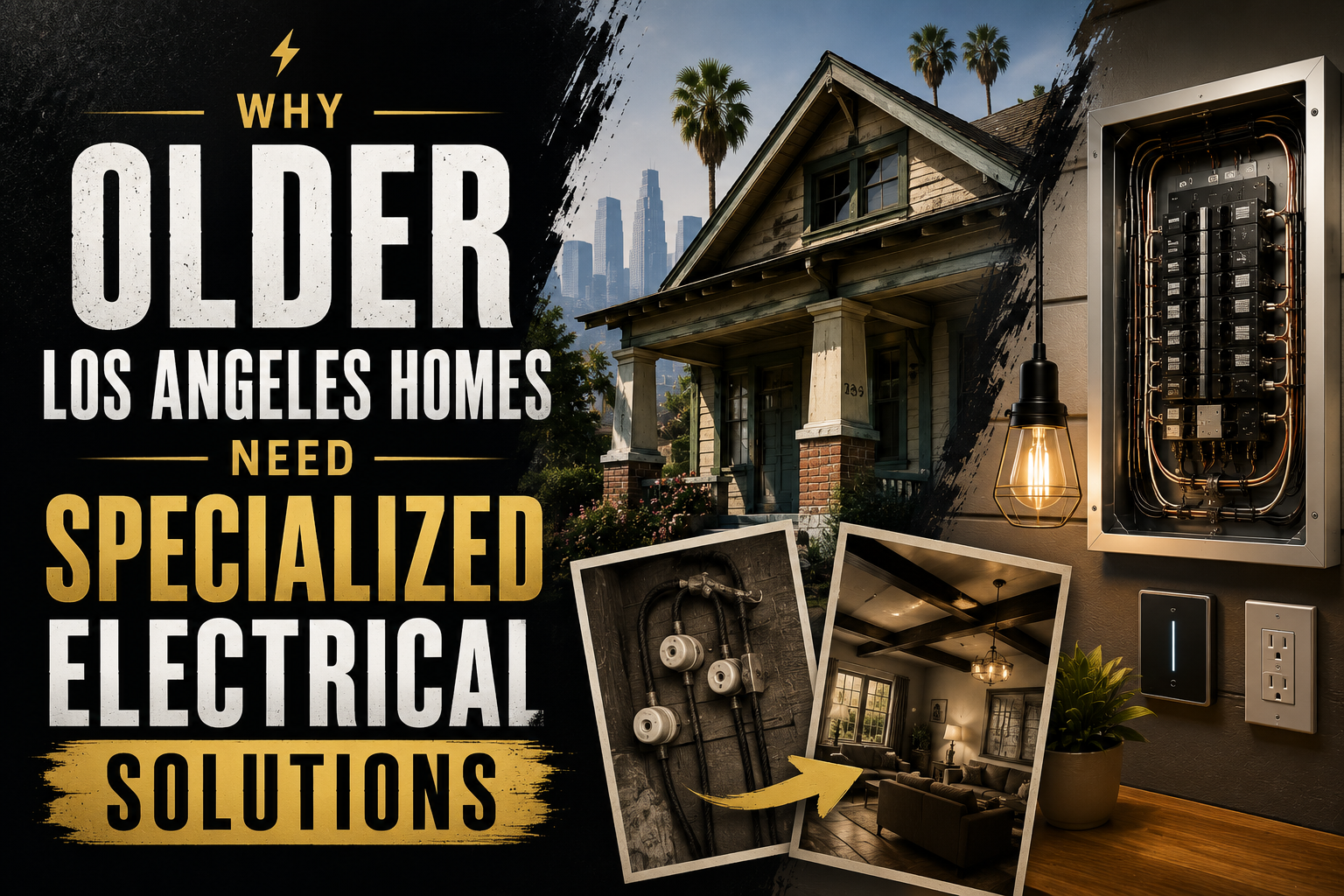
Some of the older, architecturally significant homes in Beverly Hills still have remnants of knob-and-tube wiring or cloth-insulated wiring from early twentieth-century construction. This type of wiring wasn’t designed for modern loads and often lacks a proper ground, creating both a safety issue and a code compliance issue. Wiring and rewiring services that fully modernize these systems tend to be one of the more expensive projects on this list, but they also remove one of the most significant liabilities a historic property can carry.
Where Rewiring Pays Off Fastest
Rewiring delivers its strongest return when it’s paired with other work already opening up walls, such as a kitchen or bathroom remodel. Homeowners who rewire proactively during a renovation avoid the far higher cost of opening walls a second time later. This is one of the clearest examples of sequencing electrical work intelligently rather than tackling it reactively.
EV Charger Installation: A Fast-Growing Value Driver
Few upgrades have shifted from novelty to necessity as quickly as EV charger installation. A few years ago, a home EV charger was a nice-to-have feature. Today, in a market like Beverly Hills where electric vehicle adoption runs well above the national average, buyers actively search for homes with charging infrastructure already installed.
Home EV Charger Installation
A properly installed home EV charger installation includes a dedicated 240-volt circuit sized correctly for the charger, ideally positioned close enough to the panel to minimize wiring costs while still being convenient for daily use. Homes with two or more vehicles increasingly need multiple charging stations, which changes the load calculation and sometimes triggers the need for a panel upgrade at the same time.
Commercial EV Charger Installation
For business owners, commercial EV charger installation carries its own return profile. Retail centers, office parks, and multi-family buildings that install charging stations see measurable increases in tenant retention and customer dwell time, particularly in areas where EV ownership is concentrated. The upfront electrical work, including panel capacity assessment and dedicated circuits for each station, is a meaningful investment, but one that increasingly differentiates a property in a competitive leasing market.
Why EV Charging Ranks High on the ROI List
Unlike some electrical upgrades that primarily protect against risk, EV charger installation actively adds a feature buyers and tenants are willing to pay for. That combination of safety-neutral, value-additive upgrade is relatively rare, which is part of why it consistently ranks near the top of return-on-investment conversations.
Generator Installation: Protecting Against a Growing Risk
Generator installation has moved up the priority list significantly over the past several years, largely due to Public Safety Power Shutoffs during fire season and the broader unpredictability of grid reliability across Los Angeles. A whole-home standby generator with automatic transfer switching keeps essential systems running during an outage without the homeowner needing to do anything manually.
The return here shows up in a few ways. There’s the obvious protection against spoiled food, disrupted work-from-home setups, and uncomfortable temperature swings during an outage. There’s also a growing expectation among buyers in higher-end markets that a home will have backup power, particularly for properties with wine storage, home offices, or medical equipment that depends on consistent electricity. A generator doesn’t just protect against inconvenience. It protects against real financial loss during an extended outage.
GFCI Outlet Installation and Electrical Outlet Upgrades
Compared to a panel upgrade or a generator, GFCI outlet installation looks like a small project, and in terms of cost, it is. But its return on investment is disproportionately high because it’s one of the few electrical upgrades that’s both inexpensive and specifically required by code in kitchens, bathrooms, garages, and outdoor spaces.
Homes without proper GFCI protection in wet locations represent a genuine shock hazard and a common inspection flag during a sale. Electrical outlet installation more broadly, including adding outlets in underserved areas like kitchen islands or home offices, tends to be a low-cost, high-satisfaction upgrade that homeowners notice in daily use far more than they’d expect from such a modest project.
Common Problems That Erode Value and Their Solutions
Certain electrical problems don’t just create risk, they actively erode a home’s value if left unresolved. Recognizing these early changes the entire cost equation.
Overloaded Circuits and Recurring Breaker Trips
When a circuit trips repeatedly, it’s rarely a coincidence. It usually means the circuit is carrying more load than it was designed for, often because rooms have been repurposed over the years without updating the wiring to match. Our electrical troubleshooting process identifies exactly which circuits are overloaded and whether the fix is redistributing load, adding a new circuit, or upgrading the panel entirely.
Warm Outlets and Discolored Switch Plates
A warm outlet or a switch plate with visible discoloration is a sign that heat is building up somewhere it shouldn’t. This is one of the more urgent issues we see, since it often points to a loose connection or an overloaded circuit that’s actively degrading. Left unaddressed, this is exactly the kind of issue that shows up on an inspection report and complicates a sale.
Inconsistent Power to Smart Home Devices
Smart home systems that randomly disconnect or reboot are often blamed on Wi-Fi, when the actual cause is voltage inconsistency somewhere in the electrical system. This is a newer category of problem that didn’t exist a decade ago, and it’s becoming a more common reason homeowners call for electrical repair services.
Benefits of Prioritizing High-ROI Electrical Upgrades
Homeowners who approach electrical upgrades strategically, rather than reactively, tend to see a few consistent benefits. Insurance underwriting becomes smoother, since insurers increasingly ask specific questions about panel age, wiring type, and the presence of safety features like GFCI protection. Home appraisals reflect modern infrastructure more favorably, particularly in competitive markets where buyers compare properties closely. Day-to-day comfort improves as flickering lights, tripped breakers, and inconsistent smart home performance disappear. And perhaps most importantly, the homeowner gains real peace of mind knowing the system behind the walls matches the quality of everything visible in the home.
Cost and Investment Considerations
Pricing for these upgrades varies by scope, but a general hierarchy holds true across most projects. GFCI outlet installation and targeted outlet additions sit at the lower end of the cost spectrum, delivering strong value relative to their price. Panel upgrades and replacements represent a moderate to significant investment depending on amperage and whether sub-panels are involved, but they also unlock nearly every other upgrade on this list. EV charger installation costs depend heavily on the distance from the panel and whether existing capacity supports the new circuit. Generator installation and full home rewiring tend to represent the larger investments on this list, reflecting the scale of labor and materials involved, but both address risks that are expensive to leave unresolved.
The smartest approach for most homeowners is sequencing: address panel capacity first, then layer in rewiring, EV charging, and generator installation as budget allows, rather than trying to tackle everything simultaneously.
Expert Recommendations
Start with a comprehensive electrical assessment before committing to any single upgrade. A licensed electrician Los Angeles homeowners trust should evaluate the whole system, not just the symptom you called about, since panel capacity, wiring condition, and outlet placement are all connected. If you’re planning a renovation, address wiring and panel capacity before the finishing work begins, since opening walls a second time costs far more than doing it once. And if you’re planning to sell within the next few years, prioritize the upgrades most likely to appear on an inspection report, since resolving them proactively almost always costs less than negotiating a price reduction after the fact.
Local Relevance for Beverly Hills
Beverly Hills homes carry a particular mix of factors that make ROI-focused electrical planning especially valuable. The combination of high property values, architecturally diverse housing stock, and buyers who expect move-in-ready infrastructure means electrical upgrades here often deliver a stronger relative return than in markets where buyers are more tolerant of deferred maintenance.
A residential electrician working in this market needs to balance respect for a home’s original architecture with the practical reality that the electrical system underneath needs to support modern living. This same principle extends across the broader region, whether serving as the electrician Westlake Village homeowners call for a hillside property, handling a panel upgrade Pasadena craftsman home needs, managing EV charger installation Santa Monica requests for coastal properties, working as the electrician Glendale community relies on, addressing electrical repair Long Beach properties need after weather events, or serving as the electrician Torrance business owners trust for commercial upgrades. The underlying value equation stays consistent everywhere: the right upgrades, prioritized correctly, protect both safety and property value at the same time.
Future Trends and Industry Insights
The upgrades delivering the highest return today are shifting as technology evolves. Battery backup and energy storage systems are increasingly viewed alongside generators as a resilience investment, particularly when paired with solar inverters or hybrid solar inverters that let a home store its own power rather than relying entirely on the grid. Lithium batteries have become the standard for this kind of storage due to their efficiency and longer lifespan compared to older battery chemistries.
Outdoor electrical infrastructure is also becoming a bigger part of the value conversation, with solar street lights and solar water pumps offering efficient, low-maintenance solutions for larger properties that would otherwise need significant additional circuits run to remote areas of the grounds. As smart panels with circuit-level monitoring become more mainstream, homeowners will increasingly be able to see exactly where their electrical investment is paying off, turning what used to be a hidden system into something measurable and transparent.
Frequently Asked Questions
Which single electrical upgrade delivers the best return on investment?
For most homes, a panel upgrade delivers the strongest return because it unlocks every other improvement, from EV charging to home theater installations, while also resolving the safety and appraisal concerns tied to outdated panels.
Does an electrical panel upgrade actually increase home value?
Yes, particularly when the existing panel is a model with known reliability issues or insufficient amperage for modern use. Buyers and appraisers increasingly view modern electrical infrastructure as a baseline expectation rather than a luxury.
Is EV charger installation worth it if I don’t currently own an electric vehicle?
It depends on your timeline for selling. In markets with high EV adoption, having charging infrastructure already installed can be a meaningful selling point even for buyers who don’t currently own an EV but expect to eventually.
How do I know if my home needs rewiring or just a panel upgrade?
A licensed electrician can inspect your wiring type, condition, and connections to determine whether the panel alone is the limiting factor or whether the wiring itself poses a separate risk that needs addressing.
Are GFCI outlets really necessary if my home has never had an issue?
Yes. GFCI protection isn’t about whether a problem has occurred yet, it’s about preventing the specific type of shock hazard that occurs unpredictably in wet locations, and it’s required by current code in most residential wet areas.
How much value does a generator add to a home?
While it varies by market, a properly installed whole-home generator is increasingly viewed as a resilience feature that appeals to buyers, particularly in areas prone to planned power shutoffs or extreme weather events.
Should I upgrade my panel before or after a kitchen remodel?
Before, ideally. A remodel is the most efficient time to address panel capacity and add dedicated circuits for new appliances, since the walls and connections are already more accessible.
Can I finance electrical upgrades rather than paying upfront?
Many electrical contractors offer financing options for larger projects like panel upgrades or full home rewiring. It’s worth asking about financing during your initial consultation if cost timing is a concern.
Conclusion
Not every electrical project offers the same return, but the highest-value residential electrical upgrades share a common thread: they resolve real risk while simultaneously adding capability the modern home needs. Panel upgrades, thoughtful rewiring, EV charger installation, generator systems, and proper GFCI protection all sit near the top of that list for good reason. As a trusted electrician Los Angeles homeowners in Beverly Hills and beyond have relied on for years, Volta Electric approaches every project with an eye toward long-term value, not just the immediate fix.
Ready to Invest in the Right Electrical Upgrades?
Volta Electric provides licensed electrical contracting services throughout Beverly Hills and greater Los Angeles, including Santa Monica, Pasadena, Glendale, Long Beach, Torrance, and Westlake Village. From panel upgrades and home rewiring to EV charger installation, generator installation, and emergency electrical repair, our team helps homeowners prioritize the upgrades that protect safety and maximize property value. Contact Volta Electric today to schedule a comprehensive electrical assessment tailored to your home and your investment goals.