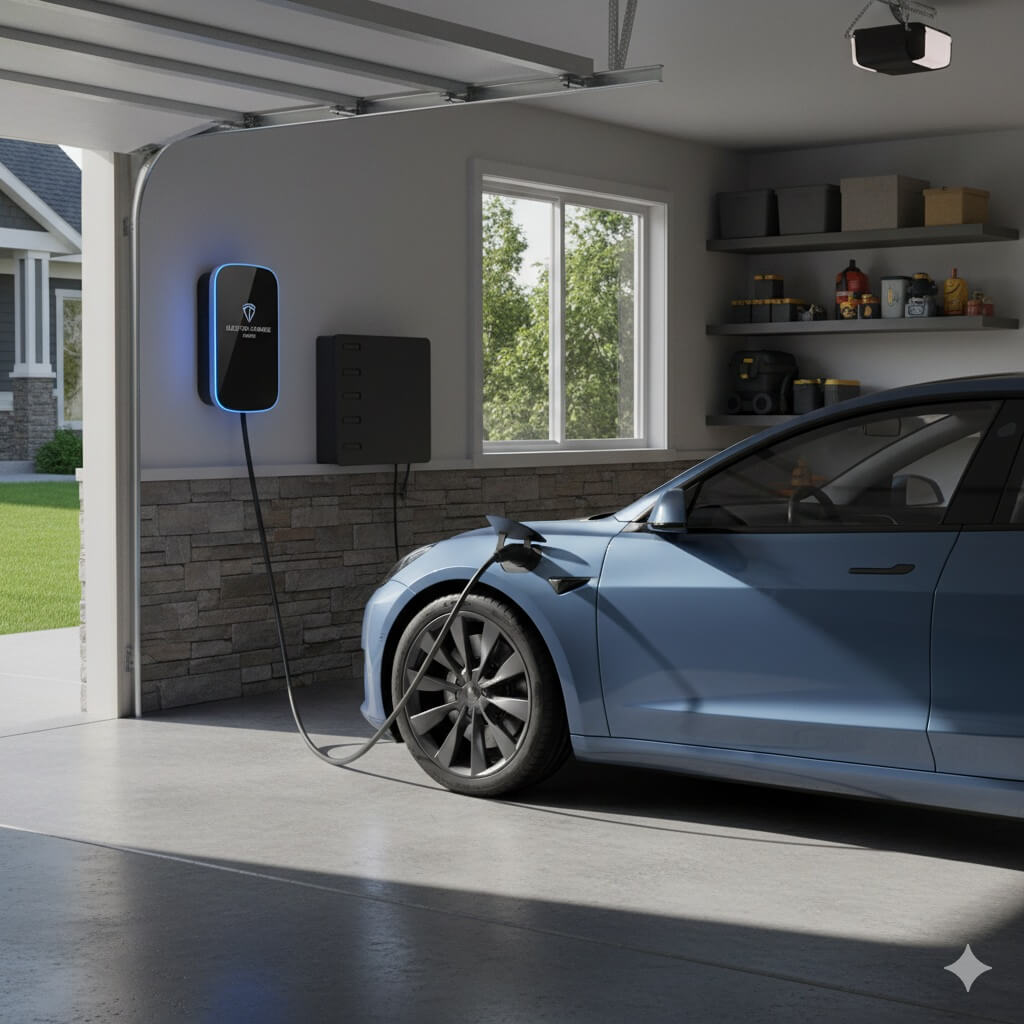
California leads the United States in electric vehicle adoption, with over 1.5 million EVs on the road and ambitious goals to phase out gas-powered vehicle sales by 2035. If you’re among the growing number of Californians in Los Angeles, San Diego, San Francisco, or anywhere across the Golden State preparing to install an EV charger at home, you’re probably wondering: do I need a permit?
The short answer is yes—almost always. But the details matter significantly, affecting your timeline, costs, safety, and even your home’s resale value. At Volta Electric, we handle EV charger permits for homeowners across Los Angeles, Ventura, Orange, Riverside and San Bernardino counties, and we understand the confusion homeowners face when trying to decode permit requirements.
This comprehensive guide will help you understand California’s EV charger permit requirements, why they exist, what the process involves, and how working with experienced professionals makes everything smoother.
Why Permits Are Required for EV Charger Installation
Before diving into specific California requirements, let’s understand why permits exist for electrical work like EV charger installation.
Safety First
A Level 2 home EV charger draws 40-60 amps of power at 240 volts—equivalent to running four electric dryers simultaneously. Improper installation can cause:
- Electrical fires from overloaded circuits
- Electrocution hazards from incorrect wiring
- Property damage from overheating connections
- Carbon monoxide poisoning if installed in enclosed garages without proper ventilation considerations
Permits ensure licensed electricians perform installations according to the National Electrical Code (NEC) and California Electrical Code, protecting you, your family, and your property.
Legal Compliance
California law requires permits for virtually all electrical work involving new circuits, which includes EV charger installation. Skipping permits can result in:
- Fines from $500 to $5,000+ depending on jurisdiction
- Mandatory removal of unpermitted installations
- Difficulty selling your home (title companies often require permit records)
- Insurance claim denials if electrical issues cause fires or damage
- Liability exposure if someone is injured
Code Compliance
Building codes exist for good reasons. The California Electrical Code (based on NEC with California amendments) specifies requirements for:
- Wire gauge based on amperage and distance
- Circuit breaker specifications
- GFCI protection
- Grounding and bonding
- Proper electrical panel capacity
- Installation location restrictions
Permits ensure compliance with these critical safety standards.
Utility Rebates and Tax Credits
Many California utilities and government programs offer rebates and incentives for EV charger installation. Most require:
- Proof of permitted installation
- Inspection certificates
- Documentation that work was performed by licensed electricians
Skipping permits means forfeiting potentially significant financial benefits. The ev charger installation cost can be partially offset by these incentives—but only with proper permits.
California’s Statewide EV Charger Requirements
California has specific statewide requirements affecting EV charger installation, beyond general electrical code:

AB 2565 – Streamlined Permitting
Assembly Bill 2565, effective January 2015, requires California cities and counties to adopt streamlined, expedited permitting processes for EV charging stations. This means:
- Applications must be processed within specified timeframes
- Checklists must be provided for permit applications
- Electronic or online submission must be available in most jurisdictions
- Fees must be reasonable and clearly disclosed
This legislation was designed to make home ev charger installation faster and more predictable across California.
California Electric Vehicle Charging Infrastructure Standards
The California Building Standards Commission has established specific requirements including:
- Minimum circuit capacity specifications
- Dedicated circuit requirements
- Proper labeling and documentation
- Accessibility considerations for multi-family dwellings
- Future EV-ready specifications for new construction
California Green Building Standards (CALGreen)
New residential construction and major renovations must include EV charging infrastructure or conduit for future installation. While this primarily affects builders, it demonstrates California’s commitment to EV infrastructure.
Do You Need a Permit in Major California Cities?
Let’s examine specific permit requirements in California’s largest metropolitan areas:
Los Angeles
Permit Required: Yes, always
Los Angeles requires permits for all EV charger installations involving electrical work. The Los Angeles Department of Building and Safety (LADBS) processes these permits through their online system.
Requirements:
- Building permit application
- Electrical plans and specifications
- Load calculation showing adequate panel capacity
- Licensed contractor (C-10 electrical license)
- Inspection after installation
Timeline: Typically 2-5 business days for permit approval with expedited EV charger processing
Fees: $200-$500 depending on project scope and home value
Los Angeles has embraced expedited permitting under AB 2565, making the process relatively straightforward for licensed electricians familiar with the system.
San Diego
Permit Required: Yes, always
San Diego’s Development Services Department handles EV charger permits with a streamlined online process.
Requirements:
- Online permit application through ProjectDox
- Site plan showing charger location
- Single-line electrical diagram
- Manufacturer specifications for charger
- C-10 licensed contractor
Timeline: 1-3 business days for standard installations
Fees: $150-$400 depending on installation complexity
San Diego is particularly EV-friendly, with efficient permit processing and helpful staff familiar with home ev charger installation requirements.
San Francisco
Permit Required: Yes, always
The San Francisco Department of Building Inspection (DBI) requires permits for all EV charger installations.
Requirements:
- Building permit application (Form 3 or Form 8)
- Electrical plans
- Manufacturer cut sheets
- Energy compliance documentation (may be required)
- Licensed electrician (C-10 license)
Timeline: 2-7 business days depending on application completeness
Fees: $250-$600 depending on scope and home value
San Francisco has higher costs but efficient processing. The city strongly supports EV adoption and has dedicated staff familiar with EV infrastructure permitting.
San Jose
Permit Required: Yes, always
San Jose requires permits through their online portal with expedited EV charger processing.
Requirements:
- Online permit application
- Electrical diagram
- Site plan
- Product specifications
- C-10 licensed contractor
Timeline: 1-3 business days for approval
Fees: $150-$350 for typical installations
San Jose offers one of California’s most efficient permit processes for EV chargers, reflecting Silicon Valley’s embrace of electric vehicle technology.
Sacramento
Permit Required: Yes, always
California’s capital requires permits for all EV charger installations through the Sacramento Community Development Department.
Requirements:
- Building permit application
- Electrical plans
- Load calculation
- C-10 licensed contractor
- Inspection upon completion
Timeline: 2-5 business days
Fees: $150-$400
Sacramento follows state guidelines closely and has streamlined processes for residential EV charger permits.
Fresno, Long Beach, Oakland, Bakersfield, Anaheim, and Other California Cities
All California cities and counties require permits for EV charger installation. While specific requirements and fees vary, the general framework is consistent:
- Permit application with electrical plans
- Licensed C-10 contractor
- Inspection after installation
- Fees ranging from $100-$600
- Processing times from 1-7 business days
What the Permit Process Involves
Understanding the permit process helps set realistic expectations for your EV charger installation timeline:
Step 1: Initial Assessment
A licensed electrician from Volta Electric visits your home to:
- Evaluate your electrical panel capacity
- Determine if panel upgrade is needed
- Identify optimal charger location
- Assess wiring route from panel to charger
- Calculate electrical load requirements
Step 2: Permit Application
Your electrician prepares and submits permit applications including:
- Electrical plans and diagrams
- Load calculations
- Equipment specifications
- Site plans
- Contractor license information
Most California jurisdictions now accept online submissions, significantly speeding the process.
Step 3: Permit Approval
Building departments review applications for:
- Code compliance
- Adequate electrical capacity
- Proper equipment specifications
- Complete documentation
Approval typically takes 1-7 business days in most California cities, though complex installations may take longer.
Step 4: Installation
Once permitted, licensed electricians perform the installation:
- Install appropriate circuit breaker in panel
- Run properly sized wire from panel to charger location
- Install mounting hardware and charger unit
- Connect and test the system
- Ensure all work meets code requirements
Professional installation typically takes 4-8 hours depending on complexity and distance from the electrical panel.
Step 5: Inspection
After installation, a building inspector verifies:
- Proper wire gauge and routing
- Correct circuit breaker installation
- Adequate panel capacity
- Proper grounding and bonding
- GFCI protection if required
- Appropriate mounting and location
- Code compliance throughout
Inspections are typically scheduled within 2-5 days of completion.
Step 6: Final Approval
Once inspection passes, the building department issues final approval, and you receive documentation that:
- Installation is legal and code-compliant
- Work was performed by licensed professionals
- Your home has increased value with permitted improvements
This documentation is crucial for home sales, insurance purposes, and utility rebates.
What If Your Electrical Panel Needs Upgrading?
Many California homes, particularly those built before 1990, have 100-amp or even 60-amp electrical service. A typical Level 2 EV charger requires 40-60 amps of dedicated capacity. If your panel lacks adequate capacity, you’ll need an electrical panel upgrade before installing your EV charger.
Combined Permits
Panel upgrades require separate building permits in most California jurisdictions. However, smart homeowners coordinate both projects:
- Single permit application covering both panel upgrade and EV charger
- One set of inspections
- Coordinated work reducing overall timeline
- Often lower combined costs than separate projects
The ev charger installation cost increases when panel upgrades are necessary, typically adding $2,000-$5,000 to your project budget. However, this investment:
- Ensures safe operation of your EV charger
- Increases your home’s electrical capacity for all uses
- Adds value to your property
- May be required for code compliance anyway
At Volta Electric, we handle combined permit applications across Los Angeles, Ventura, Orange, Riverside and San Bernardino counties, ensuring seamless coordination between panel upgrades and EV charger installation.
Can You Install an EV Charger Without a Permit?
Technically, could you install an EV charger without obtaining proper permits? Yes. Should you? Absolutely not.
The Risks Are Severe
Installing without permits exposes you to:
Financial Penalties: California jurisdictions actively enforce building codes. If unpermitted work is discovered (during home sale, insurance claim, or complaint investigation), you’ll face:
- Fines starting at $500 and often exceeding $5,000
- Mandatory removal of unpermitted installations
- Costs to properly permit and re-inspect (paying twice for the same work)
- Potential criminal charges in egregious cases
Home Sale Complications: When selling your home, buyers’ lenders often require:
- Permits for all electrical work
- Proof that work passed inspection
- Documentation that licensed contractors performed work
Unpermitted EV chargers can:
- Kill sales entirely
- Force price reductions
- Delay closings while permits are obtained retroactively
- Reduce your home’s appraised value
Insurance Denials: If an electrical fire occurs and investigators discover unpermitted work, insurance companies may:
- Deny your entire claim (not just EV charger-related portions)
- Drop your coverage
- Report you to other insurers, making future coverage difficult or expensive
Safety Hazards: The most critical risk is safety. Without proper permitting and inspection:
- Undersized wiring can overheat and cause fires
- Incorrect installation creates electrocution hazards
- Inadequate panel capacity leads to dangerous overloads
- Code violations create risks to you, your family, and neighbors
The few hundred dollars saved by skipping permits can cost hundreds of thousands in damages, legal issues, and tragic consequences.
Working with Licensed Electricians: The Smart Approach
California law requires that only licensed C-10 electrical contractors perform EV charger installations. This isn’t arbitrary—it’s essential protection.
What C-10 License Means
California’s C-10 electrical contractor license requires:
- Four years of journey-level electrical experience
- Comprehensive examination covering:
- Electrical theory and calculations
- National Electrical Code
- California Electrical Code
- Safety practices
- Business and law
- Continuing education to maintain licensure
- Bond and insurance requirements
When you hire Volta Electric or another licensed C-10 contractor, you’re getting expertise that ensures safe, code-compliant installations.
Why DIY EV Charger Installation Isn’t Legal or Safe
Some homeowners consider DIY installation to save money on ev charger installation cost. This is illegal in California for several reasons:
- State law requires licensed contractors for work requiring permits
- You cannot pull permits for your own electrical work (unlike some other trades)
- EV charger installation involves complex electrical calculations and safety considerations beyond typical homeowner knowledge
- Insurance and liability protections don’t apply to DIY electrical work
Even if you have electrical knowledge, attempting DIY EV charger installation in California is illegal, dangerous, and financially risky.
EV Charger Installation Costs in California
Understanding the complete picture helps you budget appropriately:
Typical Costs for Home EV Charger Installation:
Basic Installation (Adequate Panel Capacity, Close to Panel):
- EV charger unit: $400-$800 (Level 2, 40-amp)
- Installation labor: $800-$1,500
- Permit fees: $150-$500
- Total: $1,350-$2,800
Standard Installation (Adequate Panel, Moderate Distance):
- EV charger unit: $500-$1,000
- Installation labor: $1,200-$2,000
- Materials (wire, conduit, mounting): $300-$600
- Permit fees: $200-$500
- Total: $2,200-$4,100
Complex Installation (Panel Upgrade Required):
- EV charger unit: $500-$1,000
- Panel upgrade (100-amp to 200-amp): $2,500-$5,000
- EV charger circuit installation: $1,000-$2,000
- Permit fees (panel + charger): $400-$800
- Total: $4,400-$8,800
Cost Factors in California:
- Higher labor rates in San Francisco, Los Angeles, San Diego (versus Fresno or Bakersfield)
- Permit fees vary significantly by jurisdiction
- Installation complexity (distance, obstacles, conduit requirements)
- Panel upgrade necessity
- Charger amperage (50-60 amp chargers cost more than 32-40 amp models)
Offsetting Costs with Incentives:
California offers numerous rebates and incentives:
- Federal tax credit: not available for chargers placed in service after June 30, 2026
- California Clean Vehicle Rebate Project (CVRP): Varies by utility and income
- Local utility rebates: $500-$1,500 in many service territories
- Workplace charging programs for eligible homeowners
These incentives can reduce your net ev charger installation cost significantly—but only with proper permits and documentation.
Special Considerations for Multi-Family Dwellings
California has specific laws protecting residents’ rights to install EV chargers in apartments, condominiums, and townhomes:
AB 2565 and Civil Code Section 4745
Homeowners associations (HOAs) and landlords cannot unreasonably restrict EV charger installation. However, they can require:
- Proper permits and licensed installation
- Adherence to CC&Rs regarding appearance and location
- Proof of adequate insurance
- Compliance with building electrical capacity
Shared Electrical Infrastructure
Multi-family installations often require:
- Assessment of building electrical capacity
- Load management systems for multiple chargers
- Coordination with property management
- Potentially more complex permitting
Volta Electric works on multi-family EV charger installations across our five Southern California counties, working with HOAs, property managers, and building departments to ensure compliant installations.
Common Permit-Related Questions
Q: How long does the permit process take in California?
A: With expedited EV charger permitting under AB 2565, most California jurisdictions approve permits within 1-7 business days. Cities like San Diego and San Jose often approve in 1-3 days, while larger jurisdictions like Los Angeles typically take 2-5 days.
Q: Can I start installation before permit approval?
A: No. Beginning work before permit approval is illegal and can result in stop-work orders, fines, and mandatory removal of all work completed.
Q: What if my installation fails inspection?
A: Licensed electricians like those at Volta Electric rarely fail inspections because we know exactly what inspectors require. If corrections are needed, we make them promptly and schedule re-inspection at no additional charge to you.
Q: Do I need to be present for the inspection?
A: Typically no. Inspectors need access to your electrical panel and the charger location, which your electrician coordinates. Many homeowners prefer to be present but it’s not required.
Q: What documents should I keep after installation?
A: Maintain copies of:
- Permit application and approval
- Final inspection approval
- Installation invoice and receipts
- Product warranties and manuals
- Electrical diagrams
These documents are crucial for home sales, insurance purposes, and claiming rebates or tax credits.
Q: Can permits be obtained retroactively if I already installed without one?
A: Sometimes, but it’s complicated and expensive. You’ll likely need to:
- Apply for permits (with penalties)
- Possibly remove and reinstall components for inspection access
- Pay elevated permit fees
- Risk failed inspection requiring professional correction
- Face possible fines
It’s always better to obtain permits before installation.
The Volta Electric Advantage
At Volta Electric, we’ve streamlined the EV charger permit process for California homeowners. When you work with us, you get:
Complete Permit Management
We handle everything:
- Permit applications and submissions
- All required documentation and plans
- Communication with building departments
- Inspection scheduling and coordination
- Final approval documentation
You don’t have to navigate confusing building department requirements—we do it for you.
Licensed, Insured Professionals
Our C-10 licensed electricians install EV chargers across Los Angeles, Ventura, Orange, Riverside and San Bernardino counties. We know what the local building departments in our area look for at inspection.
Transparent Pricing
We provide detailed written estimates including:
- Equipment costs
- Labor
- Permit fees
- Any necessary panel upgrades
- Timeline expectations
No surprises, no hidden fees.
Code Compliance Guarantee
Our installations meet or exceed:
- National Electrical Code requirements
- California Electrical Code standards
- Local jurisdiction amendments
- Manufacturer specifications
We stand behind our work with a 2-year labor warranty.
Ready to Install Your EV Charger the Right Way?
Don’t let permit concerns delay your transition to electric vehicle ownership. With Volta Electric, the permit process is straightforward, efficient, and completely managed for you.
If you live in Los Angeles, Ventura, Orange, Riverside or San Bernardino County, we’re your trusted partner for permitted, professional home ev charger installation.
Contact Volta Electric today for:
- Free home electrical assessment
- Detailed installation quote including permits
- Expert guidance on charger selection
- Information about available rebates and incentives
- Professional installation with full permit compliance
Make the switch to electric vehicle charging at home—safely, legally, and professionally. Call Volta Electric now for your free consultation.
Volta Electric is a fully licensed (C-10) and insured electrical contractor serving residential and commercial clients throughout California. Our experienced electricians specialize in permitted, code-compliant EV charger installation, electrical panel upgrades, and comprehensive electrical services. We’re committed to making your transition to electric vehicle ownership smooth, safe, and hassle-free.