That Tripping Breaker Is Not the Problem. It Is the Messenger.
Most homeowners treat a tripping circuit breaker the way they treat a warning light on a car dashboard — as an inconvenience to be cleared rather than a message to be understood. You walk to the panel, flip the breaker back to the on position, and return to whatever you were doing. If it trips again, you flip it again. If it keeps tripping, you learn to manage around it — avoid running the microwave and the toaster at the same time, don’t use the hair dryer in that bathroom while someone is watching television, unplug the space heater before turning on anything else in the room.
This is an entirely understandable response. It is also, in many cases, a genuinely dangerous one.
A circuit breaker that trips is not malfunctioning. It is functioning exactly as designed. Its entire purpose is to interrupt current flow when a circuit is carrying more amperage than it can safely handle — to stop a dangerous condition before it becomes a catastrophic one. When you reset a tripping breaker without identifying and resolving the condition that caused it to trip, you are not fixing the problem. You are silencing the alarm while the condition that triggered it continues.
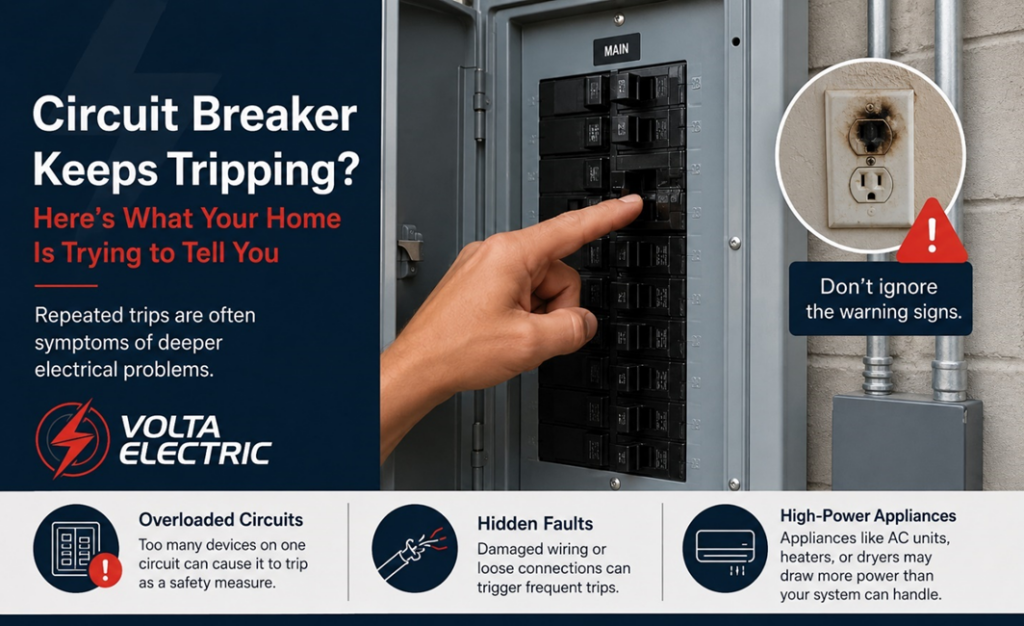
The conditions that cause circuit breakers to trip repeatedly range from the straightforward and easily resolved — too many devices on a single circuit — to the serious and potentially dangerous — a fault in the wiring, a failing breaker, a panel operating dangerously above its capacity. The breaker itself cannot tell you which category applies. That distinction requires understanding what is actually happening in your electrical system and why — which is what this guide is designed to help you do.
At Volta Electric Inc., we diagnose and resolve electrical problems throughout San Fernando, Arcadia, Santa Clarita, Westlake Village, and across Los Angeles County. The patterns we see in homes with repeatedly tripping breakers are consistent enough that a clear diagnostic framework is possible — one that helps homeowners understand what their home is communicating and what response each scenario actually requires.
How a Circuit Breaker Works: The Foundation You Need
Before examining why breakers trip, a brief explanation of how they work makes the diagnostic framework that follows more intuitive.
A circuit breaker is a mechanically operated switch that serves two functions simultaneously. In normal operation, it is simply a switch — current flows through it from the panel’s bus bar to the circuit’s wiring and onward to the devices on that circuit. Its second function activates when the current flowing through it exceeds its rated amperage threshold: a bimetallic strip inside the breaker heats up under the excess current, bends, and mechanically trips the switch to the off position, interrupting current flow.
The amperage rating stamped on a breaker — 15 amps, 20 amps, 30 amps, 50 amps — defines the threshold at which this mechanism activates. A 15-amp breaker trips when current exceeds 15 amps on that circuit. A 20-amp breaker trips at 20 amps. The rating corresponds to the ampacity — the current-carrying capacity — of the wiring on that circuit. A 15-amp circuit is wired with 14-gauge conductors that can safely carry 15 amps continuously. A 20-amp circuit uses 12-gauge conductors rated for 20 amps.
This matching of breaker rating to wire gauge is the core of circuit overcurrent protection. The breaker trips before the wiring reaches temperatures that damage insulation and create fire risk. When something causes the system to trip repeatedly, it means something is repeatedly pushing current on that circuit above its safe threshold — and understanding what that something is determines everything about how you respond.
The Three Root Causes of Repeated Breaker Trips
Virtually every case of a repeatedly tripping circuit breaker traces back to one of three root causes. Distinguishing between them is the essential first step in moving from symptom management to actual resolution.
Root Cause One: Circuit Overload
Circuit overload is the most common cause of breaker trips and the most straightforward to understand. It occurs when the devices connected to a circuit collectively draw more current than the circuit was designed to carry. The breaker detects the excess current and trips to prevent the wiring from overheating.
A standard 15-amp household circuit can deliver approximately 1,800 watts of continuous power — 15 amps multiplied by 120 volts. A 20-amp circuit delivers approximately 2,400 watts. These numbers sound generous until you start adding up the actual wattage of the devices sharing a circuit in a modern home.
A microwave oven draws 1,000 to 1,500 watts during operation. A toaster draws 800 to 1,200 watts. A coffee maker draws 800 to 1,200 watts. A hair dryer draws 1,200 to 1,875 watts. A space heater draws 1,500 watts. Any combination of two of these devices operating simultaneously on a 15-amp circuit will trip the breaker — not because anything is wrong with the circuit or the devices, but because the combined demand genuinely exceeds what a 15-amp circuit can safely deliver.
In older Los Angeles County homes — where kitchens were sometimes wired with a single 15-amp circuit serving all countertop outlets, and where bedrooms share circuits in ways that modern code requirements have addressed but historical construction did not — overload is a persistent and recurring problem that reflects a mismatch between the electrical infrastructure and the way the home is actually used.
The diagnostic indicator for circuit overload is timing. An overloaded circuit trips when demand spikes — when you run two high-draw appliances simultaneously, when a large motor-driven device starts under load. The trip is predictable and reproducible. Remove one of the high-draw devices from the circuit and the trip stops occurring. That predictability distinguishes overload from the other causes, which tend to produce less predictable trip patterns.
The solution to circuit overload depends on severity. Mild overload that occurs only when specific combinations of devices are used simultaneously can sometimes be managed behaviorally — running the microwave and the toaster at separate times, for instance. Persistent overload that reflects a fundamental mismatch between circuit capacity and actual usage requires either adding a dedicated circuit for the high-draw devices or upgrading the circuit from 15 to 20 amps where the wiring supports it. A licensed electrician can evaluate which approach is appropriate for your specific situation.
Root Cause Two: Short Circuit
A short circuit is a more serious condition than an overload, and it produces a more dramatic trip response. Where an overload builds gradually as devices draw more current than the circuit rating, a short circuit produces an instantaneous massive surge of current — enough to trip the breaker immediately and forcefully, often with an audible pop.
A short circuit occurs when a hot conductor — a wire carrying current — makes direct contact with either a neutral conductor or a ground conductor, creating a path of essentially zero resistance. In a normal circuit, current flows through the relatively high resistance of the connected devices and returns to the panel through the neutral wire. In a short circuit, current bypasses that resistance entirely and flows directly between conductors. The result is a current surge that far exceeds the breaker’s rating and trips it essentially instantaneously.
Short circuits have several common causes. Damaged insulation — wiring whose protective covering has been worn, pinched, crushed, or degraded by age — allows conductors to contact each other or contact metal components that they shouldn’t touch. A loose wire connection at an outlet, switch, or junction box that allows the conductor to move and make unintended contact. A failed device — an appliance or fixture with internal wiring damage — that creates a short circuit when connected to the circuit.
The diagnostic indicator for a short circuit is its instantaneous, forceful character. A breaker that trips the moment a specific device is plugged in, or that trips with a pop before any load has built up on the circuit, is responding to a short circuit rather than an overload. The trip is immediate and total — there is no gradual buildup that gives you time to notice increasing demand.
Short circuits require professional diagnosis and repair. The fault location needs to be identified — which could be in the wiring itself, at a connection point, or in a device — and corrected before the circuit is returned to service. Repeatedly resetting a breaker that is responding to a short circuit is both futile and dangerous.
Root Cause Three: Ground Fault
A ground fault is related to a short circuit but distinct from it in a way that matters both diagnostically and in terms of the hazard it creates. Where a short circuit involves an unintended connection between two circuit conductors, a ground fault involves an unintended connection between a hot conductor and a grounded surface — a metal enclosure, a water pipe, a wet surface, or a person.
Ground faults are the electrical hazard that GFCI protection is specifically designed to address. A standard circuit breaker trips when current exceeds its amperage rating — a threshold of 15 or 20 amps. But the amount of current required to cause cardiac arrest is as little as 100 milliamps — one tenth of one amp, far below the trip threshold of any standard breaker. A ground fault that routes current through a person creates a lethal hazard without ever approaching the trip threshold of a standard breaker.
GFCI protection addresses this by monitoring the balance between current leaving the circuit on the hot conductor and returning on the neutral. In a healthy circuit, these values are equal. When a ground fault creates a path for current to return through something other than the neutral conductor — through a person, through a grounded surface — the GFCI detects the imbalance as small as 5 milliamps and trips within milliseconds.
When a standard circuit breaker trips repeatedly in areas where ground faults are plausible — bathrooms, kitchens, garages, outdoor circuits, anywhere with potential moisture exposure — the possibility of a ground fault condition warrants investigation. The appropriate response involves both understanding the ground fault risk and upgrading the circuit’s protection to GFCI capability if it doesn’t already have it.
Specific Scenarios: What Is Happening in Your Home
The Kitchen Breaker That Trips When You Cook
This is one of the most common trip scenarios in older Los Angeles County homes. The kitchen circuit — or in some cases a single circuit serving multiple kitchen outlets — simply lacks the capacity to support simultaneous operation of the appliances that modern cooking requires.
Current electrical code requires kitchen countertop circuits to be 20-amp dedicated circuits, with at least two such circuits serving the countertop area. Older kitchens frequently have a single 15-amp circuit serving all countertop outlets. Running a microwave, a coffee maker, and an electric kettle simultaneously on a 15-amp circuit is a reliable recipe for a trip.
The correct resolution is adding dedicated circuits for the highest-draw appliances — a dedicated circuit for the microwave, a dedicated circuit for the refrigerator if it shares the countertop circuit, and sufficient countertop circuit capacity to support the kitchen’s actual usage. This is a permitted electrical project that Volta Electric Inc. performs throughout its service area as part of kitchen renovation work and as a standalone electrical upgrade.
The Bedroom Breaker That Trips at Night
A bedroom breaker that trips consistently in the evening — when space heaters, electric blankets, and multiple device chargers are in simultaneous use — is a classic overload scenario. Bedrooms in older homes frequently share circuits, sometimes with other bedrooms or with hallway lighting, in configurations that pre-date modern code requirements for dedicated bedroom circuits.
The additional concern in a bedroom breaker that trips is arc fault protection. Current NEC requirements mandate AFCI breakers in bedroom circuits — protection that detects the kind of low-level arcing that occurs in damaged or improperly connected wiring and that standard breakers cannot detect. A bedroom circuit that is both overloaded and lacking AFCI protection is an opportunity to address both issues simultaneously with an AFCI breaker upgrade and circuit addition.
The Bathroom Breaker That Trips When Using Appliances
Hair dryers, curling irons, and electric shavers draw significant current, and bathrooms are moisture-prone environments where ground fault risk is genuinely elevated. A bathroom breaker that trips when high-draw grooming appliances are in use may be responding to simple overload — particularly if the bathroom circuit is shared with other loads — or to a ground fault condition created by moisture exposure.
Bathroom circuits require GFCI protection under current code, and older bathrooms frequently lack it. A GFCI outlet installation or GFCI breaker upgrade addresses both the ground fault protection gap and provides an additional layer of protection for the circuit. Where the trip pattern suggests overload rather than ground fault, a dedicated circuit for the bathroom resolves the capacity issue.
The Breaker That Trips for No Obvious Reason
A breaker that trips without any apparent trigger — not when a specific appliance is in use, not when demand spikes, not when anything has visibly changed — is the scenario that warrants the most immediate professional attention. Random, untriggered trips suggest either a failing breaker or a wiring fault that is developing somewhere on the circuit.
A failing breaker trips at current levels below its rated threshold — the bimetallic mechanism has degraded to the point where it responds to normal operating current rather than only to genuine overcurrent events. This failure mode is not dangerous in itself, but it masks the circuit’s true protection status. A breaker that trips at 8 amps when it’s rated for 15 amps is not providing 15-amp protection — it is providing unpredictable, unreliable protection that may or may not respond correctly to a genuine fault condition.
A wiring fault that develops intermittently — a loose connection that makes and breaks contact with thermal cycling, insulation that contacts a grounded surface only when a circuit path heats up — creates unpredictable trip patterns that are difficult to reproduce and therefore difficult to self-diagnose. Professional inspection with the right tools — including thermal imaging to identify hot spots in wiring and connections that are invisible to visual inspection — is the appropriate diagnostic approach.
The Main Breaker That Trips
A main breaker trip is categorically more serious than a branch circuit breaker trip. The main breaker protects the entire electrical system of the home — it trips when total current demand across all circuits exceeds the service rating of the panel. A main breaker that trips indicates either that total household load has genuinely exceeded the panel’s service capacity, or that the main breaker itself is failing.
Either scenario requires professional evaluation rather than a reset-and-monitor approach. A panel operating above its service capacity creates conditions throughout the system that affect every circuit simultaneously. A failing main breaker means the entire home’s overcurrent protection may be unreliable. In either case, the appropriate response is a call to a licensed electrician rather than a repeated reset.
When a Tripping Breaker Means You Need a Panel Upgrade
Not every tripping breaker points to a panel upgrade — some are resolved with circuit additions, device changes, or breaker replacement. But there are specific patterns that consistently indicate the panel itself is the limiting factor rather than any individual circuit.
Multiple circuits tripping under normal loads — not a single circuit overloaded by a specific appliance combination, but several circuits showing trip patterns simultaneously — suggests that the panel is operating at or near its total capacity ceiling and that load is being distributed across circuits in ways that push individual breakers beyond their thresholds.
A panel that lacks available positions for new circuits — where every breaker slot is occupied and adding the dedicated circuits that would resolve individual overload conditions is physically impossible — has reached its architectural limit and needs to be replaced with a panel that provides the capacity and positions the home requires.
An aging panel that is approaching or past its expected service life, showing signs of wear on the breakers, or belonging to a problem brand category, warrants replacement that addresses both the immediate trip issues and the long-term safety concerns simultaneously.
Volta Electric Inc. performs electrical panel upgrades throughout Los Angeles County — 200-amp service upgrades that provide the capacity, the breaker positions, and the modern hardware that a contemporary home’s electrical demands require. Where a panel assessment reveals that an upgrade is the appropriate solution rather than individual circuit work, we provide a clear explanation of why and a free estimate for the work involved.
What Never to Do When a Breaker Keeps Tripping
This section warrants directness because the workarounds that homeowners apply to repeatedly tripping breakers are among the most dangerous electrical practices that licensed electricians encounter.
Never replace a breaker with one of a higher amperage rating to stop it from tripping. The breaker’s amperage rating corresponds to the ampacity of the circuit’s wiring. A 15-amp circuit is wired with 14-gauge conductors that can safely carry 15 amps. Installing a 20-amp or 30-amp breaker on that circuit does not upgrade the circuit — it simply removes the protection that was stopping the wiring from overheating. The wiring will now carry whatever current the connected devices demand, up to and including current levels that generate enough heat to ignite surrounding materials.
Never use tape, a coin, or any other means to hold a tripped breaker in the on position. A breaker that wants to trip is responding to a condition that creates genuine risk. Forcing it to remain on while that condition persists is forcing your electrical system to operate in a fault state without protection.
Never ignore a breaker that trips repeatedly because the circuit seems to work fine after reset. The reset restores normal operation temporarily. It does not resolve the condition that caused the trip. That condition is still there, still developing, and still representing a risk that will eventually manifest in a way that a breaker reset cannot address.
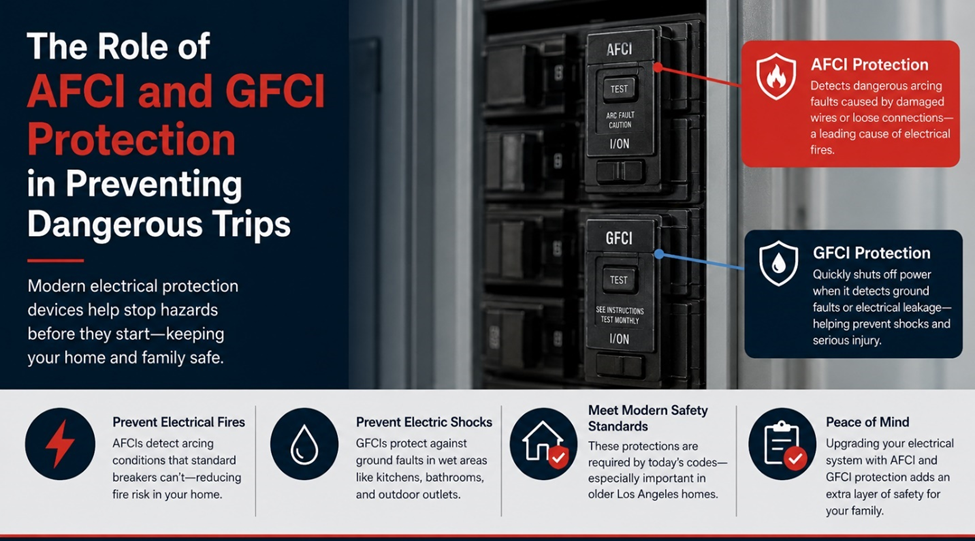
The Role of AFCI and GFCI Protection in Preventing Dangerous Trips
Modern electrical safety devices provide fault detection capabilities that standard breakers cannot, and understanding their role clarifies why some trip scenarios call for protection upgrades rather than just capacity solutions.
AFCI (Arc Fault Circuit Interrupter) breakers detect the distinctive electrical signature of arc faults — the intermittent, high-energy discharges that occur when wiring is damaged, connections are loose, or insulation has deteriorated. Arc faults are a leading cause of residential electrical fires precisely because they do not draw enough current to trip a standard breaker but generate enough localized heat to ignite surrounding materials. A circuit that trips unexpectedly without an apparent overload condition may be experiencing arc fault events that an AFCI breaker would detect and interrupt safely.
GFCI (Ground Fault Circuit Interrupter) protection, as discussed earlier, detects the current imbalance that indicates a ground fault — current escaping the circuit through an unintended path. In addition to protecting against shock hazard, GFCI protection trips faster and at lower fault current levels than standard breakers, making it more responsive to certain fault conditions. A circuit in a moisture-prone area that trips unexpectedly may benefit from GFCI protection that can detect and respond to moisture-related ground faults more sensitively than the existing standard breaker.
Volta Electric Inc. installs AFCI and GFCI protection throughout Los Angeles County as part of panel upgrades, circuit additions, and standalone safety upgrades for older homes that lack these protections in areas where current code requires them.
Frequently Asked Questions
How many times is it safe to reset a tripping breaker before calling an electrician?
If a breaker trips once under an obvious overload condition — you were running too many appliances simultaneously — resetting it once after reducing the load is reasonable. If it trips again after reset without an obvious overload condition, or if it trips repeatedly under the same normal operating conditions that it handled without tripping previously, that pattern warrants a professional diagnosis rather than continued resets. There is no safe number of resets for a breaker responding to a fault condition rather than a one-time overload.
Can a tripping breaker cause a fire?
A breaker that is tripping correctly — responding to overcurrent or fault conditions and successfully interrupting current flow — is preventing fire risk rather than creating it. The fire risk comes from the conditions that cause the trip: overloaded wiring generating heat, arc faults creating localized ignition risk, and short circuits producing high-energy discharge. The additional fire risk comes from bypassing or repeatedly overriding a tripping breaker, which allows those conditions to persist without the protection the breaker is trying to provide.
Why does my breaker trip at night even when I’m not using many appliances?
Nighttime trips without heavy appliance use suggest either a failing breaker tripping below its rated threshold, a developing wiring fault that manifests under specific thermal conditions, or a device left on overnight — a space heater, a device charger, an appliance in standby — that is drawing more current than expected. A licensed electrician can measure the actual current on the circuit during normal nighttime operation and identify whether the trip is a protection response to a genuine condition or a failing breaker responding incorrectly.
Is it normal for a new breaker to trip more frequently than the old one?
No. A new breaker that trips more frequently than the old one it replaced either has an incorrect amperage rating for the circuit, is responding to a wiring or device fault that the old breaker had degraded too much to detect reliably, or is itself defective. In any of these cases, the increased trip frequency after a breaker replacement warrants investigation rather than acceptance.
What is the difference between a breaker that trips and a breaker that won’t turn on?
A breaker that has tripped moves to a middle position between on and off — it needs to be firmly pushed to the off position before it can be reset to on. A breaker that appears to be in the on position but the circuit has no power may have failed in a different way — the mechanical contact inside the breaker may have failed without the trip mechanism activating, or the breaker may have a loose bus connection. Both conditions require professional attention, but they indicate different underlying issues.
Should I be concerned if a breaker feels warm after tripping?
A breaker that is warm to the touch after tripping under a significant load is experiencing normal operation — the bimetallic mechanism heats up during the overcurrent event, which is how it detects the condition. A breaker that is warm during normal operation, before any trip event, indicates that the circuit is running near its capacity limit continuously or that the breaker’s internal resistance has increased through aging. The latter is a concern worth having evaluated.
Can I add more circuits to my existing panel to stop breakers from tripping?
It depends on whether your panel has available breaker positions and sufficient capacity headroom to support additional circuits. A panel with open positions and adequate service rating can accept additional circuits that distribute load more appropriately and eliminate overload on existing circuits. A panel that is full or operating near its capacity ceiling cannot accept additional circuits without either tandem breakers — which are appropriate only in panels specifically rated for them — or a panel upgrade that provides the additional positions and capacity needed.
How do I know if my tripping breaker problem needs a panel upgrade or just a circuit addition?
The distinction generally comes down to whether the problem is a capacity issue at the individual circuit level or at the panel level. If the tripping is limited to specific circuits under identifiable overload conditions and your panel has available positions and capacity headroom, circuit additions address the problem appropriately. If multiple circuits are tripping, the panel has no available positions, or the panel is operating near its total service capacity, a panel upgrade is the more comprehensive and appropriate solution. A licensed electrician’s assessment distinguishes between these scenarios definitively.
Conclusion: Listen to What Your Home Is Telling You
A circuit breaker that keeps tripping is not asking you to reset it. It is asking you to find out why it keeps tripping — and to address the underlying condition before it becomes something that a breaker reset cannot fix.
The home electrical system is designed with multiple layers of protection, and the circuit breaker is one of the most important. Treating it as an inconvenience rather than a communication turns one of your home’s most important safety mechanisms against you — because the message it is sending, ignored long enough, eventually arrives in a form that is considerably harder to dismiss than a tripped breaker in the panel box.
Whether the cause is a simple circuit overload that a dedicated circuit resolves, a developing wiring fault that requires professional diagnosis, a failing breaker that needs replacement, or a panel that has reached the end of its capacity and service life, the right response starts with understanding the cause rather than clearing the symptom.
Volta Electric Inc. is fully licensed, bonded, and insured, serving San Fernando, Arcadia, Santa Clarita, Westlake Village, and all of Los Angeles County with professional electrical diagnostics, circuit additions, breaker replacements, panel upgrades, and the complete range of residential and commercial electrical services that turn a tripping breaker from a persistent frustration into a resolved problem.
Schedule your free electrical assessment today: voltaelectricinc.com/service-area/
Volta Electric Inc. | Licensed Electrical Contractor | Serving San Fernando, Arcadia, Santa Clarita, Westlake Village & All of Los Angeles County | Free Estimates | Same-Day Appointments Available