Introduction
Most homeowners have experienced it. A light flickers once while you are reading, or dims briefly when the refrigerator kicks on, or pulses faintly in a way that is just noticeable enough to register and just infrequent enough to ignore. You make a mental note. You wonder, briefly, if the bulb is going. You move on.
That response — noticing, minimizing, and continuing — is the most common reaction to flickering lights in Los Angeles homes, and it is also the response that allows a developing electrical problem to keep developing. Because while a flickering light is occasionally the result of something genuinely minor — a bulb at the end of its service life, a loose fixture connection, a brief voltage fluctuation from the utility — it is far more often a symptom of something happening deeper in the electrical system. Something that a licensed electrician in Los Angeles, given the chance to look, would want to address before it goes any further.
The frustrating truth about flickering lights is that the symptom itself tells you surprisingly little about the severity of what is causing it. A light that flickers exactly once and never again may be nothing. A light that flickers in the same pattern every evening may be signaling an arcing connection in the wall that is generating heat and burning insulation every single time it does. These two situations look identical from the couch. They are not remotely the same situation in terms of what they represent or what they demand.
This guide is for Los Angeles homeowners who want to understand what flickering lights actually mean — the full range of causes from the inconsequential to the serious, the symptoms and patterns that distinguish them, and what the right response looks like at each point on that spectrum. Electrical troubleshooting that starts with understanding what you are seeing is electrical troubleshooting that gets to the right answer faster and more reliably than guessing.
The Spectrum of Causes: From Minor to Serious
Understanding flickering lights requires accepting that the same visible symptom can arise from causes that range enormously in their significance. The symptom does not tell you where on that spectrum you sit. The pattern, the context, and a professional assessment do.
Causes That Are Genuinely Minor
Some flickering does originate from causes that require little more than a straightforward fix.
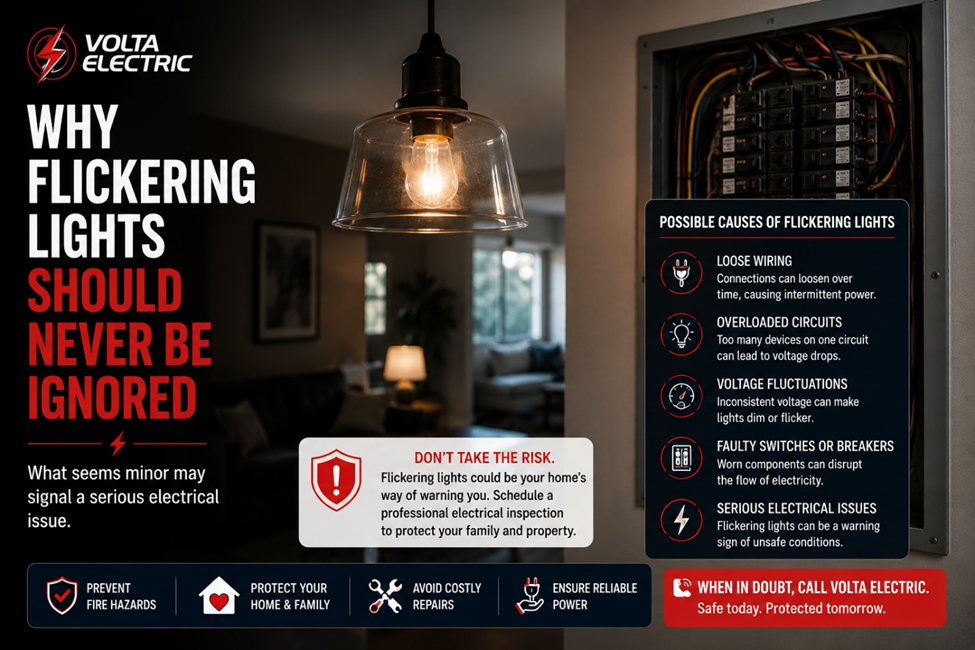
A bulb that is nearing the end of its service life will sometimes flicker before it fails completely. This is particularly true of older fluorescent fixtures and compact fluorescent lamps, which can exhibit flickering and cycling behavior as their ballasts or starters degrade. LED bulbs flicker for a different reason — they are sometimes incompatible with the dimmer switch they are connected to, producing a buzz, a flicker, or a limited dimming range that has nothing to do with the wiring and everything to do with the mismatch between the LED driver’s electronics and the dimmer’s load requirements. Replacing the dimmer with one that is rated and confirmed compatible with the specific LED fixture resolves this entirely.
A loose connection at the fixture itself — where the fixture’s wiring connects to the junction box wiring — can produce flickering that appears and disappears depending on temperature, vibration, or simply the position of wires that are making intermittent contact. This is a minor fix when it is genuinely localized to the fixture, but it requires opening the fixture and junction box to verify, because the same symptom at the fixture can also originate from a loose connection somewhere else in the circuit that merely manifests at the fixture.
Brief utility-side voltage fluctuations — often caused by large industrial loads cycling on and off somewhere on the distribution network, or by utility switching operations — can produce momentary dimming or flickering that affects the entire home simultaneously. If every light in the house dims briefly at the same instant and then returns to normal, with no other symptoms and no recurrence, this is likely a utility event rather than a problem within your home’s electrical system. If it recurs, or if it affects only part of the home, the utility explanation becomes less credible.
Causes That Are Moderate and Require Attention
Loose connections anywhere along a circuit’s path — at outlets, at switches, at junction boxes — can produce flickering at fixtures served by that circuit. Unlike a loose connection at the fixture itself, a loose connection at a mid-circuit junction box or outlet serves as a resistance point that generates heat under load every time the circuit is used. The flickering is the visible symptom. The heat generation at the connection point is the actual problem, and it is a problem that worsens over time as the loose connection causes oxidation, further resistance, and further heat generation in a self-reinforcing cycle.
Overloaded circuits — circuits that are regularly drawing current near or at their rated capacity — produce voltage drops under load that manifest as dimming when a large appliance starts, and as flickering when multiple loads are competing for the circuit’s available capacity simultaneously. This is more of an infrastructure adequacy problem than a safety emergency, but it is also a condition that, if left unaddressed, tends to stress circuit components in ways that accelerate degradation and bring the circuit closer to a fault condition over time.
Voltage fluctuations that are specific to your home — rather than utility-side events — indicate that something in your electrical system is creating inconsistency in the voltage your circuits receive. This can originate at the panel, at the service entrance connections, or at a high-resistance point somewhere in the system. Voltage that fluctuates significantly above and below nominal levels is damaging to sensitive electronics and appliances, not just uncomfortable to live with.
Causes That Are Serious and Demand Immediate Attention
Arcing faults are the most serious cause of flickering lights, and they are also the cause that is most easily mistaken for something minor. An arcing fault occurs when electricity jumps across a gap — between conductors that are not in full contact, between a conductor and a nearby grounded surface, or through deteriorated insulation that no longer reliably separates conductors from their surroundings. Arcing generates intense localized heat — temperatures that can ignite wood framing, insulation, and other combustible building materials in the vicinity of the fault.
The connection between arcing and flickering is that the arc itself creates a momentary interruption in the circuit’s current flow, and that interruption is visible as a flicker at any fixture served by the affected circuit. The flicker lasts a fraction of a second. The arc, at the moment of occurrence, may reach temperatures exceeding 10,000 degrees Fahrenheit at the fault point. These two facts coexist, which is why a light that flickers briefly and seems to recover completely can be — in the worst cases — a light that is signaling an active arcing event somewhere in the wall behind it.
Deteriorated wiring insulation, loose connections in aluminum wiring, improperly made splices, and damaged conductors are all arcing fault precursors that are common findings in older Los Angeles homes. In homes with knob-and-tube wiring, aluminum wiring, or wiring that has spent decades in the thermal environment of a Southern California attic, the probability that flickering has an arcing cause is meaningfully elevated relative to newer construction.
A failing main breaker or panel connection is another serious cause of flickering that is particularly important to recognize because it affects the entire home simultaneously. When the main breaker’s connection to the service entrance conductors deteriorates — as it can over time, particularly in older panels — the resistance at that connection creates voltage fluctuations that affect every circuit in the home. Lights throughout the house flicker together, with a pattern that may correlate with large load events like the HVAC compressor cycling. This symptom, in an older home with an aging panel, should be evaluated as a potential main breaker or service entrance connection issue until proven otherwise.
Loose service entrance connections — where the utility’s conductors connect to your home’s service entrance wiring at the weatherhead or meter base — can produce similar whole-home symptoms. These connections are partially the utility’s responsibility and partially the homeowner’s, depending on where along the service entrance the problem is located, and they require coordination between a licensed electrician and the utility to address correctly.
Reading the Pattern: What Your Flickering Is Telling You
The pattern of flickering — when it happens, how long it lasts, which lights are affected, and what else is happening when it occurs — carries diagnostic information that a licensed electrician will use to narrow the range of likely causes before any physical investigation begins. Understanding what different patterns suggest helps homeowners provide the kind of description that accelerates diagnosis.
Flickering That Correlates With a Specific Appliance Starting
When lights dim or flicker at the moment a specific large appliance starts — the central air conditioner, the refrigerator, the washing machine, the dishwasher — this is typically a voltage drop caused by the high startup current draw of a motor-driven appliance. Motors draw significantly more current in the first fraction of a second of startup than they draw during normal operation, and this momentary surge can produce a visible voltage dip on the circuits sharing that service.
A brief, momentary dim that recovers immediately when the appliance finishes starting is generally within normal parameters for an older home with motor-driven appliances. A pronounced dim that lasts for more than a second or two, or a flicker that is severe enough to briefly extinguish lights, suggests either that the circuit serving the appliance is shared with too many other loads, that the service entrance or panel connections have elevated resistance, or that the panel’s capacity is genuinely insufficient for the home’s combined load. Electrical diagnostics that investigate the service entrance and panel connections are the appropriate response when this pattern is pronounced.
Flickering Isolated to One Room or One Circuit
When flickering affects lights in one room or one specific area of the home but not others, the cause is almost certainly somewhere within that circuit — at a device on the circuit, at a junction box serving it, or in the wiring run itself. This pattern is the one most likely to originate from a loose connection at a specific point and is also the pattern most associated with an arcing fault in a specific location.
A circuit that flickers consistently and persistently in a specific room of an older Los Angeles home should be treated as a wiring investigation project, not a bulb-replacement project. The investigation requires testing the circuit, examining connections at all accessible devices, and in many cases visual inspection of wiring in accessible attic or crawl space locations. Finding an arcing fault in this context before it progresses is exactly the kind of outcome that electrical inspection and troubleshooting services exist to produce.
Whole-Home Flickering Without an Obvious Load Trigger
When lights throughout the entire home flicker simultaneously, without a clear correlation to any specific appliance starting, the cause is almost always either at the main panel, at the service entrance, or at the utility connection point. This is the pattern that should generate the most urgency, because the causes that produce it — failing main breakers, deteriorated service entrance connections, utility-side neutral conductor problems — affect the entire electrical system and can produce voltage conditions that damage appliances and electronics in addition to creating fire and shock hazards.
A loose or corroded neutral conductor — either within the home’s service entrance or in the utility’s connection to it — is among the most dangerous causes of whole-home flickering and represents a condition that can produce severely elevated voltage on some circuits while depressing voltage on others, potentially damaging or destroying sensitive equipment across the home. This condition, sometimes called a “lost neutral” or “open neutral” at the service entrance, is a utility emergency in addition to being a licensed electrician’s repair item, and it warrants an emergency call rather than scheduled service.
Flickering That Accompanies Warmth, Smell, or Sound
Any flickering that is accompanied by a warm outlet or switch plate, a burning or hot smell from any electrical device or wall location, a buzzing or crackling sound from within a wall or from the panel, or visible scorch marks at any outlet or switch — this combination of symptoms describes an active fault condition that requires immediate attention. The flickering in this context is not the problem. It is a signal that the problem is already in progress.
Homeowners who encounter this combination of symptoms should turn off the circuit at the panel if the affected circuit can be identified and isolated, and call for emergency electrical service. This is not a scenario for scheduling a service call at the next available appointment.
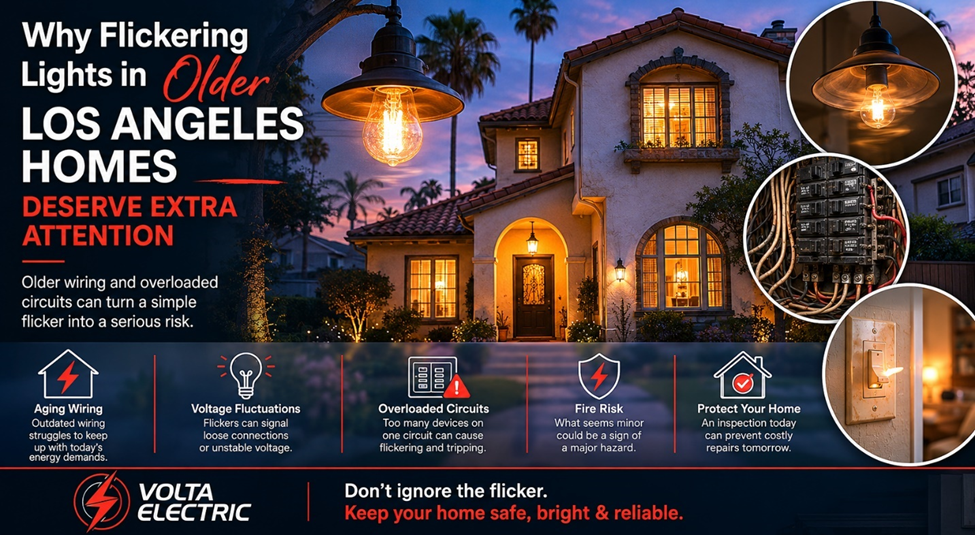
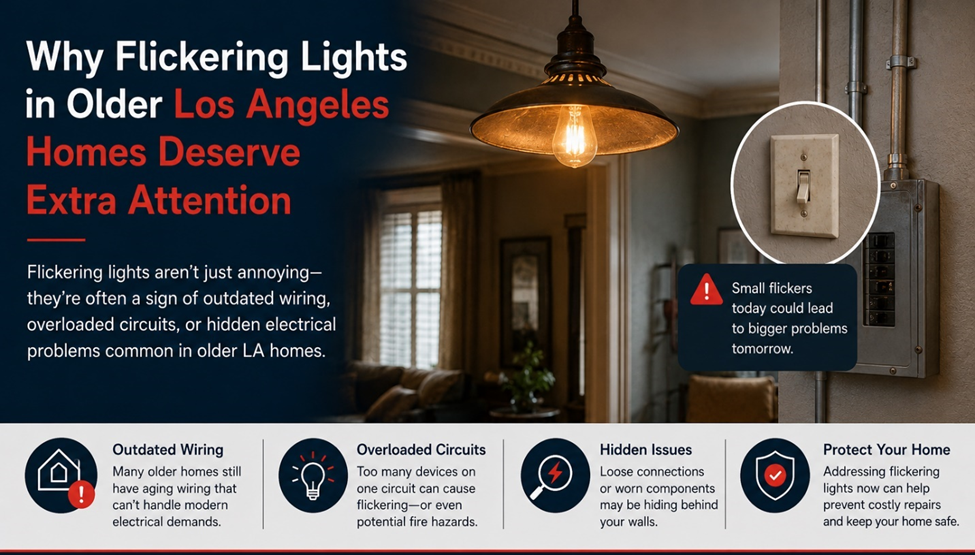
Why Flickering Lights in Older Los Angeles Homes Deserve Extra Attention
Los Angeles’s housing stock creates a specific context for flickering light symptoms that elevates the probability of serious underlying causes compared to newer construction. A flickering light in a five-year-old Carmel Valley home is statistically more likely to be a dimmer compatibility issue than an arcing fault. A flickering light in a 1940s craftsman in Highland Park or a 1960s ranch in Torrance is playing on a different odds table entirely.
The deteriorated insulation, aluminum wiring connection degradation, knob-and-tube modifications, and aging panel equipment that characterize much of Los Angeles’s older residential stock are precisely the conditions that turn a loose connection into an arcing fault, and an arcing fault into a fire, over the kind of timeline that makes the symptom easy to defer. A homeowner who decides to watch a flickering light for another few weeks in a newer home is making a different gamble than one making the same decision in a 1955 home in Burbank or a 1935 home in Pasadena where the wiring has never been assessed.
The National Fire Protection Association’s data consistently identifies electrical distribution and lighting equipment as among the leading causes of residential structure fires, and arcing faults are identified as a primary ignition mechanism within that category. California’s aging housing stock and the thermal environment of Southern California attics — where summer temperatures regularly exceed 130 degrees Fahrenheit and accelerate insulation degradation — contribute to an elevated risk profile for older Los Angeles homes specifically.
This context does not mean that every flickering light in an older Los Angeles home is a crisis. It means that flickering lights in older Los Angeles homes deserve professional evaluation rather than watchful waiting, and that the cost of that evaluation is trivially small compared to what it may prevent.
The Role of Arc Fault Circuit Interrupters in Flickering Light Situations
Arc Fault Circuit Interrupter breakers — AFCI breakers — are designed to detect the electrical signature of an arcing fault and interrupt the circuit before the arcing can ignite surrounding materials. They are required by the current National Electrical Code on most branch circuits in new residential construction and are one of the most meaningful electrical safety advances of the past two decades.
In older Los Angeles homes where AFCI protection is not present, installing AFCI breakers at the panel for circuits serving bedrooms, living spaces, and other areas where arcing risk is elevated is a direct, cost-effective safety improvement. An AFCI breaker that trips in response to an arcing event is providing exactly the protection it was designed to provide — and a trip event on an AFCI breaker is also diagnostic information, telling your electrician that an arcing condition was detected on that circuit and directing the investigation accordingly.
Homeowners in older homes who experience flickering lights and are scheduling an electrical assessment have a natural opportunity to discuss AFCI breaker installation as part of that visit. The incremental cost of adding AFCI protection at the panel while an electrician is already working there is modest. The protection it provides is ongoing and automatic.
Similarly, GFCI outlet installation in kitchens, bathrooms, garages, outdoor locations, and other areas specified by current code addresses a different but overlapping set of shock hazard risks that older Los Angeles homes commonly present. A comprehensive electrical assessment that addresses flickering symptoms is also the right time to confirm that GFCI protection is present and functional wherever the code requires it.
What to Expect From Professional Electrical Troubleshooting for Flickering Lights
Homeowners who have not previously had electrical troubleshooting performed on their home sometimes have an unclear picture of what the process involves. Understanding what a professional assessment for flickering lights actually looks like helps set appropriate expectations and prepares homeowners to provide the kind of information that makes the diagnostic process more efficient.
The assessment begins with a conversation about the pattern. When does the flickering occur? Which lights are affected? Does it correlate with specific appliances or load events? How long has it been happening, and has the frequency changed? Has anything else in the home changed recently — new appliances, recent renovation work, new tenants in a multi-unit building? This history is diagnostic information, and the more precisely a homeowner can describe the pattern, the faster the investigation can be directed toward the most likely causes.
The physical investigation typically includes testing affected outlets and switches for correct voltage, polarity, and ground continuity; examining the panel for visual signs of overheating, corrosion, loose connections, or double-tapped breakers; testing the voltage at the panel under load to identify service entrance connection issues; and where accessible, visual inspection of wiring in attic or crawl space locations that serve the affected areas. Circuit breaker replacement may be indicated if specific breakers show signs of failure. In some cases, thermal imaging of the panel and accessible wall cavities can identify heat-generating fault points that are not otherwise visible.
The output of this investigation is a specific finding — or a prioritized list of findings — with a clear explanation of what was found, what it means, and what the repair involves. Electrical troubleshooting that ends with “we couldn’t find anything” without a clear explanation of what was tested and what the next diagnostic steps would be if symptoms persist is incomplete troubleshooting, not a clean bill of health.
Flickering Lights in Commercial Properties: A Different Set of Stakes
For commercial property owners and business operators in Los Angeles, Glendale, Burbank, Long Beach, and the surrounding communities, flickering lights carry implications beyond the residential context. In a retail or restaurant environment, lighting quality directly affects customer experience and revenue. In an office environment, flickering lights create conditions that trigger headaches, reduce productivity, and may generate employee complaints or accommodation requests. In light industrial settings, lighting failures can create safety hazards in work areas where consistent illumination is a functional requirement.
Commercial electrical systems also operate at higher loads and in configurations — three-phase service, more complex panel arrangements, more devices on each circuit — where the causes of flickering are more varied and the diagnostic process is correspondingly more involved. A commercial electrician with experience in the specific electrical systems common to Los Angeles commercial buildings brings a different toolkit to commercial flickering light troubleshooting than a purely residential contractor.
For commercial tenants in leased spaces, the question of who is responsible for investigating and correcting flickering light problems depends on the lease structure and where the fault originates. Faults in the tenant’s branch circuit wiring are typically the tenant’s responsibility. Faults in the building’s common electrical infrastructure are typically the landlord’s. A licensed commercial electrician can identify where the fault originates, which establishes the responsibility question in a way that the lease language alone often cannot.
Frequently Asked Questions
Is it ever safe to ignore a flickering light?
Occasionally, yes — if the flickering can be definitively attributed to a cause that has been verified as minor, such as a bulb at end of life or a confirmed dimmer compatibility issue, and there are no other symptoms. In practice, however, definitively attributing flickering to a minor cause without any investigation is difficult, because the same symptom can have very different origins. The safe default is professional assessment, particularly in older homes where the probability of a serious underlying cause is elevated.
What is the most common cause of flickering lights in Los Angeles homes?
Loose connections — at devices on the affected circuit, at junction boxes, or at the panel — are the most frequently identified cause of persistent flickering in Los Angeles residential properties. In older homes with aluminum wiring, loose connections at outlets and switches are particularly common because aluminum wiring connection degradation is a well-documented and predictable failure mode of that wiring type. Loose connections at the panel and service entrance are the most common cause of whole-home flickering.
Can flickering lights cause a fire?
Flickering caused by an arcing fault is itself produced by an event that can cause a fire — the arc generates intense localized heat that can ignite combustible building materials in the vicinity of the fault. Flickering caused by a loose connection that is generating heat under load can also lead to fire if the heat generation reaches temperatures sufficient to ignite surrounding materials. Not all flickering involves arcing or dangerous heat generation, but the possibility cannot be ruled out without investigation.
My whole house flickers at the same time. What does that mean?
Simultaneous whole-home flickering is the pattern most associated with problems at the main panel, service entrance, or utility connection point. A loose or corroded main breaker connection, a deteriorated service entrance conductor, or a utility-side neutral problem can all produce this pattern. This is the flickering pattern that warrants the most urgent response, because the systems involved affect every circuit in the home and the failure modes are among the more serious ones available to a residential electrical system.
How much does electrical troubleshooting for flickering lights cost in Los Angeles?
A professional electrical troubleshooting visit for flickering lights in Los Angeles typically involves a service call fee — generally $100 to $250 — that covers the diagnostic visit and assessment. The cost of any repair work identified during the assessment is additional and depends on what is found. A loose connection at a device is a minor repair. A failing main breaker or service entrance repair is a more significant expense. Knowing what the troubleshooting will cost up front is reasonable to ask; knowing what any repair will cost requires knowing what the diagnosis finds.
Should I turn off the circuit if my lights are flickering?
If the flickering is on a specific, identifiable circuit and is accompanied by warmth, a burning smell, or audible buzzing, turning off that circuit at the panel is a reasonable precaution while waiting for an electrician. If the flickering is whole-home and accompanied by any of those symptoms, turning off the main breaker is appropriate and emergency service should be called. For flickering without accompanying symptoms, it is not necessary to de-energize the circuit before scheduling service, but scheduling service promptly rather than monitoring is the appropriate response.
Can a dimmer switch cause flickering?
Yes. LED fixtures paired with dimmers that are not rated and confirmed compatible with their specific driver electronics frequently exhibit flickering, buzzing, or limited dimming range. This is one of the more common minor causes of flickering in Los Angeles homes that have transitioned from incandescent or halogen bulbs to LED without updating their dimmer switches. An electrician can confirm whether the flickering is dimmer-related by testing the circuit and fixture with a compatible dimmer. If dimmer incompatibility is confirmed as the cause, the fix is straightforward and inexpensive.
How do I find a reliable electrician for flickering light troubleshooting in Los Angeles?
Verify the contractor’s C-10 Electrical Contractor license through the California Contractors State License Board website before any other consideration. A licensed contractor will pull any required permits, carry liability insurance and workers’ compensation coverage, and stand behind their diagnostic findings. Ask how they approach troubleshooting — a contractor who explains their diagnostic process clearly and systematically is a contractor who has actually done this work methodically before. Contractors who offer very low service call fees without clear explanation of what the visit includes, or who quote repairs before performing diagnosis, should be approached with appropriate skepticism.
Conclusion
A light that flickers is easy to dismiss. It is equally easy to find, in that dismissal, a kind of reassurance that is not actually justified by the evidence. The symptom is minor. The possible causes range from genuinely minor to genuinely serious. Without investigation, there is no way to know which end of that spectrum you are on.
For Los Angeles homeowners in older homes — which describes a substantial proportion of the housing stock across Pasadena, Glendale, Burbank, Torrance, Long Beach, Beverly Hills, Culver City, and the neighborhoods of the city itself — that uncertainty should be resolved rather than tolerated. The electrical systems in these homes have been accumulating age, load, modification, and degradation for decades. Flickering lights are one of the few ways those systems communicate that something deserves attention, and they deserve to be taken at their word.
A professional assessment by a licensed electrician in Los Angeles is not an overreaction to a flickering light. It is the minimum appropriate response to a symptom that, in the wrong context, signals something that no amount of watchful waiting will prevent from progressing. The assessment is fast, the cost is modest, and the finding — whatever it is — is information you are better off having.
Let Volta Electric Find the Source Before It Becomes a Crisis
Volta Electric Inc. is fully licensed, bonded, and insured, serving Los Angeles, Pasadena, Glendale, Burbank, Beverly Hills, Santa Monica, Culver City, Long Beach, Torrance, and all of Los Angeles County with professional electrical troubleshooting, electrical diagnostics, flickering lights repair, circuit breaker replacement, AFCI and GFCI outlet installation, wiring and rewiring services, panel upgrades, and the complete range of residential and commercial electrical repair services.
We diagnose before we quote. We explain what we find in plain language. We give you a clear price before any repair work begins, and we do the work correctly the first time.
Free estimates are available on all repair and installation projects. Same-day appointments are available for situations that need immediate attention — including flickering that is accompanied by warmth, smell, or whole-home symptoms that suggest a panel or service entrance problem.
Contact Volta Electric Inc. today. The flicker you have been ignoring is worth five minutes of your time to find out what it actually means. voltaelectricinc.com/electrician-in-los-angeles/
Volta Electric Inc. | Licensed Electrical Contractor | C-10 License | Serving Los Angeles, Pasadena, Glendale, Burbank, Beverly Hills, Santa Monica, Culver City, Long Beach, Torrance & All of Los Angeles County | Free Estimates | Same-Day Appointments Available