Introduction
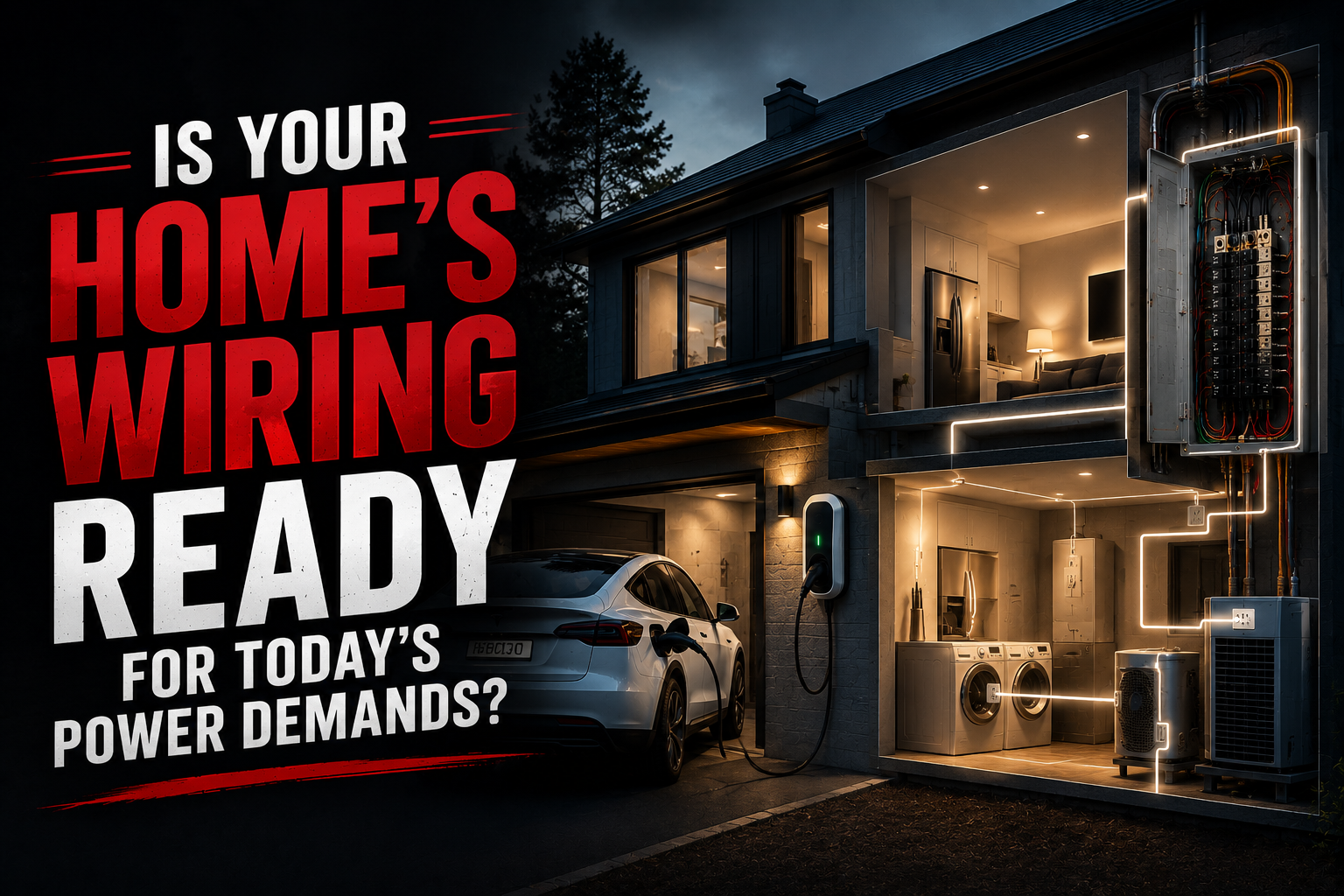
Many homes were never designed for modern electricity consumption — and the gap between what older residential wiring was built to handle and what today’s households actually demand is wider than most homeowners realize. The average American home in the 1960s consumed roughly 2,000 kilowatt-hours of electricity per year. Today, a comparable home with central air conditioning, an electric vehicle charger, a home office, smart appliances, and a heat pump water heater can consume four to five times that amount without any unusual behavior.
The wiring inside your walls, however, has not changed. If your home was built before 1980 — and a substantial portion of the housing stock in Los Angeles, Beverly Hills, Pasadena, Glendale, and surrounding communities was — the electrical infrastructure behind your outlets, switches, and panel was engineered for a world that no longer exists. It was designed for incandescent bulbs, a single television, a few small kitchen appliances, and perhaps a window air conditioner. It was not designed for the electrical reality of 2024 and beyond.
This is not a theoretical concern. Outdated, undersized, or deteriorating residential wiring is a leading cause of electrical fires in the United States, and it is a direct contributor to the kind of intermittent problems — flickering lights, frequently tripping breakers, outlets that stop working without explanation — that homeowners across Los Angeles deal with daily without understanding the underlying cause. A licensed electrician examining these symptoms is often the first person to explain to a homeowner that their wiring, not any specific device or appliance, is the source of the problem.
At Volta Electric, we assess and upgrade residential wiring systems throughout Los Angeles and the surrounding region. What we find regularly is that homeowners are living with electrical infrastructure that is silently failing to keep pace with demand — and that the consequences of ignoring that gap range from inconvenience to genuine danger. This article explains how to recognize whether your home’s wiring is adequate for your actual needs, what the risks of inadequate wiring look like in practice, and what a proper electrical upgrade involves.
Why Modern Power Demands Have Outpaced Older Wiring Systems
The transformation in residential electricity consumption over the past several decades has been gradual but relentless. Each new generation of home technology has added load to electrical systems that were never anticipated to carry it, and the cumulative effect is a fundamental mismatch between infrastructure and demand in older homes throughout Los Angeles.
Consider the sequence. Central air conditioning, which became widespread in Southern California homes during the 1970s and 1980s, added the single largest electrical load most homes had ever seen. Then came the proliferation of home electronics — computers, gaming systems, home theater equipment, and networking hardware — each individually modest but collectively significant. The smartphone era added charging infrastructure throughout the home. Modern kitchen appliances — induction ranges, high-powered microwave ovens, dishwashers with heated drying cycles — replaced their less demanding predecessors. And now, the EV charger: a single device that can draw more sustained current than almost anything else in a residential setting.
At each step, homeowners added new devices to electrical systems that were not designed with the next step in mind. The wiring in a 1965 Los Angeles bungalow was sized for the loads of 1965. The wiring in a 1978 tract home in the San Fernando Valley was sized for the loads of 1978. Neither was sized for the loads of today, and neither has automatically adapted as household demand has grown.
The result is wiring that may technically function — lights turn on, outlets provide power — while operating closer to its capacity limits than is safe or advisable. This condition does not always produce dramatic failure. More often, it produces the subtle symptoms that homeowners learn to accept as quirks of an older home rather than recognizing them as warnings.
Warning Signs That Your Home’s Wiring Is Struggling
Frequently Tripping Circuit Breakers
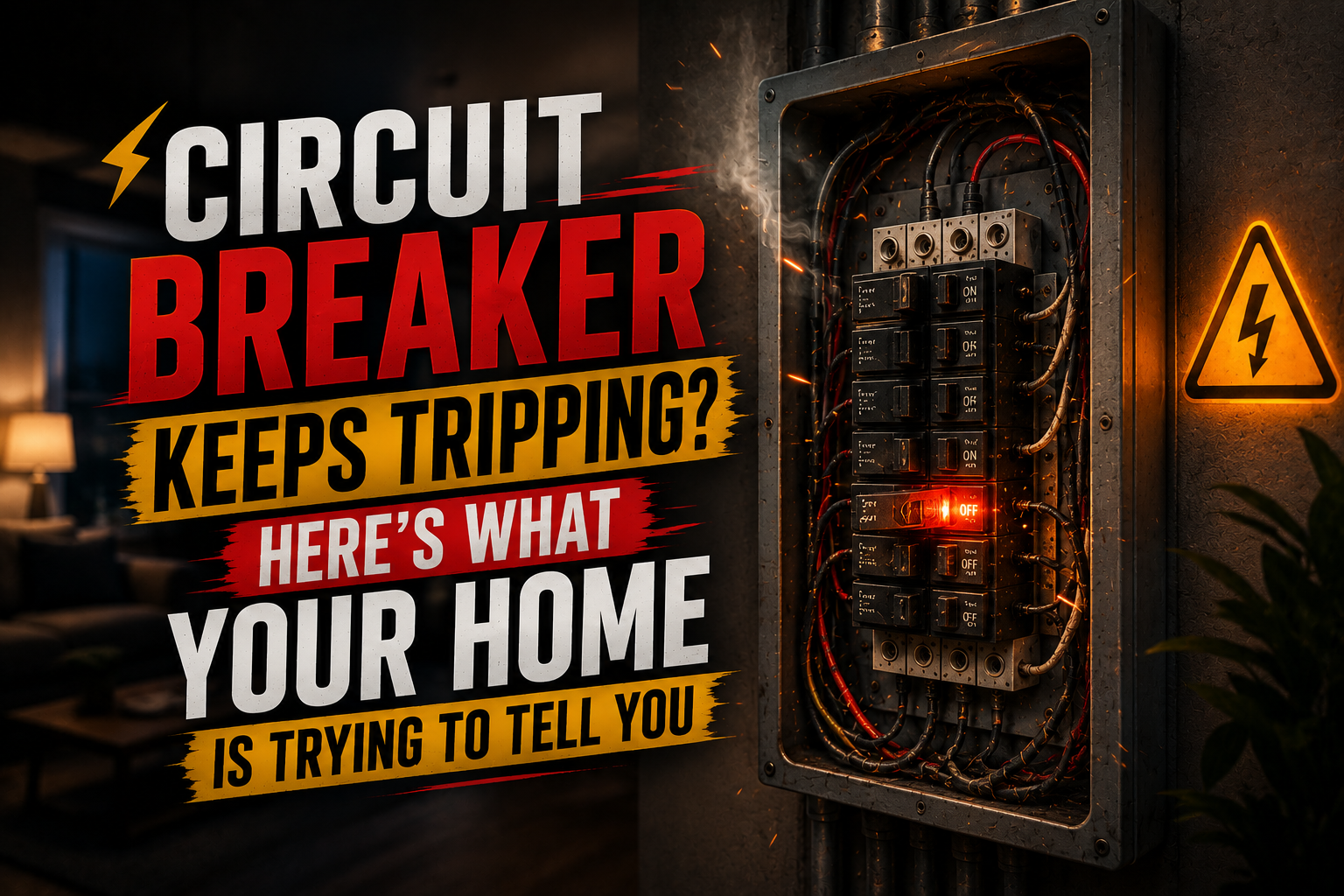
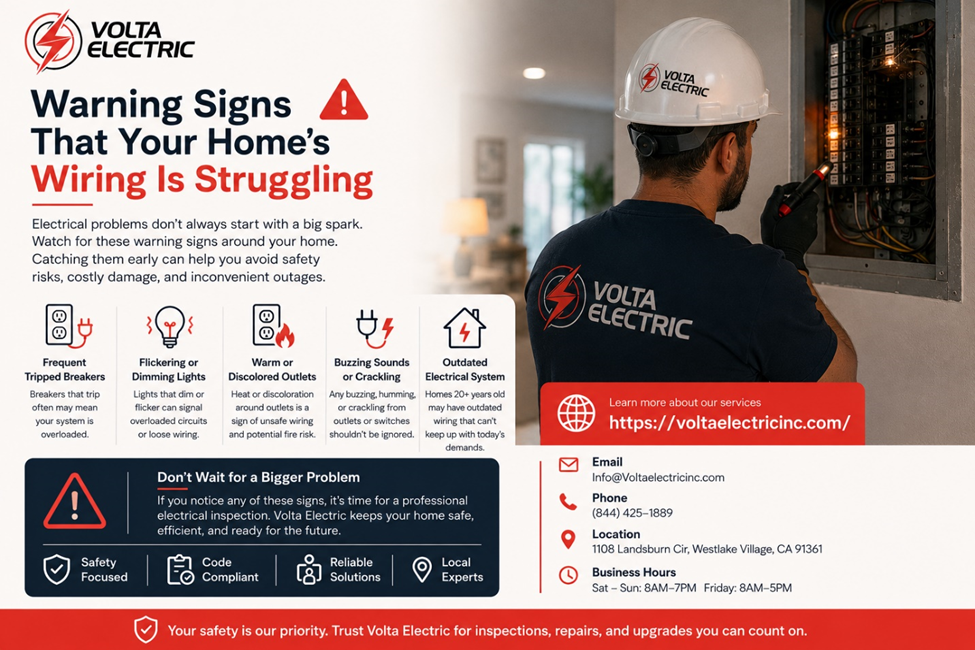
A circuit breaker that trips occasionally when genuinely overloaded is doing exactly what it was designed to do. A breaker that trips repeatedly under normal household loads, or that trips and immediately trips again when reset, is telling you that something in the system is persistently overcapacity. This pattern most commonly indicates either that too many devices share a single circuit, that the wiring on that circuit is undersized for current demand, or that the circuit itself has developed a fault.
In older Los Angeles homes, this problem frequently traces back to the original circuit layout, which divided the home into far fewer circuits than modern electrical codes require. A 1960s home might have six or eight general-purpose circuits serving an entire house that a modern electrician would wire with fifteen or twenty. When homeowners in that older home add a home office with multiple monitors, a laser printer, and supplemental lighting to a bedroom that shares a circuit with two other rooms, the breaker’s behavior is predictable — but the root cause is the inadequate circuit count of the original installation, not the specific devices being used.
Flickering or Dimming Lights
Lights that flicker when an appliance starts, dim noticeably when the HVAC system cycles on, or fluctuate without obvious cause are exhibiting the visible symptoms of voltage instability. This instability can originate at several points in the electrical system: loose connections at the panel, deteriorating wire insulation that creates intermittent contact issues, undersized wiring that causes voltage drop under load, or overloaded circuits that cannot maintain stable voltage when demand spikes.
Flickering lights are particularly worth taking seriously when they occur throughout the home simultaneously rather than on a single circuit. Whole-home flickering often points to issues at the service entrance — the conductors and connections that bring utility power into your panel — rather than in the branch circuit wiring. Service entrance problems are among the more serious wiring issues in terms of fire and safety risk, because the conductors involved carry the full current of your home’s electrical service and are more difficult to access and inspect than branch circuit wiring.
Outlets and Switches That Feel Warm
Electrical outlets, switch plates, and the faceplates of devices connected to the wall should never feel warm to the touch during normal operation. Heat at these locations indicates excessive resistance in the circuit — caused by loose connections, undersized wiring, deteriorating wire insulation, or overloaded circuits — and resistance means energy is being converted to heat inside the electrical system rather than being delivered to your devices.
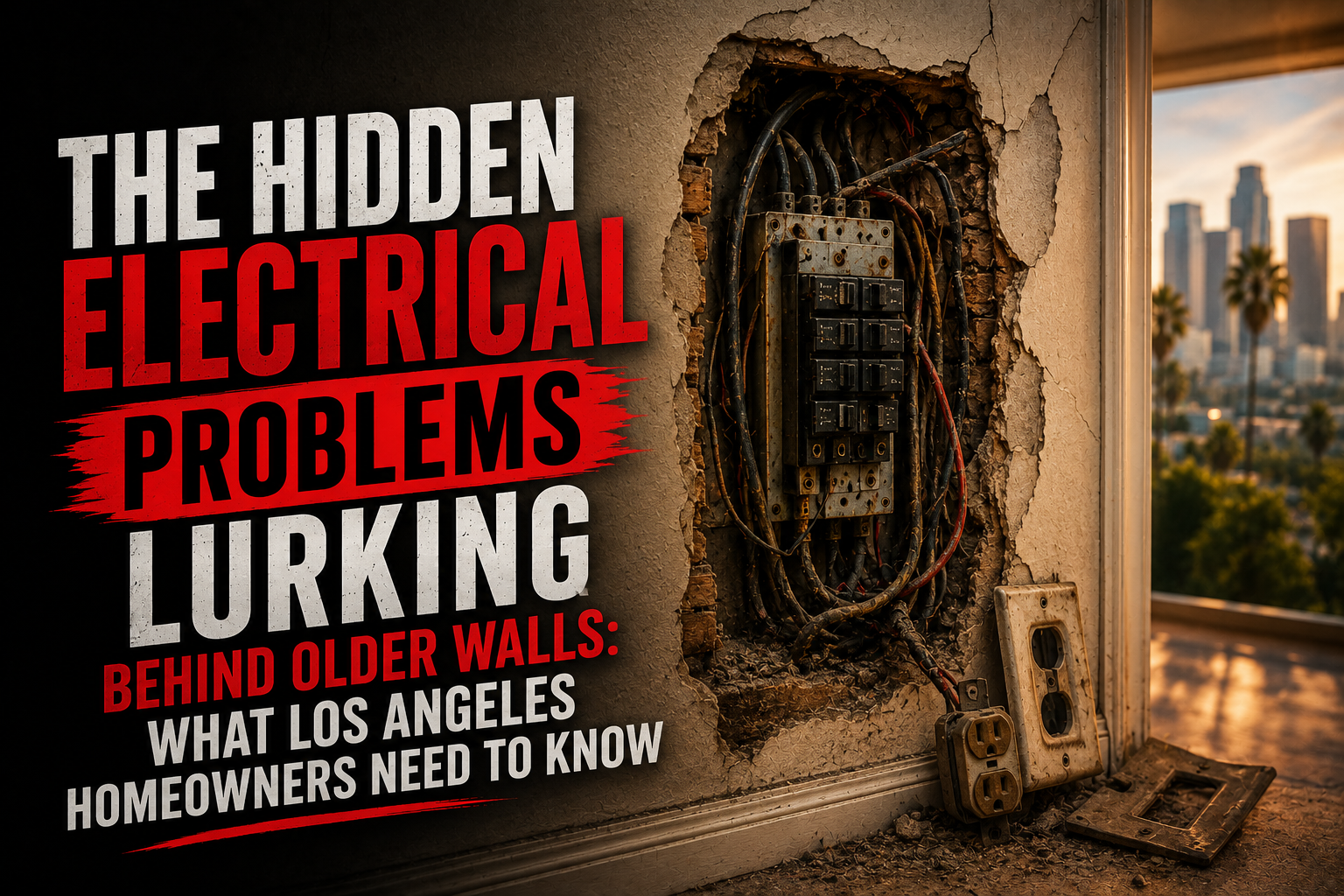
Heat generation inside walls, junction boxes, and outlet enclosures is a direct fire risk. The materials surrounding electrical wiring — wood framing, insulation, drywall — are combustible, and sustained heat at levels above design parameters can initiate smoldering that develops into a structural fire. This risk is especially relevant in older Los Angeles homes where original wiring may have aluminum branch circuit conductors, knob-and-tube wiring, or cloth-insulated wire, all of which present elevated heat and deterioration risks relative to modern copper conductors with thermoplastic insulation.
Insufficient Outlets Requiring Constant Use of Extension Cords
The number of outlets in older homes reflects the electrical habits of the era in which they were built. A 1950s or 1960s home might have a single duplex outlet on each wall of a bedroom — two receptacles per wall, serving a room that now contains a television, a streaming device, a gaming console, two phone chargers, a laptop, a desk lamp, and a smart speaker. The mathematical shortfall is obvious, and homeowners fill it with power strips and extension cords.
Extension cords are not a permanent solution to inadequate outlet count — they are a temporary workaround that, when used continuously as a substitute for permanent wiring, create risks of their own. Overloaded extension cords generate heat. Cords run under rugs or across high-traffic areas suffer physical damage that degrades insulation. Daisy-chained power strips overload outlet circuits in ways that the circuit’s breaker may not reliably detect. The correct solution is additional circuit installation and outlet placement — work that a licensed electrician can complete cleanly and to current code standards.
The Presence of Knob-and-Tube or Aluminum Branch Circuit Wiring
Two specific wiring types found in older Los Angeles homes warrant particular attention because their presence creates risks that go beyond simple capacity limitations.
Knob-and-tube wiring — the system used in homes built roughly between 1880 and 1940 — routes individual conductors through the framing structure using ceramic knobs for support and ceramic tubes where wires pass through framing members. The conductors are separated rather than bundled in a cable jacket, and the insulation is typically rubber covered with cloth braiding. Over eight or more decades, this insulation has dried, cracked, and in many cases deteriorated to the point where the bare conductor is exposed in locations that are hidden within the wall or ceiling structure.
Knob-and-tube wiring was not inherently dangerous when new. The problems arise from age-related deterioration, from modifications made by untrained hands over the decades, and from the addition of insulation in attics and wall cavities — a common energy efficiency measure that was never compatible with knob-and-tube systems, which relied on open air for heat dissipation. Many insurance carriers in California now refuse to write or renew policies on homes with active knob-and-tube wiring, and the California Residential Code treats it as a system requiring evaluation and typically replacement.
Aluminum branch circuit wiring, installed extensively in homes built from the mid-1960s through the mid-1970s as a cost-saving substitute for copper, presents a different set of risks. Aluminum expands and contracts with temperature changes at a rate different from the copper devices — outlets, switches, breakers — it connects to. Over time, this differential movement causes connections to loosen, creating resistance and heat at connection points. Aluminum wiring has been associated with a disproportionate share of residential electrical fires relative to its installation prevalence, and homes containing it require either replacement with copper wiring or remediation using approved connection methods and devices rated for aluminum conductors.
What Modern Wiring Requirements Actually Look Like
Current residential electrical wiring in California follows the National Electrical Code as adopted and amended by the California Building Code, and the requirements differ substantially from what older homes contain. Understanding what modern standards require helps homeowners contextualize what an upgrade actually delivers.
Modern residential circuits use copper conductors with THHN or NM-B thermoplastic insulation rated for the temperatures and environments in which they operate. Circuit counts are substantially higher than in older homes — kitchens alone require multiple dedicated circuits under current code, including dedicated circuits for the refrigerator, the dishwasher, the microwave, and small appliance receptacles. Bathrooms, garages, exterior outlets, and any outlet within six feet of a water source require GFCI protection. Bedrooms, living areas, hallways, and other specified locations require AFCI protection through arc fault circuit interrupter breakers.
These requirements exist because they address specific, documented failure modes. GFCI outlets prevent electrocution in wet locations — they detect the tiny current imbalance that occurs when electricity takes an unintended path through a person and interrupt the circuit in milliseconds. AFCI breakers detect the electrical signature of arcing faults — the type of fault that older breakers cannot sense and that can ignite a fire within wall structure at current levels too low to trip a conventional breaker.
Older homes contain none of these protections in the locations where current code requires them. When Volta Electric performs a residential rewiring or wiring upgrade, we bring the affected circuits and locations into current code compliance — not simply replacing wire with wire, but ensuring that the protection layers the current code mandates are present throughout the upgraded areas of the home.
Home Rewiring: What the Process Involves and When It Is Necessary
The term “rewiring” covers a spectrum of work, from replacing wiring on specific circuits that have failed or been identified as defective to a complete whole-house rewiring that replaces all branch circuit conductors, updates the panel, and brings the entire electrical system into current compliance.
Complete whole-house rewiring is typically warranted in homes with knob-and-tube wiring throughout, homes with extensive aluminum branch circuit wiring that cannot be adequately remediated, older homes with panels that cannot be upgraded to accommodate the circuit count and capacity a modern rewiring requires, or homes that have suffered fire, flood, or other damage that has compromised the wiring system. It is a significant project — in an occupied home, it involves working through existing wall surfaces with minimal damage techniques or, in some cases, opening walls for full access — and it requires a licensed electrical contractor, thorough permitting, and phased inspection throughout.
Partial rewiring — replacing specific circuits, updating wiring in specific rooms or areas, adding new circuits for high-demand loads — is appropriate for homes where the majority of the wiring is in acceptable condition but specific areas or circuits require attention. This approach allows homeowners to address the highest-priority needs first and phase additional work over time according to budget and project priorities.
In many Los Angeles homes, the most practical approach is a targeted upgrade strategy that addresses the highest-risk elements — replacing knob-and-tube circuits, updating aluminum wiring connections, adding GFCI and AFCI protection in required locations, and installing dedicated circuits for high-demand loads — while preserving functional wiring that does not present safety concerns. A qualified licensed electrician can identify which approach is appropriate for a specific home through a thorough electrical inspection.
The Connection Between Wiring Capacity and the Upgrades You Want to Make
One of the most common scenarios Volta Electric encounters is a homeowner who wants to add a Level 2 EV charger, solar panels with battery storage, or a heat pump system to their home and discovers during the assessment process that the existing wiring and panel cannot support the new loads without significant upgrades.
This connection between wiring adequacy and upgrade potential is direct and unavoidable. A Level 2 EV charger requires a dedicated 240-volt circuit with wire sized for 40 to 60 amperes of continuous load. A solar installation with battery storage requires circuits for the inverter, the battery system, and potentially a critical loads panel for backup power operation. A heat pump system — particularly a whole-home heat pump that replaces gas heating — may add 20 to 40 amperes of new load to a panel that was not designed to accommodate it.
All of these upgrades are effectively gated by the adequacy of the underlying wiring infrastructure. A home that wants to add an EV charger, participate in the clean energy transition, and reduce reliance on fossil fuels needs the wiring infrastructure to support those goals. For homes in Los Angeles with aging electrical systems, this often means that the path to a modern, clean energy home runs through a wiring assessment and targeted electrical upgrade before the desired end-state is achievable.
The good news is that addressing wiring deficiencies and installing modern circuits simultaneously with other planned upgrades — EV charger installation, panel upgrade, solar interconnection — reduces total project cost relative to completing each element separately. Coordinating these projects with a single licensed electrical contractor who understands the full scope of your goals is the most efficient path forward.

Cost and Investment Reality for Los Angeles Homeowners
Electrical wiring work covers a wide cost range depending on scope, home configuration, and the specific conditions encountered. Providing accurate estimates for projects that have not been assessed is not responsible practice, but it is useful to understand the general cost landscape for different scopes of work.
Adding individual circuits — for an EV charger, a home office, a dedicated kitchen appliance circuit, or a laundry circuit — typically ranges from $300 to $800 per circuit depending on run length, access difficulty, and materials required. GFCI outlet installation runs $150 to $300 per location for retrofit installation in existing walls. These are targeted improvements that address specific needs without full system replacement.
Partial rewiring — replacing specific problem circuits, addressing aluminum wiring connections, updating wiring in specific rooms — varies widely based on the extent of work and the access required. Whole-house rewiring is a more substantial investment, typically ranging from $8,000 to $20,000 or more for a single-family home in the Los Angeles area depending on square footage, construction type, the complexity of access within the structure, and the extent of associated panel and service work.
These figures should be weighed against the value of what they protect. The median home price in Los Angeles exceeds $800,000. The cost of comprehensive wiring upgrades that protect that asset from electrical fire risk — and that simultaneously enable the modern upgrades, appliances, and energy systems that make the home more livable and more valuable — is a fraction of the property’s value. Homeowners who frame wiring upgrades as an expense miss the more accurate framing: they are a structural investment in the safety, functionality, and future adaptability of the most valuable asset most people own.
For homes in Beverly Hills, Santa Monica, Bel Air, and other high-value Los Angeles communities, this framing is even more applicable. Electrical infrastructure that matches the quality and value of the property protects the investment, supports insurance coverage continuity, and eliminates deficiencies that would otherwise become negotiating liabilities in any future property transaction.
Expert Recommendations for Los Angeles Homeowners
If your home was built before 1980 and has not had a comprehensive electrical inspection in the past decade, scheduling one with a licensed electrician is the single most valuable step you can take. An electrical inspection is not a commitment to any specific work — it is information. It tells you what you have, what condition it is in, and what, if anything, requires attention.
When scheduling an inspection, choose a licensed electrical contractor rather than a home inspector who performs electrical inspections as a component of a general assessment. A licensed electrician has the training, tools, and code knowledge to assess wiring condition at a level of detail that a general home inspector is not equipped to provide. In California, electrical contractors must hold a valid C-10 license issued by the Contractors State License Board — verifiable through the CSLB’s online license check tool.
If an inspection reveals wiring concerns, prioritize by risk level rather than by cost or convenience. Life-safety issues — active knob-and-tube in contact with insulation, aluminum wiring with loose connections showing heat damage, missing GFCI protection in wet locations — warrant prompt attention regardless of budget constraints. Capacity and convenience issues can be phased according to priority and resources.
Finally, coordinate your electrical planning with your broader energy goals. If you intend to add solar within the next few years, an EV charger in the next year, and a heat pump eventually, share that roadmap with your electrician during the assessment. Designing your electrical upgrade to accommodate all of those future loads from the beginning eliminates the inefficiency and cost of repeated upgrades as each new system is added.

Local Context: Why This Matters Specifically in Los Angeles
The housing stock in Los Angeles and its surrounding communities creates a specific and elevated context for wiring adequacy concerns. The region has a higher proportion of pre-1970 homes than many other major American cities, reflecting its early growth period and the relative stability of its housing stock since then. Neighborhoods like Silver Lake, Los Feliz, Highland Park, Echo Park, and much of the San Fernando Valley contain significant concentrations of homes built in the 1940s, 1950s, and 1960s — precisely the era when knob-and-tube wiring was being replaced by aluminum branch circuit wiring, and when service sizes of 60 or 100 amperes were considered adequate.
The Los Angeles climate adds a specific load pressure that homeowners in cooler climates do not face to the same degree. Air conditioning in Southern California is not a seasonal luxury — it is a necessity for a significant portion of the year, and the cooling loads in homes without effective insulation and with older, inefficient HVAC systems create sustained high-current draws that stress wiring systems that were already operating near capacity for their era.
California’s aggressive clean energy policy environment also creates local pressure that accelerates the relevance of wiring adequacy. The state’s goal of carbon neutrality by 2045, the transition away from natural gas in new construction, and the ongoing growth of EV adoption all point toward increasing residential electrification — more loads, not fewer, added to homes that were built before electrification was the organizing principle of residential energy. For homeowners in Los Angeles, Culver City, Burbank, Long Beach, Torrance, and communities throughout the region, the question of whether their home’s wiring is ready for today’s demands is inseparable from the question of whether it is ready for tomorrow’s.
Future Trends: The Wiring Your Home Will Need
The residential electrical loads that are common today were not anticipated by those who designed the electrical systems of older homes. The loads that will be common in ten years are similarly difficult to fully anticipate today, but several trends are clear enough to plan for.
Whole-home electrification — the replacement of natural gas appliances with electric equivalents — will add substantial load to homes that convert. An electric range, heat pump water heater, heat pump HVAC system, and electric dryer together represent a fundamentally different electrical demand profile than a home where most thermal loads are served by gas. Homes that pursue full electrification will need panel and wiring infrastructure sized for those loads.
Bidirectional EV charging — the ability for a vehicle battery to discharge back into the home or the grid — will require wiring infrastructure capable of handling bidirectional power flows, and the charger equipment that supports this capability draws power at levels that demand properly sized dedicated circuits and panels with adequate capacity.
Home battery storage systems are becoming more accessible and more common, particularly in California where grid reliability concerns and time-of-use pricing create strong incentives for on-site energy storage. A properly installed battery backup system requires its own dedicated circuits, appropriate disconnects, and a panel configuration that allows the battery to supply critical loads during a grid outage. Homes whose wiring infrastructure is not adequate for these installations will require upgrades before they can benefit from the technology.
Planning electrical infrastructure with the next decade in mind — not just today’s needs — is the most cost-effective approach. A wiring upgrade designed to support today’s EV charger, next year’s solar installation, and eventual full electrification is far more efficient than a series of incremental upgrades that each address only the immediate need.
Frequently Asked Questions
How do I know if my home has knob-and-tube wiring?
Knob-and-tube wiring is most commonly found in homes built before 1940, though some was installed into the 1950s. It is identifiable by individual cloth-insulated wires routed through the framing structure on ceramic knobs, passing through framing members in ceramic tubes. An electrician inspecting your attic or accessible crawl space can identify it quickly. Some visible clues include cloth-covered wires rather than modern cable jackets in exposed areas like unfinished basements or attics, and ceramic components visible on framing members.
Is aluminum wiring dangerous, and what can be done about it?
Aluminum branch circuit wiring — the 15-amp and 20-amp circuits serving outlets and lights, as distinct from the aluminum service entrance conductors that are standard and acceptable — presents documented fire risk due to connection loosening over time. It is not necessarily an emergency requiring immediate wholesale replacement, but it requires evaluation and, where connections have loosened or heat damage is present, remediation. Acceptable remediation options include replacement with copper wiring, installation of approved pigtail connections using methods listed for aluminum-to-copper connections, and replacement of outlets and switches with devices specifically rated for aluminum conductors.
Can I add new circuits to my existing panel, or do I need a panel upgrade first?
This depends on whether your panel has available capacity — both in terms of total amperage and available breaker spaces. A licensed electrician can determine this through a load calculation. Panels that are full, that are rated below 200 amperes, or that contain identified defective brands typically need to be upgraded before additional circuits can be added safely.
What is the difference between a wiring upgrade and a full rewiring?
A wiring upgrade adds or replaces specific circuits while leaving the majority of the existing wiring in place. A full rewiring replaces all branch circuit conductors throughout the home. Which approach is appropriate depends on the extent and type of wiring problems present, the age and overall condition of the existing system, and the homeowner’s goals for the electrical infrastructure. A licensed electrician can assess which scope is appropriate after a thorough inspection.
How long does a whole-house rewiring take?
A whole-house rewiring in an occupied single-family home in the Los Angeles area typically takes one to three weeks depending on the size of the home, the construction type, and the complexity of access within the structure. The work is typically phased to minimize disruption, with power maintained to portions of the home throughout the process where possible.
Will outdated wiring affect my homeowners’ insurance?
It can significantly. Many insurance carriers now exclude or limit coverage for homes with knob-and-tube wiring, aluminum branch circuit wiring, or panels below 100 amperes. Some carriers are declining to write or renew policies on homes with identified wiring deficiencies. Addressing wiring problems proactively — before a renewal period or a policy review triggered by a claim — gives homeowners the most control over their insurance situation.
Does rewiring require permits in Los Angeles?
Yes. All electrical wiring work in Los Angeles — including circuit additions, outlet installations, and wiring replacement — requires permits and inspection through the Los Angeles Department of Building and Safety or the applicable local authority. Unpermitted electrical work creates liability, insurance complications, and complications in future property transactions. A licensed electrical contractor obtains required permits as part of the project scope.
How does wiring capacity affect my ability to add solar or an EV charger?
Directly and significantly. Both solar installations and EV chargers require dedicated circuits with specific amperage ratings and panel capacity to support them. If your existing wiring and panel cannot accommodate those circuits without overloading the system, a wiring and panel upgrade becomes a prerequisite. Identifying these requirements through an electrical assessment before committing to solar or EV charger installation prevents surprises during the installation process.
What should I look for when hiring an electrician for wiring work in Los Angeles?
Verify that the contractor holds a valid California C-10 Electrical Contractor license through the CSLB website. Confirm that the contractor pulls permits for all work — any contractor who suggests working without permits is a significant liability. Request references from similar projects and verify that the contractor carries appropriate general liability and workers’ compensation insurance. Get a written scope of work that specifies exactly what is included before agreeing to any price.
Conclusion
The wiring inside your walls is invisible during ordinary life, which makes it easy to forget that it is the foundation on which everything electrical in your home depends. When that foundation was built for a different era’s demands — smaller loads, simpler devices, lower expectations — the gap between infrastructure and reality accumulates silently until it announces itself through a tripping breaker, a flickering light, a warm outlet, or something worse.
For homeowners throughout Los Angeles, Beverly Hills, Pasadena, Santa Monica, Glendale, and the surrounding region, the combination of older housing stock, rising electrical demand, and California’s aggressive clean energy transition creates an unusually strong case for understanding and addressing the adequacy of their home’s wiring. The question is not whether modern power demands have outpaced the electrical systems of older homes — they have, reliably and measurably. The question is what you choose to do about it before the consequences of inaction become unavoidable.
A professional electrical assessment is where that process starts. Not a guess, not a DIY inspection, not a conversation with a neighbor who installed their own outlets — a thorough evaluation by a licensed electrician who can tell you exactly what you have, what condition it is in, and what your options are. The information you gain from that assessment is the foundation for every good decision that follows.
Find Out Exactly Where Your Home Stands — Contact Volta Electric
Volta Electric serves homeowners and property owners throughout Los Angeles, Beverly Hills, Santa Monica, Pasadena, Burbank, Culver City, Long Beach, Torrance, and Westlake Village. Our licensed electricians perform comprehensive electrical assessments, wiring upgrades, panel replacements, EV charger installations, and full residential rewiring projects with proper permitting, professional workmanship, and honest guidance at every step.
If you are not certain whether your home’s wiring is adequate for today’s demands — or for the EV charger, solar system, or home upgrades you are planning — contact Volta Electric to schedule an assessment. We will give you a clear, complete picture of your electrical infrastructure and the options available to you. No pressure, no guesswork, no surprises.
Reach out to Volta Electric today and find out exactly where your home stands.