Ceiling Fan Installation in Los Angeles
New fans, replacements and light-to-fan conversions, on a box rated to hold a fan, with the wall control or remote you want. Indoor, outdoor and high-ceiling installs for homes and businesses.
What happens when you call: our office answers, asks a few quick questions and books your free on-site estimate. Tell us the ceiling height and whether there’s a light there now.
Office hours: Sat–Thu 8 AM–11:30 PM · Fri 8 AM–5 PM
- 4.9 Google rating
- CA Lic. C-10 #1100197
- 2-year labor warranty
One switch, two seasons
Most fans have a direction switch on the motor or the remote. Set it right and the same fan cools you in summer and evens out the heat in winter.
Summer: counterclockwise
Looking up, the blades turn counterclockwise and push air straight down. The breeze makes the room feel cooler, so you can set the A/C a little higher. Fans cool people, not rooms: turn it off when you leave.
Winter: clockwise, on low
Looking up, the blades turn clockwise at low speed. They pull air up and push the warm air that collects at the ceiling out and down the walls, without a cold draft.
Guidance: U.S. Department of Energy, Energy Saver. Your fan’s manual has the final word.
The part you don’t see matters most
A ceiling fan is heavy, and it moves. It has to hang from an electrical box that’s marked as suitable for fan support and fastened to the framing, not the box left over from an old light fixture.

What we install
For bedrooms, living rooms, kitchens, home offices, covered patios and businesses.
- New fan installationWhere there’s no fixture yet, with new wiring and a wall switch.
- Light-to-fan conversionReplacing a light fixture with a fan, including a new fan-rated box.
- Fan replacement and removalOut with the old fan, in with the new, on the right box. Or just a fan taken down.
- Light kitsAdding or replacing the light on your fan.
- Wall controls and remotesSeparate fan and light control, speed control, a remote or smart controls.
- Wobble and noise fixesBalancing, tightening and replacing worn parts.
- Outdoor fansDamp-rated for covered patios, wet-rated where rain reaches.
- Fans that stopped workingWiring, switch and control problems, found and fixed.
- High and vaulted ceilingsAngled mounts and longer downrods, installed safely.
- BusinessesOffices, restaurants and shops.
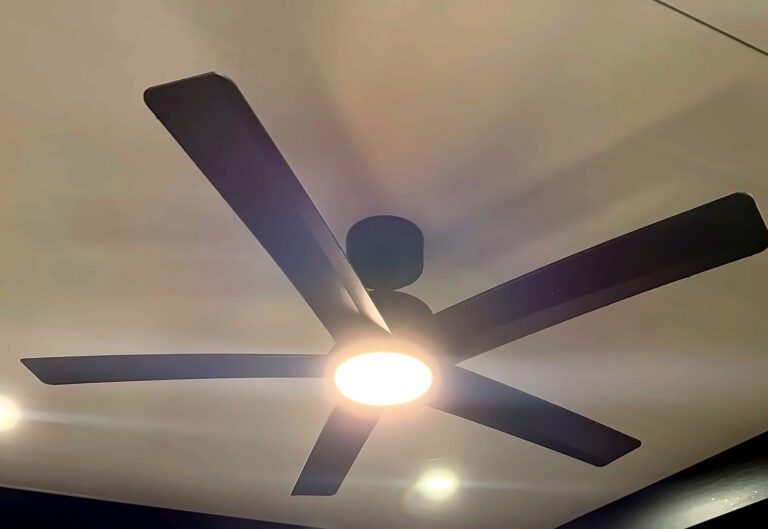
How low should it hang?
The blades should be at least 7 feet above the floor, and 8 to 9 feet works best. On higher ceilings, a longer downrod brings the fan down to where it moves air. A common guide:
| Ceiling height | Downrod |
|---|---|
| 8 ft | Flush mount (“hugger”) or the short rod in the box |
| 9 ft | 6 in |
| 10 ft | 12 in |
| 12 ft | 24 in |
| 14 ft | 36 in |
| 16 ft | 48 in |
Typical manufacturer guidance; we confirm it with your fan and your ceiling on site.
How a ceiling fan install works
Most installs are one visit. New wiring or a new switch is planned at the estimate.
Call our office
Tell us where the fan goes, the ceiling height and what’s there now. We book your free on-site estimate.
Check on site
We check the ceiling, the box, the wiring and the switch, and how you want to control it.
A clear quote
You know the price before any work starts.
Installation
Fan-rated box and brace, wiring and controls, the fan assembled, mounted and balanced.
Test it all
Every speed, both directions, the light and the controls, before we leave.
Every review, connected.
Real Google reviews, word for word. Follow the current, or scroll at your own pace.
andre dunnCalled them out lookin for an electrical fix out in Los Angeles, they came out quick and offered some good options. Thanks a lot Roy super helpful!
Lissa SholtyA circuit tripped furing the extreme hear so I called Volta at 6pm and they were able to schedule service for the next day. On arrival, Eric and his associate were so polite and ready & willing to help. Luckily my problem was just a tripped circuit I didn't know about but they checked all the breakers and made sure everything worked before they left. I'd highly recommend Volta.
Ken OgboguI was having an issue with my Tesla EV wall charger at home, Omer arrived on time the next day, diagnosed the issue and made recommendations. Very professional and knows what he's doing.
Debbie McclainStellar experience. Roy was very professional and easy to talk to, he offered several options at different costs, very affordable as well. Thanks so much to Volta, they made my electrical fix an easy experience.
Colleen NelsonThe electrician Libar was very thorough and professional during his on site assessment. Provided me with a ETA, very considerate about our schedule. Was honest and really explained our options thoroughly. If anyone is in need of electrical services in Los Angeles call Volta Electric!
liran engelhardtHave an amazing experience with Volta electric I needed to replace my subpanel in my condo. Eric came over to give me a quote. He was very professional and a real gentleman. He helped me out through the whole process with permit inspection. Everything was included very happy with them will recommend to anyone in needs for electrician in Los Angeles.
Keh-Chuh TingCalled these guys out for an estimate, and Roy came out, very easy to talk with, went over options with me, and offered something that helped with a discount! Thanks a lot guys.
sheila MixThe best electrical service i ever had! You will be pleased with service and professionalism.
kory smithExcellent job, did what was needed and did it fast.
Christine MunstermanThank you so much Roy! He came back twice because my phone wasn't with me and trouble-shooted our problem in 10 minutes! He billed it as a courtesy call. He's the best!!
Amy PEric is absolutely amazing. He came to help us identify an electrical issues that caused malfunction of our HVAC. The issue has been bothering us for almost 2 years and he’s the first one to identify and fix the issue. Absolutely amazing service and would highly recommend!
JEAN DEJESUSHad a great service with Volta electric Eric was the technician he was very professional and knowledgeable. I needed my electric panel upgraded to 200 AMP they handled the permits and inspection everything from scratch very happy with their services. Will definitely recommend their electrician service services to anyone in needs.
Estela ChavezIt is with great pleasure that I recommend Eric for all your Electrical needs. Eric diagnosed the problem right away and acted swiftly to solve the problem. Eric is the best electrician in the Long Beach area. The prices are very reasonably and the work is of great quality. We will continue to call them for our electrical needs.
Ariel DavidiBest electrician company ever!!! I had Eric from Volta electric come over to give me a quote for outlets installation. He was super professional, knowledgeable and very kind. …
Benjamin Rouillé-d'OrfeuilI needed an electrician for an EV charging project and a a technician named Libar cam to my house to look at the outlet in my garage along with the electrical panel. …
lolashowmeThe absolute best electric company in Los Angeles. Ram Came very quickly after I called and turned what was a complete disaster with my electric into something really simple and easy. And I’m so grateful for their help and I can’t recommend them enough. He was also very patient and friendly. Thank you ram and Volta!
Eunice ZetinoI had Volta electric install light fixtures in my backyard. They did a fantastic job very professional, from the office team to Eric and Junior The electricians, Very satisfied with their services, The price was super competitive. …
Albert TorresHad Volta electric install recessed lights in my kitchen, Oscar the electrician was super professional and easy to work with. 100% recommend anyone in needs for a licensed electrician in Los Angeles ! …
ANGEL TUICOLooked for an electrician in the Los Angeles area and im happy i found Volta Electric. Explained all of the work i needed to get done thoroughly, professionally and was very knowledgable about the trade. …
Annie MarkHad a great experience with Libar from Volta Electric. They were professional, communicative and very thorough from start to finish. The electrician showed up on time, explained everything clearly and efficiently. …
Ceiling fans across Southern California
We install ceiling fans throughout Los Angeles, Orange, Ventura, San Bernardino and Riverside Counties.
Do we serve your city?
Type your city or neighborhood and we’ll check it against our service list.
Related services
Ceiling fan questions
Straight answers to what customers ask us most. Still wondering about something? Call (844) 425-1889.
Do I need an electrician to install a ceiling fan?
If the job needs new wiring, a new box or a new circuit, yes. Even a simple swap means working overhead with a heavy, moving fixture, and the box has to be rated for a fan. A licensed electrician gets the support, the wiring and the balance right.
Can you replace a light fixture with a ceiling fan?
Usually, yes. The key is the box: most light-fixture boxes aren’t made to hold a fan. We replace it with a box marked for fan support, held by a brace between the joists, and add a wall control if you want the fan and light separate.
Why does my ceiling fan wobble?
Usually loose mounting screws, a blade that’s bent or out of balance, or a box that isn’t rated for a fan. We tighten, balance or replace parts, and fix the mounting if that’s the cause.
Which way should my fan spin?
Looking up at it: counterclockwise in summer, to push air down for a cooling breeze; clockwise on low in winter, to move warm air from the ceiling down the walls without a draft.
How far should the fan hang from the ceiling?
The blades should be at least 7 feet above the floor, and 8 to 9 feet is ideal. Higher ceilings need a longer downrod: around 12 inches for a 10-foot ceiling, 24 inches for 12 feet. We confirm it with your fan on site.
Can I control the fan and the light separately?
Yes, with a separate wall control or a remote. If there’s only one switch wire today, we can add a remote or run new wiring for a second switch.
What size ceiling fan do I need?
Mostly it depends on the room. A common guide: up to about 75 square feet, a fan up to 36 inches; up to about 150 square feet, 36 to 42 inches; up to about 225 square feet, around 44 inches; up to about 400 square feet, 50 to 54 inches. We confirm it with your room and the fan maker’s guidance.
Should I repair or replace my ceiling fan?
Small problems like a loose part, a wobble or a failed control can usually be fixed. An old fan with recurring motor or wiring problems is often better replaced. We look at it and tell you honestly.
Can you install a fan on a high or vaulted ceiling?
Yes, with an angled mount where needed and the right downrod length, installed from proper ladders or scaffolding.
Do you install outdoor ceiling fans?
Yes. Covered patios need a fan rated for damp locations; anywhere rain can reach it needs a wet-rated fan. We wire them with the right outdoor fittings.
How much does ceiling fan installation cost?
It depends on whether there’s wiring and a box there now, the ceiling height, and the controls. We don’t quote over the phone; call (844) 425-1889 for a free on-site estimate and you get a clear quote before any work starts.
What warranty do I get?
Our work comes with a 2-year labor warranty, and the fan carries its manufacturer’s warranty.
What areas do you serve?
Los Angeles, Orange, Ventura, San Bernardino and Riverside Counties. See all the cities we serve.
10% off your first job with Volta Electric.
Mention this offer when you call to lock in your discount on any electrical service.
Call now: (844) 425-1889
A cooler room,
installed right.
Call our office to book your free on-site estimate. We check the ceiling, the box and the wiring, and give you a clear quote.
Hours: Sat–Thu 8 AM–11:30 PM · Fri 8 AM–5 PM
- Free on-site estimates, with a clear quote before any work starts
- Licensed, bonded & insured · CA Lic. C-10 #1100197
- Financing options available for qualifying projects