Introduction
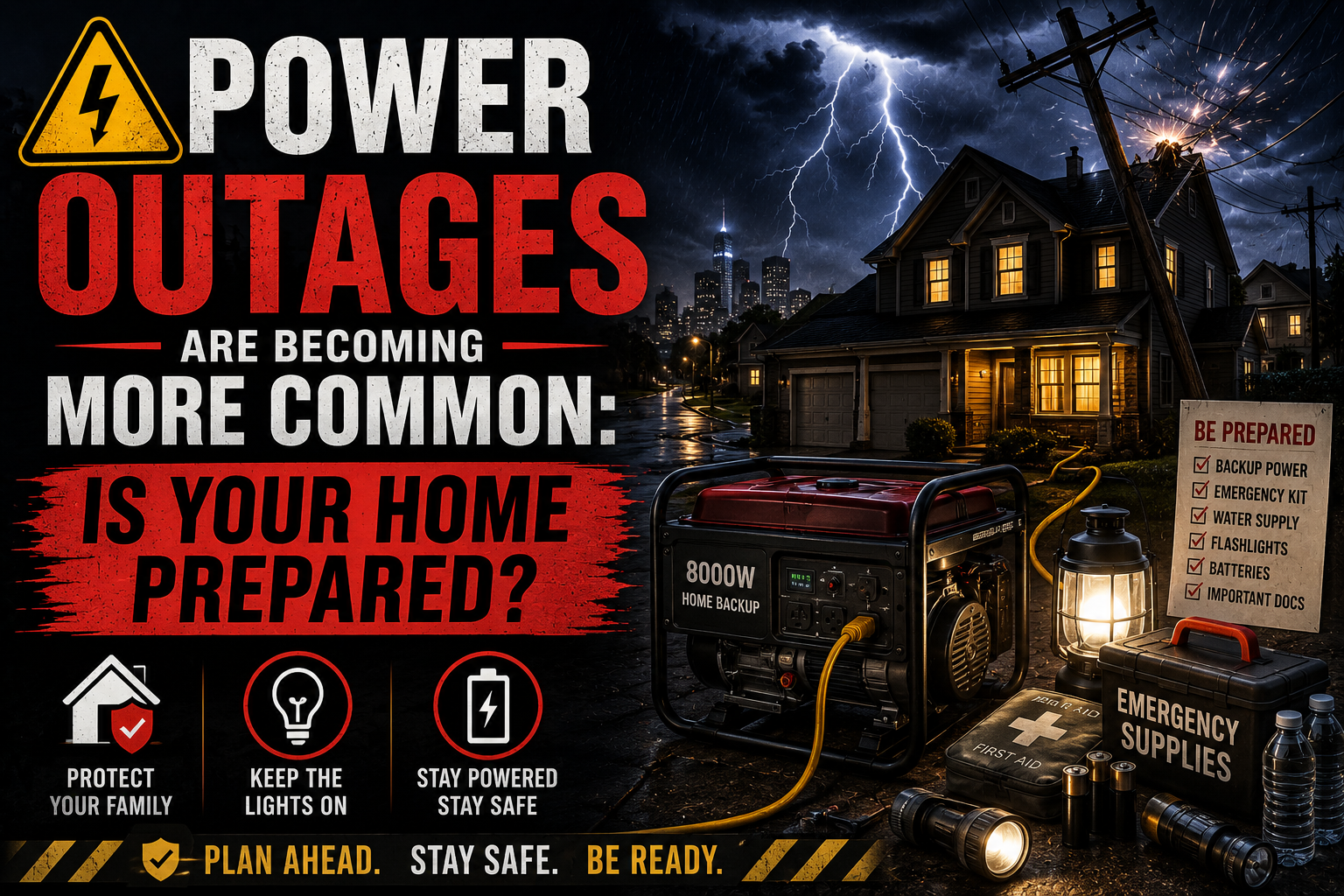
The power goes out on a Thursday evening in August. It is 97 degrees in the San Fernando Valley, and the air conditioning has been running since noon. The refrigerator holds three hundred dollars of groceries. Somewhere in the back bedroom, a family member is on a home oxygen concentrator. In the garage, the sump pump that manages the French drain sits idle.
In one house on the street, none of this matters. The lights flickered for a fraction of a second, there was a quiet mechanical sound from the side yard, and power was restored automatically before anyone could reach for a flashlight. The air conditioning never stopped. The refrigerator never warmed. The oxygen concentrator never missed a cycle.
In the house next door, someone is in the garage unwrapping extension cords, trying to remember where they stored the portable generator they bought two years ago, and discovering that the gasoline in the fuel can has gone stale.
Both households made a decision about backup power. They made different decisions, and the consequences of those decisions are playing out on the same street, in the same outage, at the same moment. One household is comfortable and protected. The other is managing a problem that is getting more complicated by the minute.
This is not a hypothetical designed to sell the more expensive option. It is an accurate description of how backup power decisions actually play out during real outages — and why understanding the genuine differences between whole-house standby generator installation and portable generator ownership matters before an outage makes the comparison for you.
This guide covers both options honestly and completely: what each one provides, what each one does not provide, what each one costs both upfront and over time, and what the specific characteristics of your household and your property should drive the decision. By the end of it, you will have a clear, factual basis for the choice — not a sales pitch, but an actual comparison between two genuinely different approaches to backup power protection.

Understanding the Core Difference Between the Two Options
Before examining cost, capability, or installation requirements, it is worth being clear about what each type of generator actually is — because the fundamental design difference between a whole-house standby generator and a portable generator shapes every specific characteristic that follows.
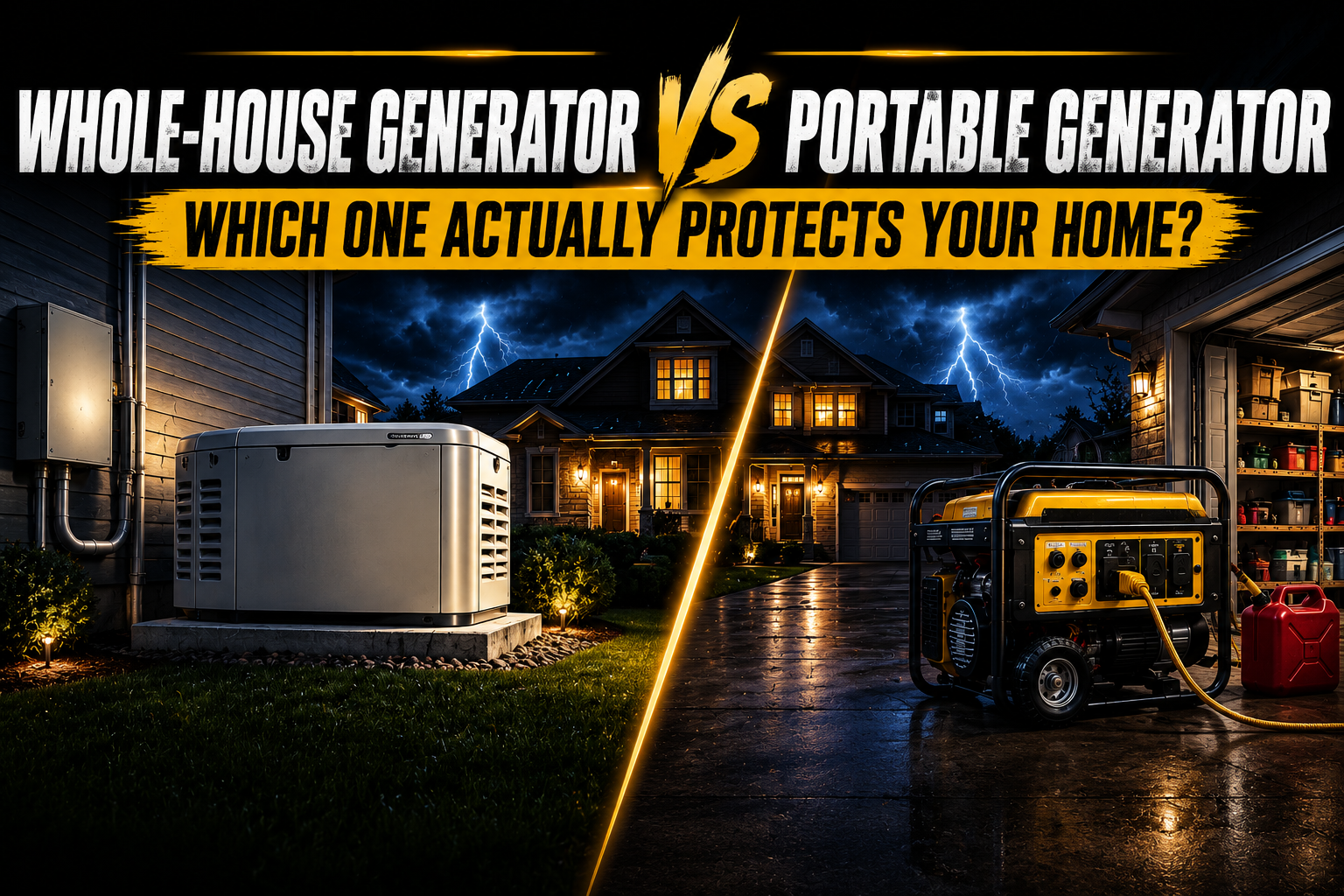
A whole-house standby generator is a permanently installed, permanently connected piece of equipment. It sits on a concrete pad outside the home, connected to the home’s electrical panel through an automatic transfer switch, and fueled by a natural gas or propane supply that is either the home’s existing utility gas line or a dedicated propane tank. It monitors utility power continuously. When utility power fails, it starts automatically — typically within ten to thirty seconds — and transfers the home’s electrical load to generator power without any action required from the homeowner. When utility power is restored, it transfers back automatically and shuts down. The homeowner may not even know an outage occurred if it was brief.
A portable generator is a fuel-powered engine mounted to a frame with wheels, stored wherever space allows, and operated when needed by retrieving it, connecting it to fuel, starting it, running extension cords to the devices you want to power, or connecting it to the home’s wiring through a manual transfer switch or interlock device if one has been installed. It requires gasoline or dual-fuel operation, it must be operated outdoors at a safe distance from any opening into the home because of carbon monoxide production, and it provides power to whatever is physically connected to it rather than to the home’s electrical system as a whole.
These are not two versions of the same thing. They are two fundamentally different approaches to backup power — one automatic, permanent, and comprehensive; one manual, stored, and selective. Every specific comparison that follows flows from this fundamental difference.
What a Whole-House Standby Generator Actually Provides
Automatic Operation Without Homeowner Intervention
The defining characteristic of a whole-house standby generator — the one that separates it most meaningfully from every portable option — is that it requires nothing from the homeowner to activate. The automatic transfer switch monitors utility power, detects the outage, starts the generator, and transfers the load in a sequence that takes less time than it takes most people to find a flashlight in the dark.
This matters more than it might initially seem. Outages in Los Angeles and the surrounding communities frequently occur at the worst possible moments — overnight when households are asleep, during extreme heat events when the grid is overloaded, during the wind events and Public Safety Power Shutoffs that Southern California Edison and LADWP implement during high fire danger conditions. In every one of these scenarios, the automatic activation of a standby generator means that protection is present when it is needed, regardless of whether anyone is home, regardless of the time of day, and regardless of whether the outage was anticipated.
A homeowner who is away from the property when an outage occurs — traveling for work, on vacation, at a school event — cannot activate a portable generator remotely. The sump pump stays off. The refrigerator warms. The security system reverts to battery backup that eventually depletes. The standby generator activates whether anyone is home or not.
Whole-Home Coverage Without Load Selection
A properly sized whole-house standby generator — specified by a licensed electrician based on the home’s electrical load profile — powers the entire home’s electrical system. Every circuit in the home has power. The air conditioning runs. The refrigerator and freezer run. The security system, the garage door openers, the home office equipment, the medical devices, the pool equipment, the landscape lighting — everything that has power from the utility has power from the generator, without the homeowner selecting which loads to prioritize or running extension cords to critical equipment.
Some whole-house standby generator installations use a load management approach — where the generator’s capacity is sized to power most but not all of the home’s circuits, and the automatic transfer switch manages which high-draw circuits are energized at any given time to stay within the generator’s capacity. This approach allows a modestly sized generator to serve a home with large aggregate electrical loads by prioritizing essential circuits. It is a legitimate design approach that an experienced generator installation electrician will discuss when the home’s load profile and budget are assessed together.
Fuel That Does Not Require Advance Preparation or Maintenance
Natural gas standby generators are connected to the home’s existing gas supply — the same supply that serves the furnace, water heater, and kitchen range. Natural gas supply is almost never interrupted during the electrical outages that create demand for generator power. The generator’s fuel supply is continuous, and the generator can run as long as the natural gas supply is available — which in the extended Public Safety Power Shutoff events that have affected communities across Los Angeles County in recent years can mean days of continuous operation.
Propane standby generators require a dedicated tank that must be maintained at adequate fuel levels — a discipline that involves periodic delivery scheduling and attention to tank level before storm season or anticipated fire weather events. With appropriate attention to tank maintenance, a propane standby generator provides comparable operational reliability to a natural gas unit.
In either case, the fuel preparation that portable generator ownership requires — maintaining fresh gasoline, adding fuel stabilizer for storage, refueling during an outage from stations that may themselves lack power — is entirely absent from standby generator operation.
Exercise Cycles and Self-Maintenance
Whole-house standby generators run an automatic weekly exercise cycle — a brief period of operation under light load — that keeps the engine ready for activation, confirms that the system is functional, and alerts the homeowner to any developing mechanical issues through the generator’s monitoring system. This automatic self-maintenance means the generator is confirmed operational on a regular basis without any homeowner action.
A portable generator that sits in storage for two years without use may or may not start when needed. The carburetor may be varnished with stale fuel. The battery — if it has an electric start — may be depleted. The fuel in the tank or can may have degraded. The first discovery of any of these conditions is typically during an outage, when the generator’s operational status is no longer academic.
What a Portable Generator Actually Provides — and What It Does Not
Selective Power for Essential Loads
A portable generator is honest about what it is: a power source for specific, connected loads rather than a substitute for utility power. At its best, a correctly operated portable generator with adequate capacity can power a refrigerator, several window air conditioning units, critical lighting, phone charging, and other selected loads — providing meaningful relief during an outage without restoring full household function.
For households whose backup power needs are genuinely limited — who rent rather than own, who live in a mild climate where heating and cooling are not life-safety issues, who do not have medical equipment dependencies, and who are primarily concerned about food preservation and basic lighting — a portable generator addresses real needs at a fraction of the cost of a standby system.
The key qualifier is that the portable generator’s value is precisely proportional to the preparation that precedes the outage: fresh fuel, a working engine, a manual transfer switch or interlock that allows safe connection to the home’s wiring, appropriate extension cords rated for the loads being carried, and the physical capability to retrieve and operate the unit. These preparations must be made before the outage and maintained through the periods between outages — which in Los Angeles can be months or years apart, long enough for preparations to lapse.
The Carbon Monoxide Reality
Portable generators produce carbon monoxide — an odorless, colorless gas that is lethal at concentrations that accumulate rapidly in enclosed and semi-enclosed spaces. Carbon monoxide poisoning from portable generators is a documented, recurring cause of injury and death during power outages, and the specific scenarios that cause it — operating a generator in a garage with the door open, operating one too close to a window or vent, bringing one inside during rain — are exactly the scenarios that exhausted, stressed homeowners make during real outages.
The Consumer Product Safety Commission and the Centers for Disease Control document generator-related carbon monoxide deaths after virtually every major outage event in the United States. These are not rare exceptions. They are predictable consequences of a product whose carbon monoxide production is poorly understood by the general public and whose safe operation requires maintaining a significant clearance from any building opening under conditions where the instinct is to move it closer to the house for convenience.
Whole-house standby generators are installed in a fixed, code-compliant location that maintains required clearances from building openings. Their placement is determined during the installation planning process by a licensed electrician familiar with the applicable codes. They do not need to be repositioned during an outage. The carbon monoxide hazard that is the most serious safety concern of portable generator operation does not apply to correctly installed standby generators.
The Transfer Switch Question
A portable generator connected to a home’s electrical system through extension cords is providing power to whatever is plugged into those cords. To power hardwired equipment — the central air conditioner, the furnace, the water heater, lights and outlets throughout the house — the generator must be connected to the home’s electrical panel through a transfer switch or generator interlock device that isolates the home’s wiring from the utility before connecting generator power.
This transfer switch connection is not optional from a safety standpoint. Connecting a generator to the home’s wiring without a properly installed transfer switch creates a condition called backfeeding — where generator power travels back through the meter and onto the utility’s lines, creating a hazard for utility workers who may be repairing lines they believe to be de-energized. Backfeeding is a serious safety violation and has caused utility worker deaths. It is also a violation of the interconnection requirements of every utility in Los Angeles and the surrounding area.
A correctly installed manual transfer switch or generator interlock, installed by a licensed electrician, eliminates the back feeding hazard and allows a portable generator to safely power the circuits it is connected to. This installation adds cost to portable generator ownership — typically $500 to $1,500 for the transfer switch and installation — and requires a permit. Homeowners who are operating portable generators without a transfer switch, using extension cords to power selected loads rather than connecting to the panel, are staying on the right side of the back feeding issue but are limited to whatever loads they can physically connect through extension cords.
The Real Cost Comparison
Generator cost comparisons that focus exclusively on purchase price misrepresent the actual financial picture of both options. The complete cost comparison requires accounting for installation, fuel, maintenance, operational requirements, and the value of what each option actually provides.
Whole-House Standby Generator: Total Cost of Ownership
The upfront cost of a whole-house standby generator installation in Los Angeles includes the generator unit, the automatic transfer switch, the installation labor, the fuel line connection or propane tank installation, the concrete pad, and the required permits and inspections. For a residential standby generator sized for whole-home coverage — typically in the 20-kilowatt to 26-kilowatt range for a standard Los Angeles single-family home — total installed cost typically runs from $8,000 to $18,000, with variation driven by generator size, fuel type, site conditions, panel configuration, and the distance from the gas meter or propane tank to the generator location.
Larger homes with significant HVAC loads, swimming pools, or whole-home EV charging infrastructure may require generators in the 30-kilowatt to 50-kilowatt range, with installed costs correspondingly higher. Smaller homes or installations using load management to serve essential circuits with a smaller generator can be completed at the lower end of the range.
Ongoing costs include an annual maintenance service — typically $150 to $300 — that covers oil and filter changes, spark plug inspection, battery maintenance, and operational testing. Natural gas standby generators add a modest amount to the monthly gas bill during exercise cycles and outage operation; the incremental fuel cost during a multi-day outage is a fraction of what portable generator fueling costs for the same duration.
Portable Generator: Total Cost of Ownership
A quality portable generator with adequate capacity for meaningful household coverage — in the 7,500-watt to 12,000-watt range — costs $800 to $2,500 for the unit. Add a manual transfer switch installation by a licensed electrician — $500 to $1,500 — and the initial investment reaches $1,300 to $4,000. This is significantly less than a standby generator installation, and the initial cost difference is real.
The ongoing costs of portable generator ownership are less visible but meaningful. Gasoline for operation during outages at a cost that depends on outage duration — a 10,000-watt generator running at 50 percent load consumes approximately one gallon per hour, which across a 72-hour outage represents significant fuel cost and the challenge of obtaining fuel when stations may themselves lack power. Fuel stabilizer for storage periods. Oil changes every 50 to 100 hours of operation. Carburetor cleaning or replacement if the unit sits unused for extended periods with fuel in the system. Battery replacement for electric start units whose batteries discharge during storage.
The operational labor of portable generator use — retrieving the unit, connecting fuel, starting the engine, running extension cords or connecting to the transfer switch, monitoring fuel level, refueling, eventually shutting down and storing the unit — is a cost that does not appear in any financial accounting but represents real effort during the circumstances when that effort is hardest to provide.
The Value Comparison That Financial Accounting Misses
A comparison of total costs that treats the two options as providing equivalent protection is not an accurate comparison. They do not provide equivalent protection. The food preservation value, the medical equipment continuity, the home security continuity, the HVAC continuity during extreme temperature events, and the automated protection of the entire property during an extended absence — these are the things that a whole-house standby generator provides that a portable generator does not.
For households where these differences are material — where a family member depends on powered medical equipment, where extended food spoilage would represent significant loss, where the home is a rental property or vacation property that may be unoccupied during an outage, where the extreme heat events of Los Angeles summers represent genuine health risks without air conditioning — the cost comparison is not simply $15,000 versus $3,000. It is the cost of comprehensive, automatic protection versus the cost of selective, manual protection during the circumstances when the distinction matters most.
Whole-House Generator Installation: What the Process Involves
For Los Angeles homeowners who have decided that a standby generator installation is the right choice, understanding what the installation process involves removes the uncertainty that sometimes delays a decision that should be made well before the next significant outage.
Site Assessment and Generator Sizing
The installation process begins with a site assessment that covers the home’s electrical load profile, the panel configuration, the available fuel supply, the physical site characteristics that determine generator placement, and the local code and permit requirements that apply to the specific jurisdiction.
Generator sizing is determined by a load calculation — the same type of formal assessment used for panel upgrade planning — that identifies the aggregate electrical load of the circuits the generator will serve. A generator that is undersized for the home’s load will either fail to start critical equipment or shut down under overload conditions during an outage. A generator that is significantly oversized runs inefficiently and costs more than necessary. Correct sizing, based on actual load assessment rather than general rules of thumb, is one of the most important things a licensed electrician brings to the generator installation planning process.
The Automatic Transfer Switch
The automatic transfer switch is the component that makes standby generation work. It monitors utility power continuously, detects outage conditions, starts the generator, waits for the generator to reach stable output voltage and frequency, transfers the home’s electrical load from utility to generator, and reverses this process when utility power is restored. The transfer switch is also the safety mechanism that prevents backfeeding — it physically disconnects the home’s wiring from the utility before connecting generator power, ensuring that generator power cannot reach the utility’s lines.
Transfer switches are available in whole-home configurations — where every circuit in the panel is transferred — and in load-center configurations — where a selected subset of critical circuits is transferred to a subpanel served by the generator. The correct configuration depends on the generator’s capacity relative to the home’s load and the homeowner’s priorities for which circuits must have generator power.
Fuel Line Connection and Permitting
In Los Angeles, natural gas standby generator installation requires connection to the home’s existing gas supply through a dedicated gas line run from the meter or from an appropriate connection point in the existing gas piping. This work requires a permit from the relevant jurisdiction and must be performed by a licensed contractor — a licensed plumber for the gas line work and a licensed electrician for the electrical installation, or a contractor holding both relevant licenses.
The permit process for standby generator installation in Los Angeles typically involves permits for both the electrical work and the gas work, with inspections for each. LADWP or Southern California Edison coordination may be required depending on the utility serving the property and the specifics of the installation. A licensed electrical contractor familiar with standby generator installation in Los Angeles manages this permitting and coordination process as a standard part of the installation scope.
Propane standby generator installations require a dedicated propane tank — either above-ground or buried, depending on site conditions and local code requirements — and a regulator and piping system connecting the tank to the generator. Propane tank installation and the associated permitting involves coordination with the propane supplier and the relevant jurisdiction in addition to the electrical and plumbing work.
Placement Requirements and Clearances
Standby generators must be placed in compliance with National Electrical Code requirements, California Electrical Code amendments, and the specific manufacturer’s installation clearances — which specify minimum distances from building openings, property lines, combustible materials, and other structures. In Los Angeles, where lot sizes and site configurations vary enormously from the dense urban neighborhoods of Culver City and Burbank to the larger lots of Pasadena and Westlake Village, finding a compliant placement sometimes requires creative site planning.
A concrete pad of appropriate dimensions must be poured to provide a stable, level surface for the generator. The pad location determines the conduit routing from the generator to the transfer switch and panel, and the gas line routing from the meter or propane tank. A licensed electrician performing a site assessment will identify the compliant placement options for the specific property and discuss how each option affects the installation scope and cost.
Specific Household Situations and Which Option Fits
Rather than a universal recommendation, the choice between a whole-house standby generator and a portable generator is genuinely situation-dependent. Several household characteristics drive the decision more clearly than any general principle.
Medical Equipment Dependencies
For any household where a family member depends on powered medical equipment — home oxygen concentrators, CPAP or BiPAP machines, home dialysis equipment, powered hospital beds, infusion pumps, or other life-sustaining devices — a whole-house standby generator is not a comfort upgrade. It is a safety necessity. The automatic activation, the continuity of power without human intervention, and the ability to maintain full household power including HVAC to maintain appropriate temperature conditions for the patient — these are not conveniences. They are the conditions under which the medical equipment functions correctly and the patient remains safe.
Portable generator operation for medical equipment requires the equipment to be physically connected to the generator, the generator to be correctly operated outdoors at a safe distance, and the entire system to depend on a human being present and capable of managing it. These requirements are not always met during the circumstances when power failure poses the greatest risk to medically dependent household members.
Rental Properties, Vacation Homes, and Frequently Absent Owners
For property owners who are not consistently present at the property — rental properties in Long Beach, Torrance, or Burbank where tenants occupy the home; vacation properties in the mountains or desert that are used intermittently; owners who travel frequently for work — a portable generator provides protection only when someone is present and prepared to operate it. An unoccupied rental property during a three-day outage has no one to start the portable generator, and the tenants — who did not purchase the generator and may not know how to operate it safely — are not well served by the portable option.
A whole-house standby generator on a rental property or vacation property protects the property — the refrigerator, the HVAC system, the security system, the pipes in cold weather — automatically, without any action from the tenants or the absent owner. It also represents a genuine differentiating amenity in the rental market.
Homes in High Fire Risk or Repeated Outage Areas
Los Angeles County communities in the wildland-urban interface — areas of the Santa Monica Mountains, the Verdugo Hills, the San Gabriel foothills above Pasadena and Arcadia — are subject to Public Safety Power Shutoffs that can last multiple days and that are implemented with relatively short notice. Communities throughout the region that experienced the power outages associated with recent wind events and wildfires understand that outages in this region are not always brief, not always predictable, and sometimes occur precisely when conditions outside make operating a portable generator difficult or dangerous.
For households in these areas, the multi-day operational reliability of a natural gas standby generator — which does not run out of fuel, does not require outdoor operation during dangerous wind conditions, and does not depend on gasoline that may be unavailable when regional infrastructure is stressed — represents a materially different level of protection than a portable generator.
Urban Apartments, Condos, and Renters
For renters, condominium owners in buildings without standby generator provisions, and households in dense urban settings where outdoor generator operation is impractical — the portable generator’s limitations are most pronounced and the standby generator’s installation requirements are most challenging. In these situations, the practical options may be limited to battery backup systems for essential devices, membership in a public charging network, and realistic planning around what can and cannot be maintained during an outage rather than a generator of either type.
This is a genuine constraint that applies to a significant portion of Los Angeles’s housing stock — multi-unit buildings, urban apartments, and dense neighborhood settings where neither standby generator installation nor safe portable generator operation is straightforwardly practical. A licensed electrician can assess whether a battery backup system — connected to the home’s critical circuits through a transfer switch in a way that provides meaningful outage protection without a generator — represents a viable alternative for these situations.
The Role of the Licensed Electrician in Generator Installation
The licensed electrician is not one participant among many in a generator installation project. They are the central figure — the professional responsible for every electrical component of the installation, and the professional who coordinates the fuel, permitting, and utility elements that involve other parties.
For standby generator installation specifically, the electrician’s role covers the automatic transfer switch specification and installation, the generator-to-panel electrical connection, the conduit routing between the generator pad and the transfer switch, the load calculation that determines correct generator sizing, the permit application and inspection coordination for the electrical scope, and the ongoing maintenance relationship that keeps the system functional over its service life.
In Los Angeles and the surrounding communities, this work requires a C-10 Electrical Contractor license from the California Contractors State License Board. Generator installation that involves gas line work additionally requires the involvement of a licensed C-36 Plumbing Contractor for the gas piping, or a general contractor whose license covers both scopes. Verifying these credentials before engaging any contractor for generator installation is the minimum due diligence that every homeowner should perform — the CSLB’s online verification tool provides current license status, bonding, and disciplinary history in under two minutes.
Frequently Asked Questions
How large a generator do I need for a typical Los Angeles home?
Generator sizing depends on the specific electrical load profile of the home, not on square footage alone. A licensed electrician performs a load calculation that identifies the aggregate draw of the circuits the generator will serve. For a typical Los Angeles single-family home with central air conditioning, a refrigerator and freezer, standard lighting and outlet loads, and a home office or entertainment system, a generator in the 20-kilowatt to 26-kilowatt range typically provides whole-home coverage. Homes with additional high-draw loads — EV chargers, pool equipment, electric vehicle supply equipment, electric ranges or dryers — may require larger capacity or a load management approach.
How long can a natural gas standby generator run continuously?
A natural gas standby generator connected to the utility’s gas supply can run as long as natural gas is available — which during the electrical outages that create demand for generator power is essentially continuous. Multi-day Public Safety Power Shutoffs, storm-related outages, and grid failures do not typically interrupt natural gas supply. The practical limit on standby generator operation is maintenance intervals — oil changes are typically required after 100 to 200 hours of continuous operation — which an extended outage may eventually require.
What permits are required for standby generator installation in Los Angeles?
Standby generator installation in Los Angeles requires electrical permits from the Department of Building and Safety for properties within city limits, or from the applicable jurisdiction for Pasadena, Glendale, Burbank, Long Beach, Torrance, and surrounding communities. Gas line work requires a separate plumbing permit. In some jurisdictions, the generator pad and any structural work may require an additional building permit. A licensed electrical contractor managing the installation coordinates all required permits as a standard component of the project scope.
Can a portable generator be connected safely to my home’s electrical panel?
Yes, with the correct transfer switch or generator interlock device installed by a licensed electrician. A manual transfer switch isolates the home’s wiring from the utility before connecting generator power — preventing the backfeeding that makes direct panel connections without a transfer switch dangerous. This installation requires a permit and inspection. Without a transfer switch, a portable generator should be used only through extension cords to specific loads — never connected directly to the panel through an outlet or direct wiring.
How far does a standby generator need to be from the house?
The specific clearance requirements depend on the generator manufacturer’s installation specifications and the applicable local code. General requirements include a minimum distance from any building opening — windows, doors, vents — to prevent exhaust gases from entering the building, and minimum clearances from combustible materials and property lines. The National Electrical Code and California amendments provide the baseline requirements, which the manufacturer’s specifications may exceed. A licensed electrician conducting a site assessment will identify compliant placement options for the specific property.
What maintenance does a whole-house standby generator require?
Annual maintenance service by a licensed generator service technician is the standard maintenance interval for most residential standby generators. A typical annual service covers oil and filter changes, spark plug inspection and replacement on schedule, battery testing and maintenance, air filter inspection, coolant check for liquid-cooled units, operational testing, and review of any fault codes or alerts logged since the previous service. Between annual services, the generator’s weekly exercise cycle confirms operational status, and the generator’s monitoring system alerts the homeowner to conditions that require attention.
Is a whole-house generator worth it in Los Angeles specifically?
For homeowners whose properties are in areas subject to Public Safety Power Shutoffs, who have household members with medical equipment dependencies, who own rental or vacation properties, or who have experienced extended outages and want to eliminate the disruption and risk they represent — the answer is consistently yes in the Los Angeles context. The specific combination of extreme summer heat that makes power loss a health risk, wildfire-related outage risk that can produce multi-day shutoffs with limited warning, and an aging grid infrastructure in some parts of the region creates a risk profile that standby generation addresses directly and that portable generation addresses only partially.
What is the difference between a transfer switch and a generator interlock?
A transfer switch is a dedicated device that mechanically and electrically transfers the connected circuits between utility power and generator power. An automatic transfer switch does this automatically when it detects an outage; a manual transfer switch requires the homeowner to operate it. A generator interlock is a simpler, less expensive device — a mechanical bracket installed on the panel that prevents the main breaker and the generator backfeed breaker from being on simultaneously, ensuring the utility is disconnected before generator power is connected. Generator interlocks are less expensive than transfer switches and serve the essential safety function of preventing back feeding, but they require the homeowner to manually manage the switching process and they do not provide the automatic operation that a standby generator installation requires.
Conclusion
The comparison between a whole-house standby generator and a portable generator is not really a comparison between two versions of the same thing. It is a comparison between two different philosophies of backup power — one that provides comprehensive, automatic, fuel-secure protection for the entire household without requiring any action from anyone, and one that provides selective, manual, fuel-dependent protection for whatever the homeowner connects to it when they are present and prepared.
Both philosophies have a place. For households with limited backup power needs, moderate budgets, and the discipline to maintain operational readiness, a correctly installed portable generator with a manual transfer switch provides meaningful protection at a fraction of the cost of standby generation. For households with medical equipment dependencies, frequent absences, high-value homes and contents, or exposure to the multi-day outages that Public Safety Power Shutoffs can produce in Los Angeles — whole-house generator installation is not a luxury addition. It is the only backup power solution that actually protects the home in the full range of scenarios it will face.
The electrician who installs your generator installation — whether standby or portable transfer switch — is the professional whose work determines whether your backup power performs when the grid fails. That work deserves the same standard of licensing verification, permit compliance, and installation quality that any critical home system installation deserves.
Choose the generator that fits your household’s actual situation. Choose the electrician whose credentials and approach you have verified. And make that choice before the next outage makes it for you.
Professional Generator Installation From Volta Electric
Volta Electric Inc. is fully licensed, bonded, and insured, serving Los Angeles, Pasadena, Glendale, Burbank, Beverly Hills, Santa Monica, Westlake Village, Culver City, Long Beach, Torrance, and all of Los Angeles County with professional standby generator installation, backup generator installation, whole house generator installation, manual and automatic transfer switch installation, generator interlock installation, electrical panel upgrades, and the complete range of residential and commercial electrical services.
We assess your home’s specific load profile, recommend the correctly sized generator for your household’s actual needs, manage all permitting and utility coordination, and install the system to a standard that performs when the power fails — which is the only moment the installation actually matters.
Free estimates on all generator installation projects. Same-day appointments available for urgent situations.
Contact Volta Electric Inc. today to schedule your generator installation assessment. The next outage is coming. Be ready for it.
Volta Electric Inc. | Licensed Electrical Contractor | C-10 License | Serving Los Angeles, Pasadena, Glendale, Burbank, Beverly Hills, Santa Monica, Westlake Village, Culver City, Long Beach, Torrance & All of Los Angeles County | Free Estimates | Same-Day Appointments Available