
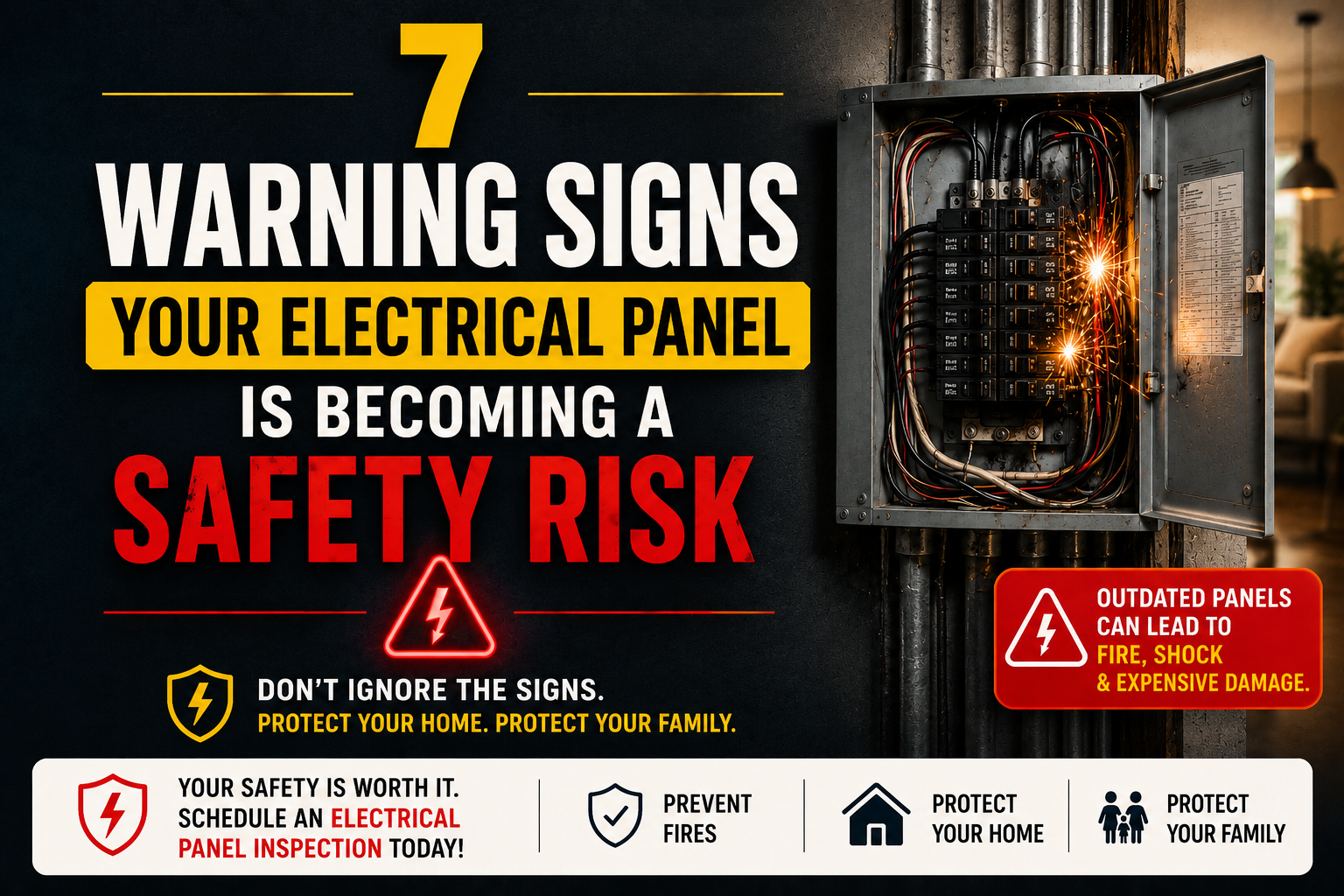
Most Homeowners Miss These Warning Signs Until Something Goes Seriously Wrong
There is a particular blind spot that affects even the most attentive homeowners. They notice when the roof leaks, when the water heater makes strange sounds, when the HVAC system starts struggling to keep up. These are visible, audible, tangible problems that demand attention.
The electrical panel sits quietly in a closet, a garage wall, or a utility room and does its job without asking for acknowledgment. Most homeowners walk past it dozens of times a week without giving it a second thought. And for years — sometimes decades — that arrangement works well enough. Until it doesn’t.
The problem with electrical panel failures is that they rarely announce themselves with the kind of dramatic, unmistakable signal that other home system failures produce. They build slowly, through a progression of warning signs that are easy to rationalize, easy to dismiss, and easy to attribute to something other than what they actually indicate. A breaker that trips once gets reset and forgotten. A light that flickers gets blamed on the bulb. A faint smell that comes and goes gets attributed to something in the kitchen or the garage.
By the time the situation escalates into something that cannot be ignored — a breaker that won’t reset at all, visible scorching on the panel cover, a circuit that goes dead and stays dead — the panel has typically been communicating distress for months or years. The homeowners who catch these problems early, who recognize the warning signs for what they are and act on them before they escalate, protect their homes, their families, and their finances in ways that are difficult to quantify until you consider what the alternative looks like.
At Volta Electric Inc., we inspect and upgrade electrical panels throughout Los Angeles County, serving homeowners in San Fernando, Arcadia, Santa Clarita, Westlake Village, and surrounding communities. This guide covers the seven warning signs that your electrical panel is becoming a safety risk — what each one means, why it matters, and what to do about it.
Why Electrical Panels Fail: The Background You Need
Before examining the specific warning signs, it helps to understand the context that makes panel failure a realistic concern for a significant portion of Los Angeles homeowners rather than a theoretical possibility.
Los Angeles County has one of the oldest residential housing stocks in California. A substantial portion of the single-family homes in established neighborhoods across the county were built between the 1940s and 1970s — an era when electrical panels were designed for a fraction of the load that modern homes carry. The 60-amp and 100-amp panels that were standard during those decades were sized for a world without central air conditioning, without induction cooktops, without home office infrastructure, and without the proliferation of electronics that defines contemporary residential life.
Beyond raw capacity, age creates its own failure mechanisms. Breakers have mechanical components that wear through decades of operation. Bus bar connections develop resistance through thousands of thermal expansion and contraction cycles. Insulation on internal wiring deteriorates. The cumulative effect is a panel that may have been adequately designed for its era and correctly installed at the time but has reached the end of its reliable service life.
On top of the age dimension, Los Angeles has a documented population of panel brands with known safety histories — Federal Pacific Electric Stab-Lok panels and Zinsco panels that were installed throughout the county during the same decades and have failure characteristics that make them worth replacing regardless of age or apparent condition.
Understanding this background makes the warning signs that follow more meaningful — they are not isolated quirks but communications from a system under stress.
Warning Sign 1: Breakers That Trip Frequently or Refuse to Reset
What Is Actually Happening
A circuit breaker has one essential job: to interrupt current flow when a circuit is carrying more amperage than it was designed to handle safely. When a breaker trips, it is performing its protective function correctly. The concern is not a breaker that trips once under a genuine overload condition — that is normal operation. The concern is a breaker that trips repeatedly under loads that shouldn’t be triggering it, or one that trips and cannot be successfully reset.
Frequent tripping on circuits that are not obviously overloaded indicates one of several underlying conditions. The breaker itself may be worn and triggering at amperage levels below its rated threshold — a failure mode that develops in aging breakers whose internal mechanisms have degraded through years of operation. The circuit may be carrying more load than its design anticipated because additional outlets or fixtures have been added over the years without corresponding electrical infrastructure updates. Or the panel itself may be operating near its total capacity, creating conditions where individual circuits are more susceptible to overcurrent events.
A breaker that trips and refuses to reset — one that trips again immediately after being switched back to the on position — is communicating something more urgent. It is telling you that the fault condition that caused the trip has not resolved, which means the protective function is working but the underlying problem is persisting. Forcing a breaker to stay on through repeated resets when it wants to trip is one of the most dangerous things a homeowner can do with their electrical system.
What It Means for Your Panel
Occasional tripping on a heavily loaded circuit is not necessarily a panel-level concern. Persistent tripping across multiple circuits, or a pattern of tripping that has developed gradually over months, is a panel-level concern. It suggests either that the panel’s capacity has become inadequate for the home’s actual electrical load or that aging breakers are no longer performing reliably — both of which warrant professional evaluation rather than repeated resets and continued monitoring.
Warning Sign 2: Flickering or Dimming Lights
What Is Actually Happening
Lights that flicker or dim briefly when a large appliance activates — the air conditioner compressor kicking on, the refrigerator starting its cooling cycle, the washing machine motor engaging — are experiencing a voltage drop. When a large motor-driven load starts, it draws a significant inrush current that momentarily reduces the voltage available to other circuits. In a properly sized electrical system with adequate capacity, this voltage drop is minimal and its effect on lighting is imperceptible.
When the voltage drop is visible — when lights dim noticeably or flicker in response to appliance activation — the electrical system is telling you that it lacks the capacity to handle the combined load without voltage fluctuations. In mild cases, this indicates a panel approaching its capacity ceiling. In more pronounced cases, it may indicate aging bus connections that have developed resistance, a service entrance that is undersized for the home’s current load, or wiring deficiencies in the affected circuits.
Lights that flicker without any identifiable trigger — randomly, regardless of what other loads are operating — indicate a different and potentially more serious condition. Random flickering can result from loose connections in the panel, deteriorating wiring at junction points, or a failing breaker making intermittent contact. These conditions generate the kind of arcing that AFCI (Arc Fault Circuit Interrupter) protection is designed to detect — and they represent fire risk that persistent flickering should never be allowed to become.
What It Means for Your Panel
Consistent dimming when large appliances start is an efficiency and capacity concern that typically resolves with a panel upgrade. Random flickering is a safety concern that warrants immediate professional investigation regardless of how intermittent it seems. The difference matters, and a licensed electrician can distinguish between the two during a panel assessment.
Warning Sign 3: A Burning Smell Near the Panel or Outlets
What Is Actually Happening
This is the warning sign that should stop you in your tracks regardless of how faint or intermittent it seems. A burning smell emanating from your electrical panel, from outlets, or from areas of the wall where wiring runs indicates that something in your electrical system is generating enough heat to affect surrounding materials — insulation, wire jacketing, the plastic components of outlet boxes, or in the worst cases, the framing and insulation inside your walls.
The most common source of a burning smell from an electrical panel is an overloaded circuit or failing breaker generating heat at the panel’s internal connections. Heat that builds up in an enclosed panel enclosure has nowhere to dissipate efficiently, and it affects adjacent components — insulation on internal wiring, the plastic of breaker housings, the bus bar connections — in ways that degrade the panel’s integrity and create conditions for more serious failure.
A burning smell from outlets or wall areas where no panel is located indicates a connection problem downstream from the panel — a loose wire at an outlet box, a junction connection that has developed resistance, or wiring that is carrying more current than it was designed for. Any of these conditions can generate enough heat to ignite surrounding materials, and the insidious aspect of wall-cavity electrical fires is that they can burn for an extended period before becoming visible.
What It Means for Your Panel
There is no threshold below which a burning smell from electrical equipment is acceptable. A faint smell that comes and goes is not a minor concern that can be monitored — it is a sign of a fault condition that needs to be diagnosed and resolved immediately. Contact a licensed electrician the same day. If the smell is strong, continuous, or accompanied by visible discoloration or smoke, treat it as an emergency.
Warning Sign 4: The Panel Feels Warm or Hot to the Touch
What Is Actually Happening
An electrical panel operating normally generates some heat — current flowing through conductors and connections produces thermal energy as a byproduct of resistance, and a panel under load will be slightly warm. What it should not be is noticeably warm to the touch on the exterior cover, and it certainly should not be hot.
A panel cover that feels distinctly warm indicates that heat is being generated inside the enclosure at a rate that is conducting through the metal cover — a level of heat production that exceeds normal operating parameters significantly. The internal temperature that would produce a noticeably warm exterior is well above what properly functioning electrical components should be generating.
The sources of abnormal heat generation in an electrical panel include overloaded circuits running continuously near their amperage limits, failing breakers with increased internal resistance, corroded or loose bus bar connections, and in some cases the early stages of an arc fault condition developing within the panel itself. Each of these generates heat that accumulates in the enclosed space of the panel cabinet.
A panel that is hot rather than merely warm is a more urgent situation — one where the heat generation is severe enough to create immediate risk to surrounding materials and where the fault condition producing it requires same-day professional attention.
What It Means for Your Panel
Check your panel cover periodically — not during a formal inspection, just as part of the casual awareness of your home’s systems that any attentive homeowner maintains. A panel that is noticeably warm under normal household operation is not performing correctly, and the condition that’s producing that heat needs to be identified and addressed before it progresses.
Warning Sign 5: Visible Rust, Corrosion, or Physical Damage
What Is Actually Happening
The physical condition of your electrical panel’s enclosure and components tells you things about what has happened to it over its service life that electrical behavior alone cannot.
Rust on the panel enclosure indicates moisture exposure — either from a leak, from condensation in a poorly ventilated installation location, or from the panel being in an environment with consistently high humidity. Moisture and electrical components are a combination that creates multiple failure modes simultaneously.
Rust on the exterior of the panel is the visible indicator of a moisture intrusion history. Inside the panel — which a licensed electrician can inspect safely — moisture exposure may have caused corrosion on bus bars, terminal connections, and breaker components that increases electrical resistance at connection points, accelerates the degradation of internal insulation, and compromises the mechanical reliability of breaker mechanisms.
Visible discoloration or scorch marks on the panel cover, around individual breakers, or on the wiring visible at the panel’s top entry points are indicators of past heat events — moments when temperatures inside the panel reached levels that left physical evidence. These marks indicate that the panel has already experienced conditions that exceed normal operating parameters, and they warrant professional inspection regardless of whether the panel appears to be functioning normally at the moment.
Physical damage to the panel enclosure — dents, deformation, improperly sealed openings — may seem like cosmetic concerns but can affect the panel’s ability to contain an arc fault or fire event. Electrical panels are designed to contain fault events within the enclosure; a physically compromised enclosure may not perform this protective function reliably.
What It Means for Your Panel
A panel showing visible rust, corrosion, or scorch marks has a history that its current behavior may not fully disclose. Professional inspection is warranted, and in many cases panels with significant physical deterioration are better candidates for replacement than repair — particularly when they are already approaching the end of their expected service life.
Warning Sign 6: Your Home Still Has a Fuse Box
What Is Actually Happening
If your Los Angeles home still uses screw-in fuses rather than circuit breakers, you are operating on electrical infrastructure that predates modern safety standards by several decades and that is fundamentally incompatible with current electrical code requirements and contemporary household loads.
Fuse boxes were the standard for residential electrical protection through the 1950s and into the early 1960s. They perform the same basic overcurrent protection function as circuit breakers — interrupting current flow when a circuit exceeds its rated amperage — but through a different mechanism: a thin metal strip inside the fuse that melts and physically breaks the circuit when overloaded. Unlike a breaker, a blown fuse cannot be reset. It must be replaced.
The safety concern with fuse boxes is not primarily the fuse mechanism itself but the human behavior it produces. When a fuse blows, the natural response is to replace it — and the natural tendency, particularly in homes where the same fuse blows repeatedly, is to replace it with a higher-amperage fuse that will stop blowing so often. This practice, called over-fusing, installs a fuse rated for more amperage than the circuit’s wiring can safely carry. The result is a circuit with no effective overcurrent protection — the wiring will overheat long before the fuse responds, because the fuse is sized for a current level that exceeds the wire’s thermal limit.
Beyond the over-fusing risk, fuse boxes cannot accommodate modern safety devices. AFCI breakers — required by current code in bedrooms and throughout residential living spaces — cannot be installed in a fuse box. GFCI breakers require a breaker panel to function. A home with a fuse box cannot be brought to current electrical safety standards without replacing the panel.
What It Means for Your Panel
If your home has a fuse box, panel replacement is not a future consideration — it is a present necessity. The combination of capacity limitations, over-fusing risk, insurance implications, and incompatibility with current safety requirements makes fuse box replacement the highest-priority electrical upgrade available to any Los Angeles homeowner still operating with this infrastructure.
Warning Sign 7: Your Panel Is a Known Problem Brand
What Is Actually Happening
Two panel brands installed extensively throughout Los Angeles County during the postwar decades have documented safety histories that make them worth replacing regardless of whether they are currently displaying other warning signs: Federal Pacific Electric (FPE) Stab-Lok panels and Zinsco panels.
Federal Pacific Electric Stab-Lok panels were installed in millions of American homes from the 1950s through the 1980s. Extensive investigation — including Consumer Product Safety Commission studies and independent engineering analysis — has established that FPE Stab-Lok breakers fail to trip under overload conditions at rates significantly higher than they should. A breaker that fails to trip when it should provides no overcurrent protection. The circuit continues to carry current above its rated limit, the wiring overheats, and the fire risk that the breaker was designed to prevent is realized.
Zinsco panels, similarly common in the same construction era, have a documented tendency for their breakers to physically bond to the bus bar over time — a condition that means the breaker can no longer be switched off manually or mechanically. A breaker that cannot interrupt current flow, by definition, cannot protect the circuit it serves.
Neither of these panels is necessarily visibly defective at the time of inspection. They may appear to operate normally while carrying these inherent failure risks. The problem is not what you can see but what is happening at the mechanical and material level inside the panel — failure modes that reveal themselves at the worst possible moment rather than during routine observation.
What It Means for Your Panel
If you know or suspect your home has an FPE Stab-Lok or Zinsco panel, schedule a professional inspection. Identification is straightforward for a licensed electrician — panel brand and model information is typically visible on the enclosure and on the breakers themselves. Replacement of these panels is a genuine safety upgrade rather than a precautionary one.
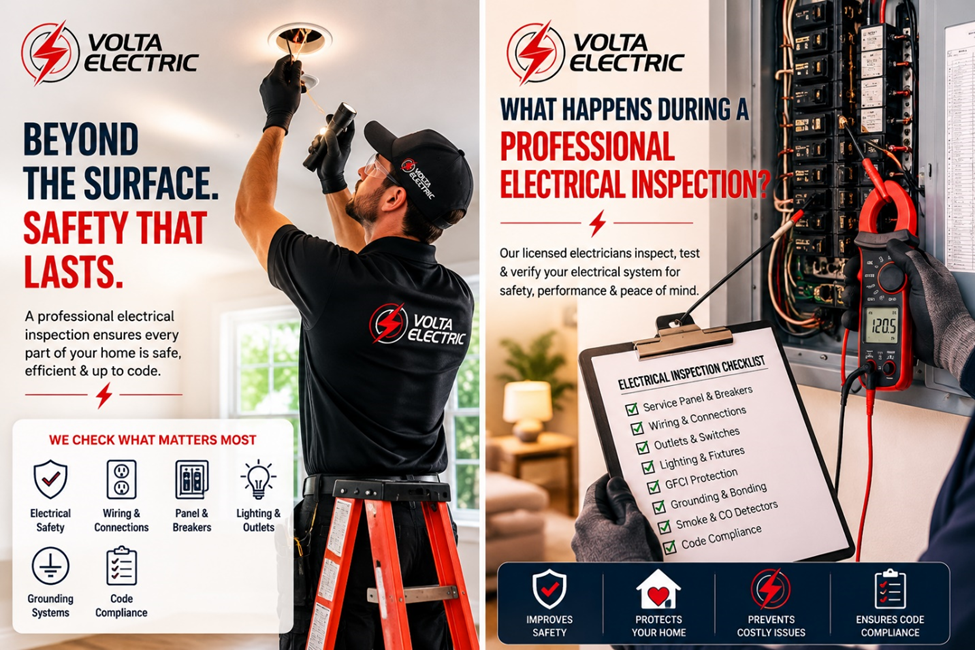
What Happens During a Professional Panel Assessment
Understanding what a professional panel assessment involves helps homeowners know what to expect and why the evaluation provides value that visual self-inspection cannot replicate.
A licensed electrician conducting a panel assessment will examine the panel enclosure for physical condition, check for signs of heat damage, corrosion, or moisture exposure, assess the breaker inventory for correct sizing relative to circuit wiring, test breakers for proper mechanical operation, evaluate bus bar connections for evidence of overheating or corrosion, review the grounding and bonding system for code compliance, and assess total panel capacity relative to the home’s current electrical load.
This evaluation produces either confirmation that the panel is in acceptable condition or a clear picture of what needs to be addressed — and in the latter case, a prioritized recommendation for whether repair, targeted component replacement, or full panel upgrade is the appropriate response.
Volta Electric Inc. provides panel assessments throughout Los Angeles County as part of our free estimate process. We inspect, we diagnose honestly, and we give you the information you need to make an informed decision — with no pressure and no obligation to proceed with work you don’t need.
The Cost of Waiting: Why Early Action Pays Off
The economics of electrical panel problems strongly favor early intervention over deferred action. A panel assessment that identifies a failing breaker and replaces it before it causes a fault event is a modest repair cost. The same failing breaker, left in service until it causes a circuit fire in a wall cavity, produces consequences that are an order of magnitude more expensive — and potentially dangerous in ways that have nothing to do with money.
Beyond the emergency cost dimension, there is the property value reality that Los Angeles homeowners face at the point of sale. A panel assessment ordered by a buyer’s inspector that identifies an FPE Stab-Lok panel, a fuse box, or a 60-amp panel serving a modern home’s electrical load becomes a negotiating point — a price reduction demand, a replacement condition, or in some cases a reason for the buyer to walk away. The same upgrade that costs a defined amount when planned proactively becomes a time-pressured transaction-threatening event when discovered during escrow.
The panel upgrades that Volta Electric Inc. performs across San Fernando, Arcadia, Santa Clarita, and Los Angeles County are investments that pay returns in safety, reliability, insurance compliance, and property value that consistently exceed their cost over the life of the property.
Frequently Asked Questions
How long do electrical panels typically last?
The service life of a residential electrical panel depends on the brand, the installation quality, the load it has carried over its life, and the environmental conditions of its installation location. Most industry guidance places the expected service life of a quality panel at 25 to 40 years under normal conditions. Panels from problem brands like FPE and Zinsco warrant replacement regardless of age. Panels approaching or past 30 years of service in Los Angeles homes warrant professional assessment even in the absence of obvious warning signs.
Can I replace just the breakers instead of the whole panel?
In some cases, yes — replacing individual failing breakers is appropriate when the panel enclosure and bus infrastructure are in good condition and the panel has adequate capacity for the home’s current load. In other cases — aging panels near or past their service life, panels with bus bar deterioration, panels with insufficient capacity, or problem-brand panels — individual breaker replacement addresses symptoms without resolving the underlying issue. A professional assessment distinguishes between these situations.
Is a panel upgrade always required when installing an EV charger?
Not always. Whether a panel upgrade is required before EV charger installation depends on the current panel’s capacity, the total existing load, and the circuit amperage the charger requires. A 200-amp panel with available capacity and breaker positions may support a Level 2 charging circuit without any panel work. A 100-amp panel already carrying significant load frequently cannot. We assess panel capacity as a standard part of every EV charger installation consultation.
What is the difference between a panel upgrade and a panel replacement?
In practice, these terms are often used interchangeably, but technically a panel replacement involves swapping the existing panel for a new one of the same service size, while a panel upgrade involves increasing the service capacity — typically from 100 to 200 amps. Both involve removing the existing panel and installing a new one. The upgrade designation applies when the amperage rating changes; the replacement designation applies when the same capacity is maintained in a new enclosure with new hardware.
How do I know if my panel is an FPE Stab-Lok or Zinsco panel?
FPE Stab-Lok panels are typically identifiable by the “Federal Pacific” or “Stab-Lok” labeling on the panel enclosure and by the distinctive appearance of the breakers, which are thinner than standard breakers and have a characteristic red indicator stripe. Zinsco panels typically carry the Zinsco brand name or the GTE-Sylvania name under which some were sold. If you are uncertain about your panel brand, a licensed electrician can identify it definitively during an inspection.
What permits are required for a panel upgrade in Los Angeles?
Panel upgrades require electrical permits through the relevant municipal building authority — the City of Los Angeles’s Department of Building and Safety for properties within city limits, or the appropriate city building department for other jurisdictions within LA County. The permit process includes plan review and a final inspection by a city inspector after installation. Volta Electric Inc. manages the complete permit process for every panel upgrade we perform.
Will my homeowner’s insurance cover damage caused by a panel failure?
Whether insurance covers panel failure damage depends on your specific policy, the cause of the failure, and whether the panel meets the requirements your policy specifies. Some insurers specifically exclude coverage for damage caused by panels from known problem brands. Others have general provisions requiring code-compliant electrical systems. A panel failure claim that investigation traces to a known defective panel brand, an unpermitted installation, or deferred maintenance despite documented warning signs may face coverage challenges. Proactive panel upgrades protect insurance coverage as well as the property itself.
Does Volta Electric Inc. offer same-day panel assessments?
We offer same-day appointments for situations that require urgent attention — including cases where warning signs suggest an active safety concern rather than a developing one. For non-emergency panel assessments and free estimates, we schedule appointments at your convenience throughout our Los Angeles County service area.
Conclusion: Do Not Wait for Your Panel to Fail on Its Own Terms
Electrical panels do not improve with age. The warning signs covered in this guide — frequent breaker trips, flickering lights, burning smells, warm panel covers, visible deterioration, outdated fuse box infrastructure, and known problem panel brands — are not quirks to be lived with or symptoms to be managed through workarounds. They are a panel communicating that it needs professional attention before a manageable situation becomes an unmanageable one.
The homes that suffer serious electrical failures are not usually the ones with obvious problems that were ignored despite dramatic warning signs. They are more often the ones where the warning signs were subtle enough to rationalize away, frequent enough to become background noise, and persistent enough that the moment of genuine failure arrives as a surprise — despite the fact that the system had been asking for help for years.
An electrical panel upgrade performed proactively, on your schedule, after a professional assessment that gives you complete information and honest recommendations, is a fundamentally different experience from an emergency panel replacement after a failure event. The outcome in terms of hardware may be similar. The circumstances, the cost, and the consequences for your property and family are not.
Volta Electric Inc. is fully licensed, bonded, and insured, serving San Fernando, Arcadia, Santa Clarita, Westlake Village, and all of Los Angeles County with professional panel assessments, electrical panel upgrades, and the complete range of residential and commercial electrical services that Los Angeles properties require.
Schedule your free panel assessment today: voltaelectricinc.com/service-area/
Volta Electric Inc. | Licensed Electrical Contractor | Serving San Fernando, Arcadia, Santa Clarita, Westlake Village & All of Los Angeles County | Free Estimates | Same-Day Appointments Available


