

Why Choosing the Right Electrician in Los Angeles Matters More Than You Think
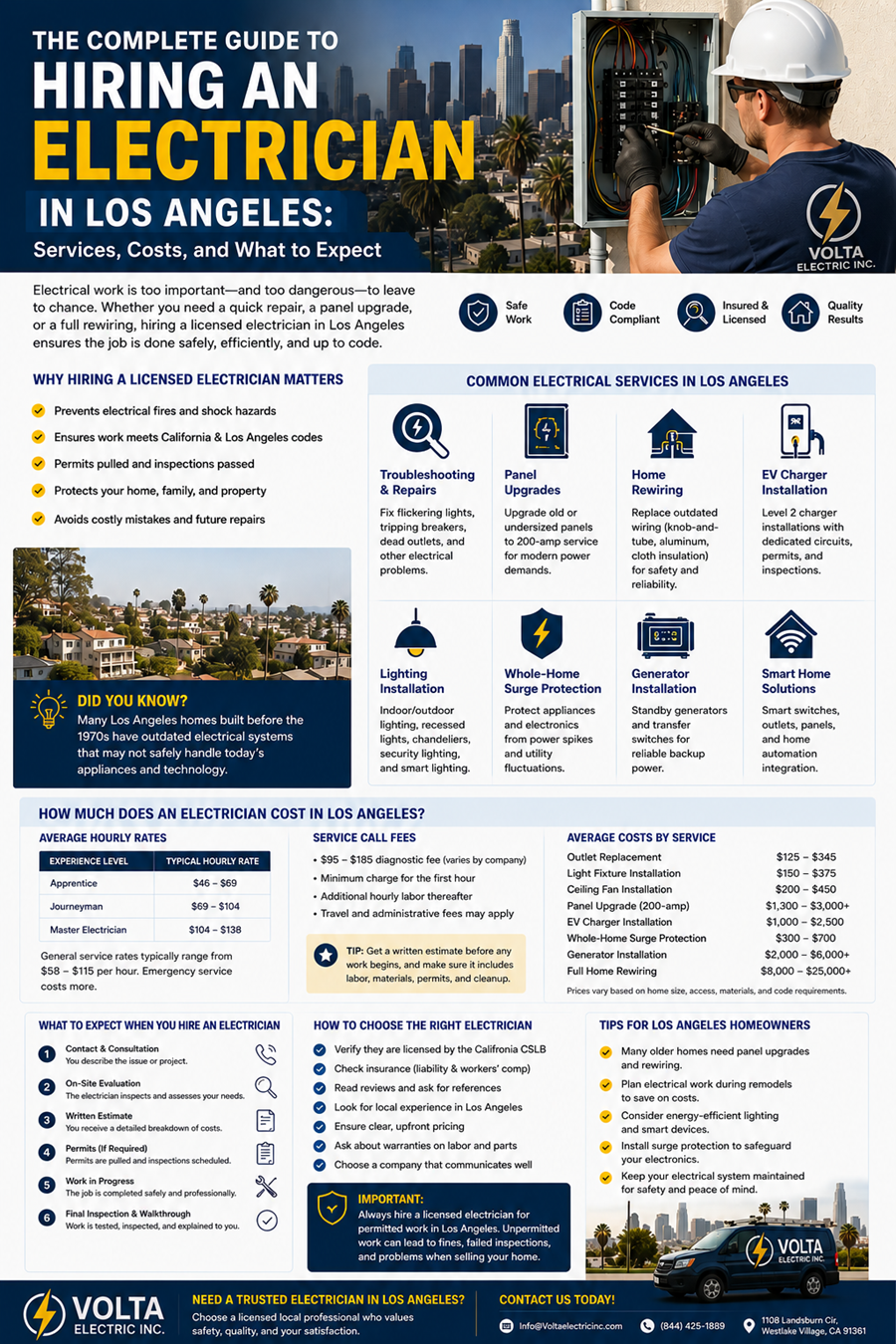
Los Angeles is one of the most electrically complex cities in the country. The sheer diversity of its housing stock — from 1920s Craftsman bungalows in Highland Park to mid-century ranch homes in the San Fernando Valley to contemporary mixed-use commercial buildings in Downtown — means that electrical work here demands a level of adaptability and expertise that generic service providers simply cannot offer. Add California’s uniquely stringent building codes, Southern California Edison’s specific interconnection requirements, and the growing demand for EV charging infrastructure and energy-efficient systems, and the decision of which electrician to hire becomes genuinely consequential.
For Los Angeles homeowners, business owners, and property managers, hiring a licensed electrician is not just a practical necessity — it is a legal one. California law requires that electrical work above a certain scope be performed by a licensed C-10 Electrical Contractor or properly supervised by one. Work done outside those parameters creates permit problems, insurance exposure, and safety risks that follow a property for as long as it exists.
Volta Electric Inc. is a fully licensed, bonded, and insured electrical contracting firm serving Los Angeles and all of Los Angeles County. This guide covers everything you need to know about electrical services in Los Angeles — what different services involve, what they cost, what problems they solve, and how to make informed decisions at every stage of an electrical project.
Understanding the Scope of Residential Electrical Services in Los Angeles
What a Full-Service Residential Electrician Actually Covers
Residential electrical work in Los Angeles spans a range far broader than most homeowners realize until they need it. At one end of the spectrum are straightforward repairs — a tripped breaker that won’t reset, a dead outlet, a ceiling fan that stopped working. At the other end are comprehensive infrastructure projects — whole-home rewiring, service panel replacement, EV charging system installation, and generator integration that fundamentally modernize a property’s electrical capability.
Between those extremes lies the work that most Los Angeles homeowners encounter at some point in owning a property: adding circuits for kitchen remodels, upgrading panels to support new appliances, installing GFCI protection in bathrooms and kitchens that were built before current code requirements existed, and addressing the accumulated electrical decisions of previous owners that may or may not have been made wisely.
A full-service residential electrician handles all of these categories and understands how they connect. The electrician diagnosing a persistently tripping kitchen breaker may discover that the root cause is a panel that has been operating at or above capacity for years — and that the correct solution isn’t just resetting the breaker but upgrading the electrical infrastructure that created the condition. That systems-level perspective is what distinguishes a qualified residential electrician from someone who simply fixes the immediate symptom and moves on.
Electrical Panel Upgrades: The Foundation of a Modern Home
Few electrical improvements deliver more comprehensive benefit to a Los Angeles home than a properly executed electrical panel upgrade. The electrical panel — also called the breaker box or load center — is the distribution hub for every circuit in the home. Its capacity rating, measured in amps, defines the total electrical load the home can safely support simultaneously.
Los Angeles has an enormous inventory of homes built during the postwar residential boom of the 1940s through 1960s, many of which still carry the original 60-amp or 100-amp service panels that were standard for their era. These panels were engineered for a world where the heaviest household electrical loads were a refrigerator, a washing machine, and window air conditioning units. They were not designed for central HVAC systems, induction cooktops, whole-home entertainment setups, home office infrastructure, and Level 2 EV charging circuits — the combination of loads that a contemporary Los Angeles home routinely carries.
A 200-amp panel upgrade resolves this capacity mismatch and creates the electrical headroom that modern living requires. Beyond capacity, panel upgrades address aging hardware — breakers that have worn beyond reliable operation, bus connections that have developed resistance through decades of thermal cycling, and in some cases panel brands with documented safety histories, including Federal Pacific Electric Stab-Lok panels and Zinsco panels that appear throughout the LA housing stock and warrant replacement regardless of apparent operation.
The panel upgrade process involves coordination with Southern California Edison for service entrance modification where required, permitting through the appropriate municipal authority, and a licensed electrician’s installation that meets current NEC and California Electrical Code requirements. Volta Electric Inc. manages this entire process — from permit application through final inspection — for every panel upgrade we perform across Los Angeles County.
EV Charger Installation in Los Angeles: Meeting the Demand of California’s Electric Vehicle Revolution
Why Home EV Charging Infrastructure Has Become Essential
California leads the nation in electric vehicle adoption, and Los Angeles leads California. The state’s zero-emission vehicle mandates, Southern California’s chronic air quality challenges, and the rapidly expanding selection of compelling electric vehicles across every market segment have combined to create an EV adoption rate in the LA metro area that is transforming residential electrical demand in real time.
For Los Angeles homeowners who have made the switch to electric driving — or who are planning to — home EV charging infrastructure is the single most impactful electrical upgrade available. The difference between Level 1 charging on a standard 120-volt outlet and a properly installed Level 2 home charging system is the difference between an inconvenient compromise and a genuinely superior ownership experience. Level 1 delivers 3 to 5 miles of range per hour of charging. Level 2 delivers 20 to 30 miles per hour — enough to restore a full day’s driving range overnight, every night, without planning or detours.
Level 2 home EV charger installation requires a dedicated 240-volt circuit, a properly sized breaker, conductors correctly gauged for both the circuit amperage and the physical distance of the run, and a weatherproofed installation that meets California Electrical Code outdoor installation requirements. For many Los Angeles homes — particularly those with older panels operating near capacity — the EV charger installation conversation begins with a panel assessment and frequently leads to a panel upgrade as the necessary prerequisite.
Tesla Charger Installation and Multi-Brand Compatibility
Tesla owners in Los Angeles represent a significant portion of the EV charging installation requests Volta Electric Inc. handles across the county. Tesla’s Wall Connector is a well-regarded Level 2 charging unit that supports the full onboard charging rate of all current Tesla models and requires a dedicated 60-amp circuit for optimal performance. The transition to NACS (North American Charging Standard) connectors across multiple manufacturers — including Ford, General Motors, Rivian, and others — means that Tesla charging infrastructure is increasingly relevant beyond the Tesla ownership base.
Commercial EV charger installation in Los Angeles serves a distinct and growing market. Apartment buildings and multi-family properties navigating California’s EV charging requirements for new construction and major renovations, retail and hospitality properties deploying charging as a customer amenity, and commercial fleets transitioning to electric vehicles all represent applications that require commercial-grade installation planning, load management considerations, and electrical infrastructure that scales with demand over time.
Wiring and Rewiring Services: Addressing Los Angeles’s Aging Housing Stock

When Rewiring Becomes Necessary
The age distribution of Los Angeles’s residential housing stock creates consistent demand for wiring and rewiring services that cities with newer construction profiles simply don’t face to the same degree. A significant portion of the homes in established LA neighborhoods — Echo Park, Silver Lake, Mid-City, Koreatown, the eastern San Fernando Valley — were built during eras when wiring materials and practices that are now understood to be problematic were standard.
Aluminum branch circuit wiring, used extensively in residential construction during the late 1960s and early 1970s as copper prices spiked, is present in thousands of Los Angeles homes. Aluminum wiring is not inherently dangerous when correctly maintained, but it has physical characteristics — higher thermal expansion coefficients, oxidation tendencies at connection points — that make it more likely to develop loose connections over time than copper wiring. Loose connections in aluminum-wired circuits generate heat and create arc fault and fire risk that grows with the age of the installation. Homes with aluminum branch circuit wiring should be assessed by a licensed electrician who understands the specific requirements for aluminum wiring maintenance and remediation.
Knob-and-tube wiring, which predates the widespread use of insulated cable assemblies, appears in some of LA’s oldest residential properties and is incompatible with modern load demands, cannot be safely insulated with blown-in attic insulation, and is a red flag for homeowners insurance underwriting. Where knob-and-tube is identified in a Los Angeles home, whole-home rewiring is the appropriate long-term solution.
Beyond these legacy wiring types, rewiring is also required for additions, ADU construction, major renovations that change the electrical load profile of the home, and properties where the cumulative wiring decisions of multiple previous owners and contractors have created a system that doesn’t function coherently as a whole.
GFCI and AFCI Protection: Code Compliance and Genuine Safety
Current California Electrical Code requires GFCI (Ground Fault Circuit Interrupter) protection at all kitchen countertop circuits, bathrooms, garages, outdoor outlets, unfinished basement areas, and anywhere else where water contact with electrical outlets is possible. AFCI (Arc Fault Circuit Interrupter) protection is required in bedrooms and increasingly throughout residential living spaces under current code cycles.
Older Los Angeles homes frequently lack both forms of protection in areas where they’re now required — not because they were installed incorrectly when built, but because code requirements have evolved substantially since their construction. GFCI outlet installation and AFCI breaker upgrades are among the most impactful safety improvements available to owners of older LA properties, addressing fault conditions that standard overcurrent protection cannot detect and that represent genuine fire and shock hazard risks.
Commercial Electrical Services in Los Angeles: What Businesses Need to Know
The Commercial Electrical Landscape in Los Angeles
Commercial electrical work in Los Angeles operates in a regulatory and technical environment that differs significantly from residential work — in scope, in code requirements, in permitting complexity, and in the consequences of errors. A licensed commercial electrician in Los Angeles needs to understand three-phase power distribution, commercial load calculations, Title 24 energy compliance requirements, ADA electrical accessibility standards, and the specific permitting and inspection processes of the various municipal jurisdictions that make up Los Angeles County.
Los Angeles businesses require electrical services across a wide spectrum of applications. Tenant improvements in commercial buildings require new circuit distribution, lighting systems that meet Title 24 energy efficiency standards, and HVAC electrical connections for modern climate control systems. Restaurants face specific electrical demands — commercial kitchen equipment with high-amperage circuits, exhaust hood fire suppression system electrical connections, and refrigeration systems that require dedicated circuits and reliable overcurrent protection. Retail spaces need flexible lighting systems, adequate receptacle coverage for modern point-of-sale and display technology, and electrical infrastructure that can adapt as the business evolves.
Volta Electric Inc. brings full commercial electrical capability to businesses throughout Los Angeles County — from straightforward tenant improvement work to comprehensive commercial panel installations, commercial EV charging infrastructure, emergency lighting systems, and the full range of services that keep commercial properties operating safely, efficiently, and in compliance with current code.
Generator Installation for Los Angeles Properties
Southern California’s wildfire-driven Public Safety Power Shutoff (PSPS) events have transformed the conversation around backup power for Los Angeles homes and businesses. What was once a consideration primarily for properties in high-fire-risk areas has become relevant across a much broader swath of LA County as SCE’s PSPS events have affected urban and suburban areas that previously had no meaningful outage exposure.
Standby generator installation for Los Angeles properties involves selecting an appropriately sized generator for the intended load — whole-home backup requires substantially more capacity than a system designed to run essential circuits only — installing a transfer switch that safely disconnects the property from the utility grid before the generator activates, running appropriate gas supply connections where natural gas generators are used, and completing the electrical interconnection to current code.
Portable generator interconnection, permanent standby generator installation, and battery backup systems represent a spectrum of backup power solutions with different cost profiles, capabilities, and installation requirements. Battery backup systems — increasingly competitive with generators for many residential applications given the falling cost of lithium battery storage — are another energy storage solution worth evaluating alongside traditional generator options for Los Angeles homeowners concerned about outage resilience.
Emergency Electrical Services: When You Need Help Now
Electrical emergencies in Los Angeles don’t follow business hours, and the risks associated with delaying response to genuine electrical hazards are significant enough that 24/7 emergency electrician availability is a real and important service category rather than a marketing claim.
The situations that constitute genuine electrical emergencies include sparking outlets or panels, burning smells from walls or electrical equipment, breakers that trip repeatedly or won’t reset under normal load, complete loss of power to the property or to critical circuits, outlets that are warm to the touch, and any situation where the integrity of the electrical system is in doubt and the safety of occupants may be affected.
Volta Electric Inc. provides emergency electrician response throughout San Fernando, Arcadia, Santa Clarita, Westlake Village, and across Los Angeles County. Our emergency response prioritizes exactly the situations where delayed service creates escalating risk — because an electrical fault that’s caught and isolated promptly is a repair, and the same fault left unaddressed overnight can become a much larger problem.
The Cost of Electrical Services in Los Angeles: What to Expect
Cost transparency is one of the most important things a licensed electrician in Los Angeles can provide, and one of the areas where the industry has historically done poorly by its customers. Los Angeles electrical service costs vary based on project scope, permit requirements, panel size, property access, and the specific conditions found during an installation — but a reasonable framework for understanding cost ranges helps property owners plan and evaluate proposals.
Electrical panel upgrades in Los Angeles typically range from $1,500 to $4,000 or more depending on service size, whether the service entrance requires upgrading, and the complexity of the installation. A straightforward 200-amp panel replacement in a property with accessible wiring and a cooperative utility timeline sits at the lower end of that range. A project requiring service entrance replacement, additional subpanel work, or significant circuit reconfiguration sits at the higher end.
Level 2 EV charger installation costs in Los Angeles generally range from $500 to $2,000 for the electrical installation component, depending on the distance from panel to EVSE location, whether conduit work is required through finished spaces, and whether a panel upgrade is needed as a prerequisite. The EVSE unit itself is priced separately from the installation.
Whole-home rewiring is a significant investment — typically ranging from $8,000 to $20,000 or more for a complete rewiring of a single-family residence — but it is also a comprehensive solution that addresses every wiring concern simultaneously and effectively resets the electrical infrastructure of the property to a modern, code-compliant baseline.
For smaller services — outlet installation, GFCI upgrades, circuit additions, lighting installation — costs are generally project-specific and best addressed through a free estimate that accounts for your property’s actual conditions. Volta Electric Inc. provides free estimates on all projects, with no obligation and no pressure to proceed.
Why Licensed and Permitted Electrical Work Protects Your Los Angeles Property
The permitting requirement for electrical work in Los Angeles jurisdictions exists for reasons that directly benefit property owners — not as administrative overhead that adds cost without value. Permitted electrical work is inspected by a municipal inspector who has no financial relationship with the contractor and whose job is to verify that the work meets current safety standards before walls are closed and the project is finalized. That independent verification is genuinely valuable, and the documentation it creates is valuable in ways that only become fully apparent at specific moments: a home sale, an insurance claim, a future electrical project.
Unpermitted electrical work in Los Angeles creates a paper trail problem that surfaces reliably at the worst possible time. California’s disclosure requirements obligate sellers to disclose known unpermitted work. Buyers and their inspectors identify signs of unpermitted modifications. Lenders may require remediation before financing is approved. Retroactive permitting — bringing unpermitted work into compliance after the fact — frequently requires opening walls for inspection, correcting anything that doesn’t meet current code, and paying fees that exceed what the original permitted work would have cost.
Beyond the transactional dimension, unpermitted electrical work creates insurance exposure that property owners frequently don’t discover until they file a claim. When an electrical fire or fault is traced to unpermitted work, the policy language requiring code-compliant systems and licensed workmanship gives the insurer a documented basis for claim denial. That outcome — a denied claim following a fire loss in a Los Angeles property — represents a financial catastrophe that no amount of permit-avoidance savings can offset.
Local Relevance: Electrical Challenges Specific to Los Angeles
Los Angeles presents electrical challenges that are particular to its climate, geography, housing stock, and regulatory environment. Understanding these local factors is part of what makes a genuinely local licensed electrician a more effective partner than a regional or national service provider with no specific LA expertise.
The earthquake risk that defines Los Angeles’s geological reality has electrical implications that aren’t always appreciated. Seismic events can loosen electrical connections, shift wiring in ways that create new fault conditions, and stress service entrance connections in older properties. Post-earthquake electrical inspection is a legitimate and useful service in LA in a way it simply isn’t in most of the country.
Title 24 energy compliance — California’s energy efficiency standards for building construction and renovation — creates electrical requirements for lighting systems, HVAC controls, and building automation that affect virtually every permitted renovation project in Los Angeles. An electrician unfamiliar with Title 24 requirements may install systems that fail inspection for energy code compliance even if the electrical installation itself is otherwise correct. Volta Electric Inc. designs lighting and control systems to meet Title 24 requirements as a standard part of permitted renovation work.
Los Angeles’s ADU (Accessory Dwelling Unit) construction boom — driven by state legislation that has dramatically simplified ADU permitting — has created substantial demand for electrical services that bring new living units online: new panel capacity to support the added load, dedicated meter installations where separate utility service is desired, and full electrical rough-in for new construction. This is a significant and growing segment of residential electrical work in Los Angeles that requires both residential electrical expertise and familiarity with LA’s specific ADU permitting processes.
Future Trends in Los Angeles Electrical Services
The trajectory of electrical services in Los Angeles over the next decade is shaped by forces that are already clearly visible: accelerating EV adoption, the expanding role of battery backup systems and home energy storage in managing grid outages and time-of-use electricity costs, the increasing sophistication of smart home electrical systems, and California’s continuing push toward all-electric new construction that will drive demand for electrical panel capacity upgrades across the existing housing stock.
Solar PV installation — while a distinct trade from electrical contracting — creates downstream electrical work that licensed electricians handle: service panel upgrades to accommodate solar interconnection, battery storage system electrical connections, and the subpanel and circuit work associated with solar-plus-storage system installation. As Los Angeles homeowners increasingly adopt integrated solar and storage approaches to managing electricity costs and outage resilience, the intersection of solar electrical work and conventional electrical contracting will continue to grow.
The electrification of space heating and water heating — already underway in new California construction and accelerating in existing buildings under state and local policy pressure — will drive demand for panel upgrades and new circuit installations in properties converting from natural gas to electric appliances. A Los Angeles home that converts its gas furnace to a heat pump, its gas water heater to a heat pump water heater, and its gas range to an induction cooktop in the same renovation cycle may be adding 40 to 80 amps of new load to a panel that was designed for none of it. Managing that transition correctly requires both electrical expertise and an understanding of how California’s electrification policy landscape is evolving.
Frequently Asked Questions
How do I verify that an electrician is properly licensed in California?
The California Contractors State License Board (CSLB) maintains a publicly searchable database at cslb.ca.gov where any licensed contractor’s status, license classification, bond status, and insurance information can be verified. For electrical contractors, the relevant license classification is C-10. Always verify before hiring, and be skeptical of any contractor who is reluctant to provide their license number for verification.
What permits are required for electrical work in Los Angeles?
Permit requirements in Los Angeles vary by the scope of work and the specific jurisdiction — the City of Los Angeles has its own permitting process through the Department of Building and Safety, while other cities within LA County have their own municipal building departments. Generally, any work that involves new circuits, panel changes, rewiring, or new electrical equipment installation requires a permit. Minor repairs and direct replacements of like-for-like devices typically do not. Volta Electric Inc. determines permit requirements for each project and pulls all required permits as part of our standard process.
How long does a 200-amp panel upgrade take?
A straightforward 200-amp panel replacement in a Los Angeles home typically takes one full day — including the coordination with Southern California Edison for meter pull, the panel installation, circuit transfer, and cleanup. Projects that involve service entrance replacement, additional subpanel work, or complex circuit reconfiguration may take longer. The permit and inspection timeline adds time before and after the physical installation — we manage this process and keep clients informed of the schedule throughout.
What is the difference between a residential and commercial electrician?
The distinction primarily relates to the type of electrical systems involved rather than the person’s credentials. Commercial electrical systems typically involve three-phase power distribution, higher voltages, more complex load calculations, and compliance requirements — Title 24, ADA, commercial building codes — that differ from residential work. A fully qualified commercial electrician is licensed under the same C-10 classification as a residential electrician but has experience and training specific to commercial system types and the regulatory environment they operate in. Volta Electric Inc. handles both residential and commercial work across Los Angeles County.
How do I know if my home needs rewiring?
The most reliable indicators of rewiring need in a Los Angeles home include the presence of aluminum branch circuit wiring (common in homes built between roughly 1965 and 1973), knob-and-tube wiring (found in pre-World War II homes), two-prong ungrounded outlets throughout the home, a history of breaker trips or flickering lights that can’t be attributed to specific overload conditions, and any professional assessment that identifies wiring in poor physical condition. Age alone — while not diagnostic — is a reasonable prompt for a professional wiring assessment in homes over 40 years old that have never had their wiring evaluated.
What size EV charger circuit do I need for my vehicle?
The appropriate circuit size depends on your vehicle’s onboard charger capacity. Most EVs accept Level 2 charging at 7.2 to 11.5 kilowatts, which a 40-amp to 48-amp EVSE on a 50-amp to 60-amp dedicated circuit serves at or near the vehicle’s maximum acceptance rate. The Ford F-150 Lightning and certain other vehicles with higher onboard charger capacity benefit from a 48-amp EVSE on a 60-amp circuit to access their full charging speed. We assess your specific vehicle and installation conditions and recommend the circuit configuration that delivers optimal performance for your situation.
Does Volta Electric Inc. serve areas outside San Fernando?
Yes. Volta Electric Inc. serves the full Los Angeles County service area, including Arcadia, Santa Clarita, Westlake Village, West Hollywood, the broader San Fernando Valley, and surrounding communities. Our service location pages for specific cities reflect our localized knowledge of each area’s permitting processes, code interpretations, and housing characteristics — but our service coverage extends across the county.
What should I do if I smell burning near my electrical panel?
A burning smell near your electrical panel is a situation that warrants immediate action rather than a wait-and-see approach. Turn off the main breaker if you can safely access it, do not use electrical switches or outlets in the affected area, and contact an emergency electrician immediately. Do not attempt to investigate the panel interior yourself. If you see smoke or flames, evacuate and call the fire department before calling an electrician. A burning smell from electrical equipment almost always indicates a fault condition — overloaded wiring, a failing connection, or a component in the process of failing — that poses real fire risk until diagnosed and addressed by a licensed professional.
Conclusion: Making the Right Electrical Choice for Your Los Angeles Property
Electrical work in Los Angeles touches everything — the safety of your home, the value of your property, your insurance coverage, your ability to support modern technology and appliances, and your capacity to adapt your property to California’s rapidly evolving energy landscape. Getting it right means working with a licensed electrician who understands not just how to complete individual tasks but how those tasks fit into the complete picture of your property’s electrical health and long-term needs.
The range of electrical services available to Los Angeles homeowners and businesses is broad, and the stakes associated with those services — from a simple outlet installation to a complete rewiring or commercial panel installation — vary accordingly. What stays constant across every project category is the importance of licensed, permitted, professionally executed work that protects your investment, your insurance, and the people who occupy your property.
Volta Electric Inc. brings that standard to every project we take on across Los Angeles and Los Angeles County. We are fully licensed, bonded, and insured, committed to transparent pricing with free estimates on all projects, and experienced across the full spectrum of residential and commercial electrical services that Los Angeles properties require.
Schedule Your Free Estimate With Volta Electric Inc. Today
Whether you need an emergency electrician for a situation that cannot wait, a licensed electrical contractor for a panel upgrade or EV charger installation, or a professional assessment of your property’s electrical condition and what it will take to bring it to where it needs to be — Volta Electric Inc. is ready to help.
We serve San Fernando, Arcadia, Santa Clarita, Westlake Village, and communities throughout Los Angeles County with the same standard of licensed, permitted, professionally executed electrical work on every project regardless of size.
Contact us today for your free estimate. No obligation, no pressure — just honest, expert guidance from a team that knows Los Angeles electrical work from the ground up.
voltaelectricinc.com/service-area/
Volta Electric Inc. | Licensed C-10 Electrical Contractor | Fully Licensed, Bonded, and Insured | Serving Los Angeles and All of Los Angeles County | Free Estimates | Same-Day Appointments Available

