Introduction
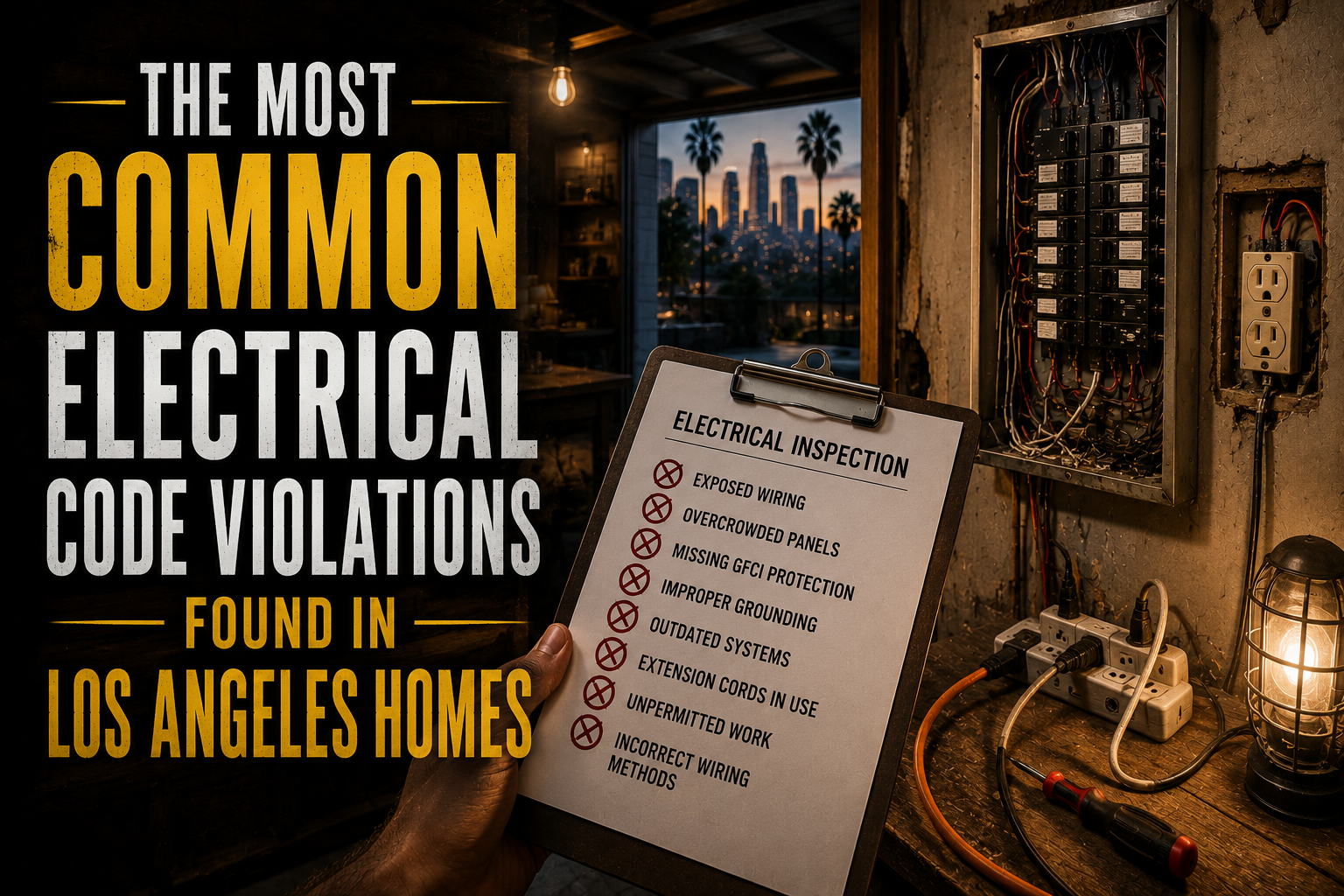
Most homeowners assume that if the lights turn on and the outlets work, their electrical system is fine. In reality, electrical code compliance is far more specific than “does it function,” and many violations go unnoticed for years, sometimes for decades, until a renovation, an insurance inspection, or a home sale brings them to light. In a city like Los Angeles, where housing spans nearly a century of construction and countless rounds of DIY updates and unpermitted renovations, code violations are not the exception. They are closer to the norm.
This matters more than it might seem at first glance. Electrical code requirements exist because they reflect decades of accumulated knowledge about what actually causes house fires, shock injuries, and equipment failures. A violation is not simply a technicality that an inspector flags to justify their fee. It is almost always tied to a real, documented failure mode that the code was written to prevent. Understanding the most common violations found in Los Angeles homes helps property owners recognize risk before it becomes a fire, a failed inspection, or a costly surprise during a real estate transaction.
Why Code Violations Are So Common in Los Angeles Housing Stock
Los Angeles has one of the more architecturally diverse housing markets in the country, spanning craftsman bungalows from the early 1900s, mid-century ranch homes, post-war tract housing, and decades of additions, remodels, and garage conversions layered on top of all of it. Every one of those additions was governed by whatever electrical code was in effect at the time, and very few homes have had every prior modification brought up to current standards.
Unpermitted work compounds the problem considerably. A homeowner who wired a garage conversion or added a subpanel without pulling a permit may have done functional work, but functional and code-compliant are not the same thing. Without a permit, there was no inspection to catch mistakes, which means violations from unpermitted projects often sit undiscovered until a licensed electrician or a home inspector examines the work directly during an unrelated project or a pre-sale evaluation.
There is also a simple issue of code evolution. The National Electrical Code is updated on a regular cycle, and requirements that did not exist twenty years ago, such as certain GFCI and AFCI protection requirements, are now standard. A home that was fully compliant at the time it was built or last permitted can still carry violations relative to current code, even though nothing about the wiring itself has changed.
The Most Frequently Found Violations
Missing or Inadequate GFCI Protection
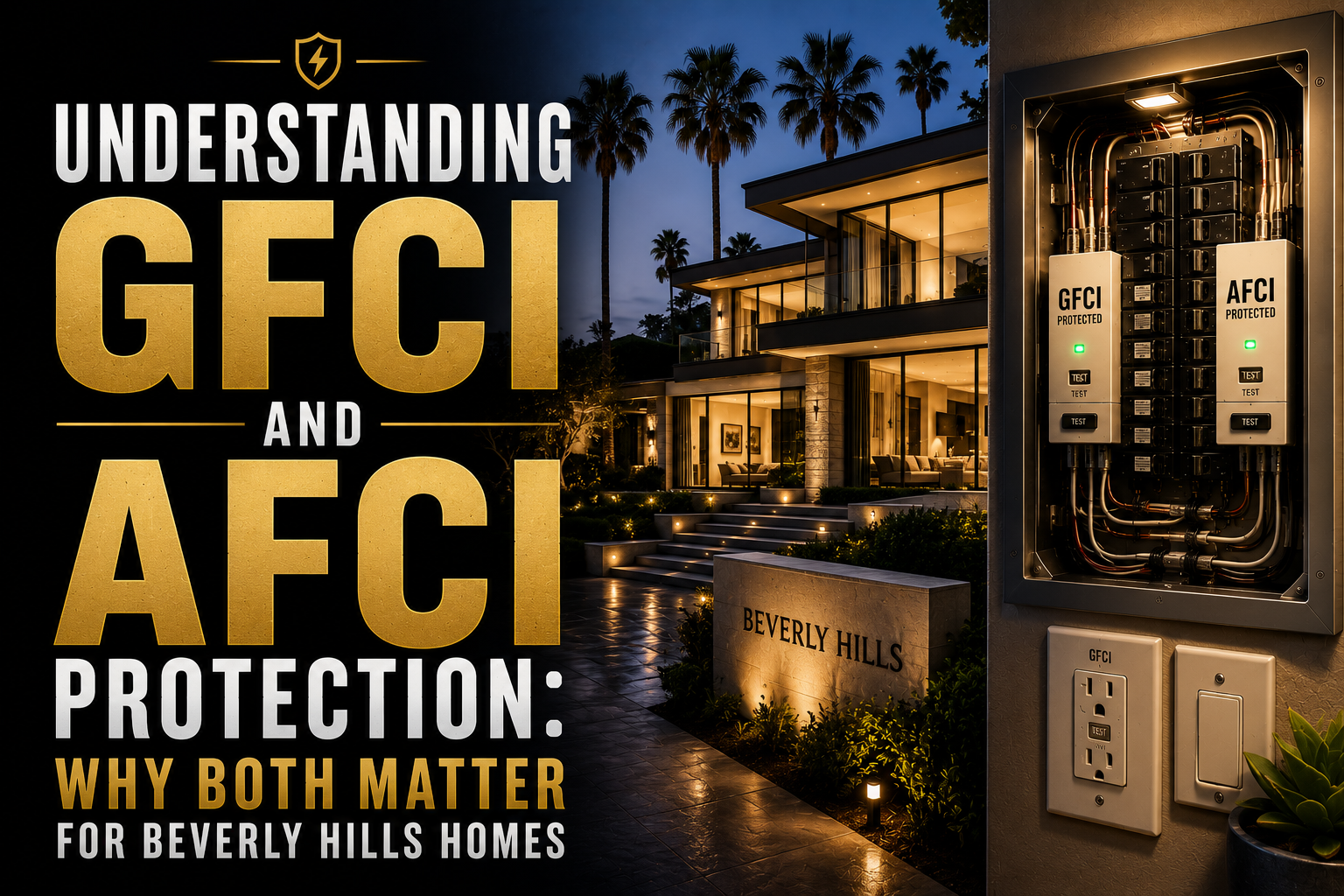
Ground fault circuit interrupter protection is one of the single most commonly missing safety features in Los Angeles homes, particularly those built or last updated before GFCI requirements expanded to cover most of the areas they apply to today. Current code requires GFCI outlet installation in kitchens, bathrooms, garages, unfinished basements, and most exterior locations, but a large share of older homes still have standard outlets in these areas, especially if the home has not had a kitchen or bathroom remodel since the requirement was expanded.
This violation is dangerous specifically because these are the areas where water and electricity are most likely to interact. A GFCI outlet detects a ground fault and cuts power in a fraction of a second, well before a dangerous shock can occur, and its absence in a kitchen or bathroom removes that protection entirely. The fix is usually straightforward electrical outlet installation, and it is one of the more affordable corrections available relative to the safety benefit it provides.
Missing AFCI Protection on Bedroom and Living Area Circuits
Arc fault circuit interrupter protection is less familiar to most homeowners than GFCI protection, but it addresses a different and equally serious risk: arcing faults caused by damaged wiring, worn insulation, or loose connections, which can ignite nearby combustible materials without ever tripping a standard breaker. Current code requires AFCI protection on most branch circuits serving bedrooms, living rooms, and similar spaces, but this requirement is relatively recent in code history, which means a significant share of homes, even those with reasonably modern panels, were never updated to include it.
Retrofitting AFCI protection typically involves replacing standard breakers with AFCI-rated breakers at the panel, which is a task best handled during electrical troubleshooting or a broader panel upgrade rather than as a piecemeal correction, since panel compatibility and available space need to be assessed first.
Double-Tapped Breakers
A double-tapped breaker occurs when two circuit wires are connected to a single breaker terminal that was only designed to accept one, a shortcut sometimes used when a panel runs out of available slots for new circuits. This is one of the most frequently cited violations during any electrical repair services call in Los Angeles, and it is a legitimate fire risk, since the connection point was never engineered to reliably clamp two conductors, leading to loose connections and heat buildup over time.
The correct fix depends on the panel’s design. Some panels have breakers rated for double connections in specific slots, but most double-tapped situations found in the field are improper regardless of panel brand. A licensed electrician typically resolves this by adding a tandem breaker where the panel design allows it, or by identifying that a panel upgrade is needed if the panel is already at capacity and cannot safely accommodate additional circuits.
Undersized Electrical Panels Relative to Actual Load
Many older Los Angeles homes still operate on 60 or 100-amp electrical service, a capacity that was adequate decades ago but is now routinely insufficient for households running central air conditioning, electric ranges, home offices, and increasingly, a home EV charger installation. While an undersized panel is not always a direct code violation on its own, it frequently leads to violations elsewhere, since homeowners and past contractors have often added circuits in ways that exceed the panel’s safe capacity rather than pursuing a proper panel upgrade.
An electrical panel replacement resolves both the capacity issue and any accumulated violations tied to overloading, and it is frequently the single most impactful correction available to bring an older home into broader compliance, since so many downstream issues trace back to insufficient panel capacity in the first place.
Improper Grounding and Bonding
Grounding issues are among the more serious violations because they are invisible during normal operation and only become dangerous during a fault condition, at exactly the moment protection matters most. Common problems include outlets with three-prong receptacles installed without an actual ground wire connected, sometimes called a “cheater” ground, as well as improperly bonded water pipes, gas lines, or panel neutral and ground connections that were never separated correctly during a past renovation.
These issues are not something a homeowner can typically diagnose visually, since a three-prong outlet with no functioning ground looks identical to one that is properly grounded. Professional electrical troubleshooting with proper testing equipment is required to identify grounding violations accurately, which is one of the more compelling reasons to have an older home’s electrical system professionally assessed rather than relying on a visual inspection alone.
Overloaded Circuits and Improper Wire Gauge
Wiring sized incorrectly for the load it carries is another frequent finding, particularly in homes where circuits were extended or additional outlets were added without verifying that the existing wire gauge could safely handle the additional draw. This commonly shows up in garage conversions, added home offices, or kitchen renovations where new appliances were installed on existing circuits never designed to support them.
Wiring and rewiring services address this by evaluating the actual load on each circuit against the wire gauge in place and correcting any mismatch, either by adding a dedicated circuit for higher-draw equipment or by upgrading the wiring itself where undersized conductors are found serving loads beyond their rated capacity.
Junction Boxes Without Covers or Improperly Accessed
Exposed junction boxes, whether missing a cover entirely or buried behind drywall without an access panel, are a surprisingly common violation, often the result of past renovation work where a wiring splice was made and then covered over without proper enclosure. Code requires every splice to be contained within an approved, accessible junction box, both to contain any arcing that might occur and to allow future inspection or repair without demolition.
This violation is often discovered only when a homeowner attempts a renovation or when an electrician traces a circuit during troubleshooting and finds a splice concealed behind a finished wall. Correcting it usually requires either installing a proper accessible junction box at the splice location or, in some cases, running new wiring to eliminate the improper splice altogether.
Benefits of Addressing Code Violations Proactively
Correcting electrical code violations delivers value well beyond simply passing an inspection. Safety is the most direct benefit, since nearly every common violation traces back to a documented fire or shock risk that the code was specifically written to prevent. Homes with corrected violations are measurably safer for daily living, not just theoretically compliant on paper.
Insurance implications are significant as well. California insurers increasingly ask about electrical system age and known issues during underwriting, and unresolved violations discovered after a claim can complicate coverage or even affect a payout in some circumstances. Addressing violations proactively, with proper documentation, protects a homeowner’s position well before any claim situation arises.
Resale value benefits follow a similar pattern to the safety and insurance angles. Buyers and their inspectors in Los Angeles are attentive to electrical findings, and a home with documented, corrected violations moves through escrow with far less friction than one where issues surface for the first time during a buyer’s inspection. Finally, day-to-day reliability improves once overloaded circuits, double-tapped breakers, and undersized panels are addressed, eliminating the intermittent nuisance trips and flickering lights that many homeowners simply learn to tolerate over time.
Cost and Investment Considerations
The cost of addressing code violations varies enormously depending on scope, from a single afternoon replacing a handful of outlets with GFCI protection to a more involved project addressing panel capacity, grounding, and wiring gauge issues across an entire home. A useful way to think about budgeting is to separate corrections into three tiers:
- Immediate Safety Issues: Like double-tapped breakers and missing GFCI protection, which are typically the least expensive to correct and the highest priority regardless of budget.
- Capacity Issues: Like an undersized panel, which represent a larger investment but often resolve multiple downstream violations at once.
- Cosmetic or Convenience Work: Electrical work that can reasonably wait until the first two tiers are addressed.
Homeowners are often surprised to learn that addressing violations proactively tends to cost meaningfully less than correcting the same issues under time pressure during a real estate transaction or after an insurance-mandated remediation deadline. Planning electrical corrections as a phased project, rather than waiting for an external party to force the issue, generally produces both a better outcome and a lower total cost.
Expert Recommendations
The most effective starting point for any homeowner concerned about code compliance is a comprehensive electrical assessment from a licensed electrician, ideally one with specific experience working in older Los Angeles housing stock where these violations are most concentrated. This assessment should document every finding clearly, distinguishing between urgent safety issues and lower-priority compliance gaps, so the homeowner can make an informed decision about sequencing and budget rather than tackling everything at once out of uncertainty.
Permits matter considerably here as well. Any correction involving panel work, new circuits, or significant rewiring should be permitted, both because it is legally required for most of this scope of work and because permitted work creates a documented history that protects the homeowner during future insurance claims, renovations, or a home sale. Homeowners should be skeptical of any contractor who suggests skipping permits to save time or money, since this shortcut often creates more risk than it saves.
It is also worth having any electrical contractor explain findings in plain terms rather than accepting a list of code section numbers without context. Understanding why a double-tapped breaker or a missing ground matter, not just that it was flagged, helps homeowners make better decisions about prioritization and gives them the information they need to evaluate future electrical work with more confidence.
Local Relevance for Los Angeles
Los Angeles presents a particularly concentrated version of this issue given its housing stock diversity. Homes in older, established neighborhoods carry higher rates of legacy violations tied to original construction-era wiring practices, while homes with a history of unpermitted additions, common across the region given decades of informal garage conversions and room additions, tend to carry violations tied to that specific unpermitted work rather than the original structure.
This pattern holds fairly consistently across the broader region. Pasadena and Glendale, with substantial inventories of homes from similar construction eras to central Los Angeles, see comparable violation patterns, and a panel upgrade in Pasadena often resolves several accumulated compliance issues at once. Santa Monica’s coastal housing stock adds an additional variable, since salt air accelerates corrosion at electrical connections, sometimes turning a marginal grounding issue into an active violation faster than it would develop inland. Torrance and Long Beach, with substantial mid-century development, see frequent double-tap and undersized panel findings, while electrical repair needs in Long Beach in particular often trace back to decades of incremental additions without a corresponding panel upgrade. Westlake Village’s newer housing generally fares better on code compliance, though its older ranch-style properties are not immune to the same issues found throughout the rest of the region.
Given how much this varies property by property, a general electrician Los Angeles homeowners might call for a routine repair should ideally have the specific experience needed to recognize violation patterns tied to different construction eras, rather than treating every home the same way regardless of its age or renovation history.
Future Trends and Industry Insights
Electrical code requirements continue to expand with each revision cycle, generally in the direction of more comprehensive AFCI and GFCI coverage, and homes that are compliant today may fall behind new standards within a decade, much the way homes compliant a decade ago now commonly show AFCI gaps relative to current requirements. Homeowners who address violations now, using current code as the baseline, are better positioned for the next revision cycle than those who make only the minimum correction needed to resolve today’s specific finding.
There is also a growing overlap between code compliance work and broader home electrification. As more homeowners add EV charger installation, home battery backup, or Energy Storage Systems alongside Solar Inverters and Hybrid Solar Inverters, electricians are increasingly finding and correcting legacy code violations as a natural part of these larger projects, since a panel or circuit assessment for a new addition often surfaces pre-existing issues that had gone unnoticed for years. Homeowners considering Lithium Batteries for backup power, or exterior additions like Solar Water Pumps or Solar Street Lights, should expect their electrician to flag any compliance issues discovered along the way, and treating that discovery as an opportunity rather than a delay tends to produce better long-term outcomes.
Smart panel technology is also beginning to play a role in ongoing compliance, since circuit-level monitoring can help homeowners and electricians identify overloaded circuits or unusual load patterns before they escalate into a more serious violation or a safety incident.
Frequently Asked Questions
How do I know if my home has electrical code violations?
Most violations are not visible to an untrained eye, since issues like improper grounding, missing AFCI protection, or double-tapped breakers require professional inspection with proper testing equipment to identify accurately.
Are electrical code violations always a fire risk?
Not every violation carries the same level of risk, but many of the most common ones, including double-tapped breakers, missing GFCI protection, and improper grounding, are directly tied to documented fire or shock hazards.
Do I need to fix code violations if my home already passed a previous inspection?
Possibly, since code requirements change over time and a home compliant at a previous inspection date may not meet current standards, particularly around GFCI and AFCI protection requirements added more recently.
Will fixing electrical code violations affect my homeowner’s insurance?
It can help. Many insurers in California are increasingly attentive to electrical system condition, and documented corrections can support smoother underwriting and claims processes down the line.
How much does it cost to correct common electrical code violations?
Cost depends heavily on scope, ranging from relatively affordable outlet and breaker corrections to larger panel upgrade projects, and an accurate estimate requires an in-person assessment from a licensed electrician.
Can unpermitted electrical work cause problems even if it seems to work fine?
Yes. Functional and code-compliant are not the same thing, and unpermitted work often contains violations that were never caught by an inspector, since no inspection occurred at the time the work was done.
What is the difference between GFCI and AFCI protection?
GFCI protection detects ground faults, typically relevant where water and electricity may interact, while AFCI protection detects arcing faults from damaged or worn wiring, which is why code requires each in different areas of a home.
Should I address every violation at once or prioritize certain ones first?
Prioritization is generally recommended, starting with active safety risks like double-tapped breakers or missing ground connections, followed by capacity issues like an undersized panel, with lower-urgency items addressed afterward.
Conclusion
Electrical code violations are remarkably common across Los Angeles housing stock, and the fact that many violations go unnoticed for years does not make them any less serious once discovered. From missing GFCI and AFCI protection to double-tapped breakers, undersized panels, and improper grounding, these issues share a common thread: each one exists because it addresses a real, documented risk, not an arbitrary requirement. Addressing violations proactively, with a licensed electrician who understands the specific patterns found in Los Angeles homes, protects both the safety and long-term value of a property far more effectively than waiting for an inspection, an insurance issue, or a real estate transaction to force the conversation.
Work With Volta Electric on Code Compliance
If you want a clear, honest assessment of your home’s electrical code compliance anywhere in the Los Angeles area, Volta Electric can help. Our licensed electricians identify the most common violations found in homes across every era of construction and provide a prioritized, permitted plan to bring your electrical system fully up to current standards. Contact Volta Electric today to schedule a comprehensive electrical code compliance assessment for your home.