Introduction
Most home improvement conversations focus on the visible — kitchens, bathrooms, landscaping, exterior paint. These are the upgrades that photograph well and generate enthusiasm during a showing. What they rarely generate is the kind of return that comes from solving a problem the next buyer would otherwise have to solve themselves. Electrical upgrades occupy a different and, in many ways, more compelling category: they combine genuine safety improvements, meaningful operational benefits, and real property value contribution in a way that few other home improvement categories can match.
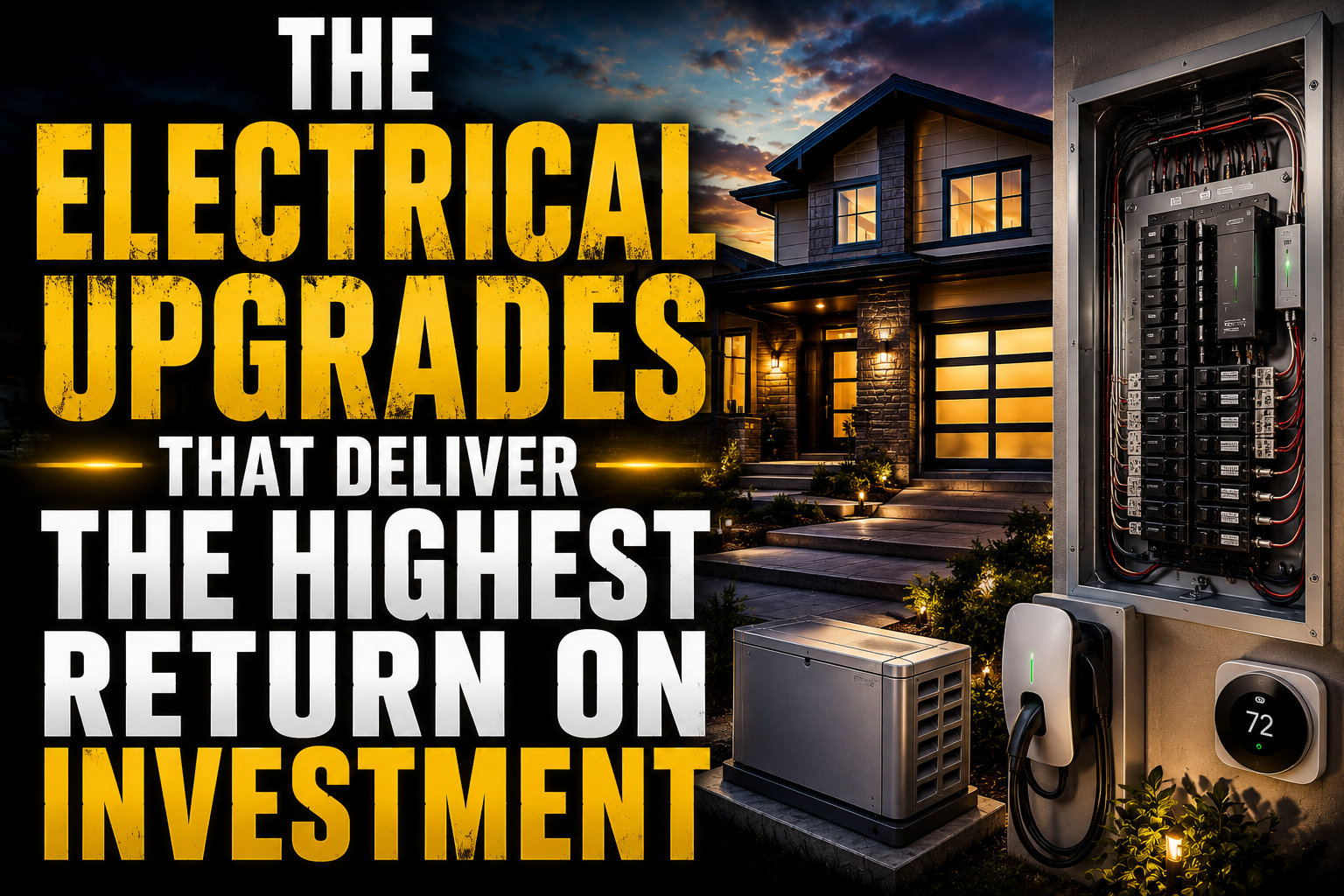
The residential electrical upgrades that deliver the highest return on investment are not the flashiest projects in a home improvement budget. An electrical panel upgrade doesn’t make for compelling before-and-after photography. A whole-home rewiring project is invisible once the walls are closed. GFCI outlet installation and arc fault circuit interrupter upgrades don’t change the way the kitchen looks. But these are the projects that remove the items from an inspection report that kill deals, that eliminate the safety risks that drive insurance complications, and that provide the infrastructure foundation on which the home’s value increasingly depends.
In Los Angeles and throughout Southern California, the electrical upgrade conversation has also expanded significantly as EV adoption has accelerated, as utility rate structures have changed to reward homes with smart energy infrastructure, and as buyers in the $1 million and above market — which describes a large portion of the LA residential market — have become sophisticated enough to recognize electrical infrastructure quality as a real differentiator. Understanding which upgrades provide the highest return — both in immediate safety and operational terms and in eventual property value — allows homeowners to sequence their investment intelligently rather than spending on projects that look impressive but deliver modest real-world benefit.

Why Electrical Upgrades Generate Returns Differently Than Other Improvements
Before examining specific projects, it is worth understanding why electrical upgrades generate returns in a pattern that differs from cosmetic or luxury improvements.
A kitchen remodel generates value by increasing appeal — it makes the home more desirable to a broader pool of buyers and can justify a higher asking price. But a kitchen remodel on a home with a 100-amp panel, outdated wiring, and no EV charging capability still carries the electrical infrastructure deficit that a knowledgeable buyer will identify and price into their offer. Cosmetic value and infrastructure value are not interchangeable.
Electrical upgrades generate return in three distinct ways. First, they remove negative value — the inspection report items, the insurance complications, and the negotiation vulnerabilities that depress offer prices. A panel from a manufacturer with documented reliability issues is a negotiation item. Aluminum branch circuit wiring without proper remediation is a disclosure item. No GFCI protection in required locations is a code compliance item. Removing these negatives from the property’s profile often contributes more to net sale price than the upgrade cost, making the return calculation strongly positive even before positive value additions are considered.
Second, electrical upgrades add positive value that is recognized by appraisers, buyers, and lenders in markets where EV charging capability, adequate service capacity, and modern safety features have become standard expectations. A home with 200-amp service, an EV-ready garage circuit, whole-home surge protection, and arc fault protection carries a different and more valuable electrical profile than one that does not — particularly in the Los Angeles market where EV ownership rates are among the highest in the country.
Third, electrical upgrades generate ongoing operational returns through energy cost savings, reduced maintenance costs, and insurance premium effects that accumulate over the ownership period before any property value realization. A homeowner who installs a 200-amp panel, adds a smart EV charger, and integrates the home with time-of-use rate optimization captures real dollar savings every month. Those operational returns make the upgrade financially beneficial regardless of when or whether the home is sold.
Upgrade One: Electrical Panel Upgrade to 200-Amp Service
The electrical panel upgrade from 100-amp to 200-amp service is consistently among the highest-return electrical investments available to homeowners in older properties — which, in Los Angeles, means a significant portion of the housing stock.
The case for this upgrade operates on multiple levels simultaneously. From a safety standpoint, a 100-amp panel serving a modern household with central air conditioning, multiple high-draw appliances, and the battery of electronics and devices that define contemporary living is operating with limited headroom that creates overloading risk. From an operational standpoint, a 100-amp service panel cannot safely accommodate an EV charger, a battery storage system, heat pump upgrades, or the combination of electrical additions that most homeowners in the region are planning or have already undertaken. From a property value standpoint, a 100-amp panel is an immediate inspection flag that sophisticated buyers and their inspectors identify as a capacity and safety concern requiring investment.
What the Upgrade Involves
An electrical panel upgrade from 100-amp to 200-amp service involves replacing the panel, upgrading the service entrance conductors from the utility connection point to the new panel, and coordinating with the utility for meter and service drop upgrades. The work requires permits, involves a utility coordination step that affects project timeline, and is performed by a licensed electrician who pulls permits and completes inspections as part of the project scope.
The installed cost of a 100-amp to 200-amp service upgrade in the Los Angeles market typically runs between $2,500 and $5,000 depending on service entrance complexity, panel location, and local permitting requirements. The return on this investment, measured by its effect on sale price negotiations and its enablement of subsequent electrical additions, consistently exceeds the installation cost in markets where 200-amp service has become the buyer expectation.
The Panel Upgrade as Infrastructure Foundation
The panel upgrade also functions as the infrastructure foundation for every other electrical upgrade on this list. An EV charger installation, a battery storage interconnection, additional circuit capacity for workshop or office spaces — all of these require adequate panel service to proceed. Sequencing the panel upgrade early in the home improvement plan rather than discovering its necessity as a prerequisite during a subsequent project avoids the disruption and frustration of reactive rather than planned electrical infrastructure investment.
Homes with panels from Federal Pacific Electric or Zinsco — manufacturers whose products have documented breaker failure histories — have an additional and more urgent case for panel replacement that precedes any capacity arguments. The electrical panel replacement for these installations is a safety project first and an infrastructure upgrade second, and it warrants priority in any homeowner’s electrical improvement sequence.
Upgrade Two: EV Charger Installation and EV-Ready Infrastructure
In no other major metropolitan area in the United States is the value of EV charging infrastructure more clearly recognized in residential real estate than in the Los Angeles market. EV ownership rates in communities from Westlake Village to Beverly Hills to Pasadena to Long Beach are among the highest in the country, and buyers in the LA market increasingly evaluate home listings with charging capability as a direct functional consideration, not merely a nice-to-have.
A Level 2 EV charger installation — a dedicated 240-volt circuit and hardwired or outlet-connected charger in the garage — addresses two buyer population segments simultaneously. Buyers who already own EVs are looking for homes where charging infrastructure is already in place and calibrated to their needs. Buyers who anticipate EV ownership within the next several years recognize that a home with existing EV infrastructure eliminates a post-purchase expense they would otherwise face.
The Smart Charger Advantage
The choice of charger hardware matters beyond the basic circuit installation. Smart EV chargers with Wi-Fi connectivity, scheduling capability, and energy management integration deliver ongoing operational returns through time-of-use rate optimization — a meaningful financial benefit in Southern California Edison and LADWP service territories where peak rates during afternoon and evening hours are substantially higher than off-peak rates. A smart charger programmed to charge during off-peak hours saves the homeowner real money monthly and represents a feature that a knowledgeable buyer will recognize and value.
Smart chargers that integrate with solar generation systems or home energy management platforms extend this value further, allowing the vehicle to be charged preferentially from solar surplus rather than grid power. For homes in the Los Angeles area with rooftop solar, this integration closes the loop on the home energy investment in a way that buyers with both EVs and solar installations find genuinely compelling.
EV-Ready Conduit as a Low-Cost Forward Investment
For homeowners who are not ready for a full charger installation but are undertaking other electrical or renovation work, EV-ready conduit installation — running empty conduit from the electrical panel to the garage with appropriate pull wire, and noting the available conduit in property disclosures — is a low-cost forward investment that adds buyer appeal and reduces the future cost of charger installation. The conduit run costs a fraction of a complete charger installation but effectively eliminates the most disruptive and expensive portion of a future installation.
Upgrade Three: Whole-Home Rewiring for Older Properties
For homes with wiring that has reached the end of its serviceable life — knob-and-tube wiring from the pre-World War II era, aluminum branch circuit wiring from the 1965 to 1973 period, or rubber-insulated wiring from mid-century construction that has degraded with age — home rewiring services represent the most comprehensive and durable electrical safety investment available.
Whole-home rewiring replaces every branch circuit in the home with modern copper wiring in appropriate conduit or non-metallic sheathed cable, installed to current electrical code standards with proper grounding, GFCI protection in required locations, and AFCI protection on habitable space circuits. The result is an electrical system that carries no legacy safety concerns, is fully grounded throughout, and is appropriately sized for modern residential loads.
The Insurance and Financing Dimension
The insurance and financing implications of old or problematic wiring are often underestimated by homeowners who have simply never filed a claim or sought to refinance a property with problematic electrical conditions. Some insurance carriers decline to write policies or renew existing policies on homes with knob-and-tube wiring or aluminum branch circuit wiring without remediation documentation. Others write policies with explicit exclusions for fire damage originating in these wiring systems — an exclusion that may not be apparent until a claim is filed.
Mortgage lenders serving buyers of homes with documented wiring problems may require remediation as a condition of loan approval — turning what seems like a deferred maintenance item into a deal-breaking obstacle during escrow. A homeowner who completes rewiring before listing eliminates this obstacle entirely and reaches a broader buyer pool without the lender-imposed conditions that complicate transactions involving homes with problematic wiring.
Rewiring as the Starting Point for Complete Electrical Modernization
Home rewiring services conducted in conjunction with a panel upgrade represent the most comprehensive electrical modernization approach available to owners of older properties. When walls are open for rewiring, the marginal cost of adding circuits, upgrading outlet configurations, installing proper dedicated appliance circuits, and positioning conduit for future additions is far lower than it would be in a finished-wall environment. Homeowners who approach rewiring and panel upgrade as a coordinated project rather than sequential separate projects capture significant savings on the combined scope.
Upgrade Four: Arc Fault Circuit Interrupter Protection
Arc fault circuit interrupters — AFCI breakers or combination devices — are the electrical code’s response to the category of electrical fire risk that standard circuit breakers do not address. Standard breakers protect against overload and short circuit conditions. They do not detect the specific electrical signature of arcing — the phenomenon where current jumps a gap in a loose connection, damaged wire, or deteriorated insulation and produces the heat that is responsible for a significant portion of residential electrical fires.
AFCI protection has been required by the National Electrical Code on most residential circuits in new construction and substantial renovations since 2008, with the requirement expanding to cover virtually all habitable space circuits in subsequent code cycles. Homes built or renovated before those requirements apply are not protected unless AFCI devices have been added voluntarily.
The Fire Prevention Value Proposition
The return on AFCI installation is best understood as risk reduction rather than cosmetic or functional improvement. The probability that any given home will experience an electrical fire in any given year is relatively low. The financial and human consequences when that relatively unlikely event does occur are severe. AFCI protection meaningfully reduces the probability of the fire-causing event by detecting and interrupting arcing conditions before they generate sufficient heat to ignite surrounding materials.
For homeowners in the Los Angeles area — where fire risk carries particular resonance given the region’s history with structure fires and the insurance market’s response to that history — the risk reduction value of AFCI protection has direct financial expression in insurance premium discussions and in the property’s risk profile for underwriting purposes.
AFCI breakers are installed in the main panel, replacing standard breakers on the circuits they protect. The installed cost per circuit is modest, and a whole-home AFCI upgrade for a typical single-family residence is one of the more affordable comprehensive electrical safety improvements available.
Upgrade Five: Whole-Home Surge Protection
The proliferation of sensitive electronics in modern homes — smart TVs, computing equipment, smart home devices, smart appliances, EV charging systems, and solar inverters — has made whole-home surge protection one of the most cost-effective electrical safety investments a homeowner can make relative to the value of the equipment it protects.
Point-of-use surge protectors — the familiar power strip with surge protection that many homeowners use for individual devices — provide some protection against surges that enter through the outlet but do not protect against surges that enter through other pathways or that exceed the capacity of the point-of-use device. A whole-home surge protector installed at the main panel intercepts voltage spikes before they reach any circuit in the home, protecting every device on every circuit simultaneously.
What Surges Actually Damage
The most damaging surges in residential electrical systems are not from lightning strikes directly to the home — those are dramatic but rare. The more common and cumulatively damaging surge events are the smaller voltage spikes that accompany utility switching operations, motor starts and stops within the home, and the thousands of minor transient events that occur on any active electrical system over time. These sub-catastrophic surges progressively degrade the electronics and microprocessors in modern appliances and devices, shortening their operational lives in ways that homeowners attribute to appliance quality rather than the electrical environment in which those appliances operate.
A whole-home surge protector installed at the panel, combined with point-of-use protection for the most sensitive equipment, provides comprehensive surge defense at a total installed cost that is typically recovered within a few years through extended equipment life alone — before any insurance or property value considerations are factored in.
Upgrade Six: GFCI Outlet Installation and Electrical Outlet Upgrades
GFCI outlet installation in locations where it is required by current electrical code — bathrooms, kitchens, garages, outdoor locations, and other areas specified in the NEC — is one of the most straightforward electrical compliance upgrades available to owners of older homes. It is also one of the most consistently flagged items in pre-sale home inspections, making it a repair that sellers frequently end up completing under time pressure at the request of buyers or their lenders.
Completing GFCI outlet installation proactively eliminates this inspection flag before it becomes a transactional obstacle. It also closes a genuine shock hazard gap in the home’s safety profile. GFCI protection has been standard in new construction for decades and its absence in required locations is a recognized deficiency that insurance carriers, lenders, and buyers all note.
Outlet Configuration Modernization
Beyond GFCI compliance, outlet configuration modernization — adding USB charging ports to frequently used outlet locations, replacing two-prong ungrounded outlets with properly grounded three-prong devices, and adding outlets in locations where the current layout requires extension cords for routine use — represents a category of electrical outlet installation work that improves daily livability and removes the extension cord reliance that creates ongoing safety risks.
Ungrounded two-prong outlets in an older home are simultaneously a safety concern, an inspection flag, and a daily functional inconvenience for modern device users. The proper resolution — adding grounding conductors or installing GFCI receptacles in ungrounded locations, as permitted by code — is a licensed electrician’s work that improves the outlet’s safety profile and functionality simultaneously.
Upgrade Seven: Smart Electrical Panel and Energy Management Integration
For homeowners investing in comprehensive electrical modernization, the smart electrical panel represents the forward-looking tier of residential electrical upgrades. Products from manufacturers including Span, Leviton, and others have brought load monitoring, circuit-level control, and energy management integration to the main electrical panel — enabling homeowners to observe and manage their electrical system in real time from a smartphone application.
A smart panel provides circuit-level visibility into energy consumption, the ability to remotely control individual circuits, integration with solar generation and battery storage systems, automatic load management that protects the generator or battery system from being overwhelmed, and detailed energy data that supports time-of-use rate optimization. These are capabilities that resonate strongly with technology-oriented buyers in Los Angeles markets, and the combination of functionality and novelty positions a smart panel installation as a genuine differentiator in a competitive listing environment.
The installation cost for a smart panel is higher than a conventional 200-amp panel upgrade, and the premium is appropriate for homeowners who intend to build a comprehensive home energy management system around it. For homeowners who primarily need service capacity upgrade without the management layer, a conventional 200-amp panel with room for future expansion remains the more cost-effective foundational choice.
How to Sequence Electrical Upgrades for Maximum Return
The order in which electrical upgrades are undertaken affects both the cost of completing them and the return they generate. Several sequencing principles apply consistently.
- Address safety and compliance first. GFCI outlet installation, AFCI breaker installation, and panel replacement for Federal Pacific or Zinsco equipment carry the most urgent safety rationale and create the most immediate insurance and disclosure risk if deferred. These projects should lead the electrical improvement sequence regardless of what other upgrades are planned.
- Complete infrastructure before appliances. The panel upgrade belongs before EV charger installation, battery storage integration, or any other high-draw electrical addition. Discovering during a charger installation that the panel needs upgrading adds cost, delay, and contractor mobilization expense to a project that was supposed to be simple. The panel upgrade completed in advance of these additions eliminates that sequencing problem.
- Coordinate projects that benefit from simultaneous execution. Panel upgrade and rewiring conducted together allow wall access during rewiring to simplify panel-related conduit work. EV charger installation and solar interconnection conducted with the same contractor allows coordinated panel modification work that would require separate mobilizations if sequenced independently.
- Plan additions with future expansion in mind. A panel upgrade specified with the capacity for future solar, battery, and additional EV charging avoids the need for a second upgrade when those additions are undertaken. Running conduit for future circuits while walls are accessible during current projects eliminates the most expensive portion of future work.
What Los Angeles Buyers Are Actually Evaluating
The profile of a Los Angeles buyer in 2026 — in communities from Beverly Hills and Santa Monica to Pasadena, Glendale, Long Beach, and Westlake Village — has shifted toward greater electrical infrastructure awareness than at any previous point. Several factors explain this shift.
EV ownership in the region is high enough that a large percentage of active buyers either own an EV currently or expect to own one within their planned homeownership period. This creates a direct, functional evaluation of charging infrastructure that is specific and concrete rather than generally aspirational.
Utility rates and time-of-use pricing have made energy management relevant to household budgeting in ways that were not true before these rate structures became standard. Buyers who understand their utility bills are beginning to recognize that homes with smart electrical infrastructure and solar-plus-storage capability have lower ongoing energy costs — a real financial differentiator that carries through the ownership period.
Home inspectors in the Southern California market are increasingly thorough in their electrical system evaluation, and buyers who have been through one or more transactions involving inspection reports with significant electrical findings have become attuned to what a clean electrical inspection looks like. A home that produces a clean inspection report — no panel flags, no wiring concerns, no missing GFCI or AFCI protection, no capacity limitations — reaches a broader pool of buyers who are not managing inspection contingencies and the negotiations they generate.
Frequently Asked Questions
Which electrical upgrade adds the most value to a home in Los Angeles?
The answer varies by the home’s starting condition, but for properties with 100-amp service or older problematic wiring, the panel upgrade or rewiring project that removes a significant inspection flag typically delivers the highest return relative to cost. For homes with modern electrical infrastructure already in place, EV charger installation is the single addition with the clearest buyer-facing value proposition in the Los Angeles market given regional EV adoption rates.
How much does a whole-home rewiring project cost?
Whole-home rewiring costs vary significantly by home size, accessibility of wiring pathways, and local labor rates. For a typical single-family home in the Los Angeles area, rewiring projects run from approximately $8,000 to $20,000 depending on square footage, number of circuits, and whether the work can be completed with minimal wall damage or requires more extensive access. This is a wide range that reflects genuine project variability — a site assessment is required for meaningful cost estimation.
Will electrical upgrades help my home pass inspection before sale?
Completing the electrical upgrades that address known deficiencies before listing eliminates those deficiencies from the buyer’s inspection report, removing the negotiation leverage those findings would otherwise create. Proactive electrical improvement before listing is consistently more cost-effective than completing the same work under transaction time pressure at a buyer’s request.
Do I need to disclose electrical upgrades to potential buyers?
In California, significant improvements to the home’s systems — including electrical panel upgrades, rewiring, and major electrical additions — should be disclosed as part of the standard seller disclosure process. Permitted and inspected work is disclosed positively, as documentation of compliant, professionally performed improvements. Unpermitted work requires disclosure as well and may complicate the transaction if buyers or their lenders require permits to be retroactively obtained.
Is AFCI protection worth installing in an older home that doesn’t require it?
For any home where arcing-related fire risk is a concern — which encompasses homes with older wiring, homes with a history of electrical modifications of uncertain quality, and simply homes where the owners are attentive to fire risk — AFCI installation on habitable space circuits delivers meaningful fire prevention value at a modest per-circuit cost. It is among the most favorable cost-to-risk-reduction ratios of any electrical safety improvement.
How long do electrical upgrades take to complete?
Project duration varies by scope. A panel upgrade typically takes one to two days for the electrical work, plus permit and utility coordination time. Whole-home rewiring for a typical single-family residence typically takes three to seven days depending on home size and wall access conditions. Individual circuit additions, GFCI installations, and similar targeted improvements typically take a few hours each. Your electrician should provide specific timeline estimates based on your project scope during the proposal phase.
Can I do any of these electrical upgrades myself?
In California, work that requires a permit — including panel upgrades, new circuit installation, rewiring, EV charger installation, and transfer switch installation — must be performed or supervised by a licensed electrical contractor. GFCI outlet replacements on existing circuits are within the scope of homeowner DIY work in many jurisdictions, though permit requirements vary. Work involving the main panel, service entrance, or new circuit runs should always be performed by a licensed professional.
What should I look for in an electrician for a major upgrade project?
Verify the contractor’s California Contractors State License Board license and confirm it is current and in good standing. Ask for references from similar-scope projects completed within the past two years. Confirm that all required permits are included in the project scope. Ask how the contractor handles unexpected findings during the project — the answer reveals their transparency and how they manage the scope changes that complex electrical projects sometimes require.
Conclusion
The residential electrical upgrades that deliver the highest return on investment share a common characteristic: they solve real problems that affect safety, functionality, and the home’s position in the market simultaneously. A 200-amp panel upgrade, a whole-home rewiring project, EV charger installation, AFCI protection, whole-home surge protection, and comprehensive GFCI outlet installation are not glamorous projects. They are the foundational investments that remove risk, create capacity, and establish the electrical infrastructure on which the modern home’s value increasingly depends.
In Los Angeles — where the buyer population is sophisticated, EV adoption is high, utility rates reward smart energy infrastructure, and the inspection process is thorough — the return on quality electrical upgrades is particularly clear. Homeowners who invest in their electrical infrastructure proactively, rather than responding to inspection findings under transaction pressure, consistently capture better outcomes when it matters most.
The sequencing principle that applies across all of these upgrades is simple: address safety and compliance first, complete infrastructure before appliances, coordinate projects that benefit from simultaneous execution, and plan with future additions in mind. An electrical improvement program built on those principles delivers returns that compound over the ownership period and position the property optimally for whatever comes next.
Volta Electric: Residential Electrical Upgrades Across Los Angeles
Volta Electric delivers the full range of residential electrical upgrades for homeowners throughout Los Angeles, Westlake Village, Beverly Hills, Santa Monica, Pasadena, Glendale, Burbank, Culver City, Long Beach, and Torrance. From electrical panel upgrades and whole-home rewiring to EV charger installation, AFCI and GFCI protection, and smart panel integration, our licensed electricians provide assessments, proposals, and installations that are thorough, permitted, and built to deliver lasting value.
If you’re planning electrical improvements and want to understand which upgrades make the most sense for your property and goals, contact Volta Electric for an assessment.
Contact Volta Electric today to discuss your residential electrical upgrade priorities.