Introduction
The power went out sometime after midnight. By morning, the food in the refrigerator had been at risk for seven hours, the sump pump hadn’t run, and the family with a member dependent on home medical equipment had spent the night managing around a problem that should never have been allowed to become a crisis. The outage lasted eighteen hours. The utility called it a weather event. The homeowner called it a wake-up call.
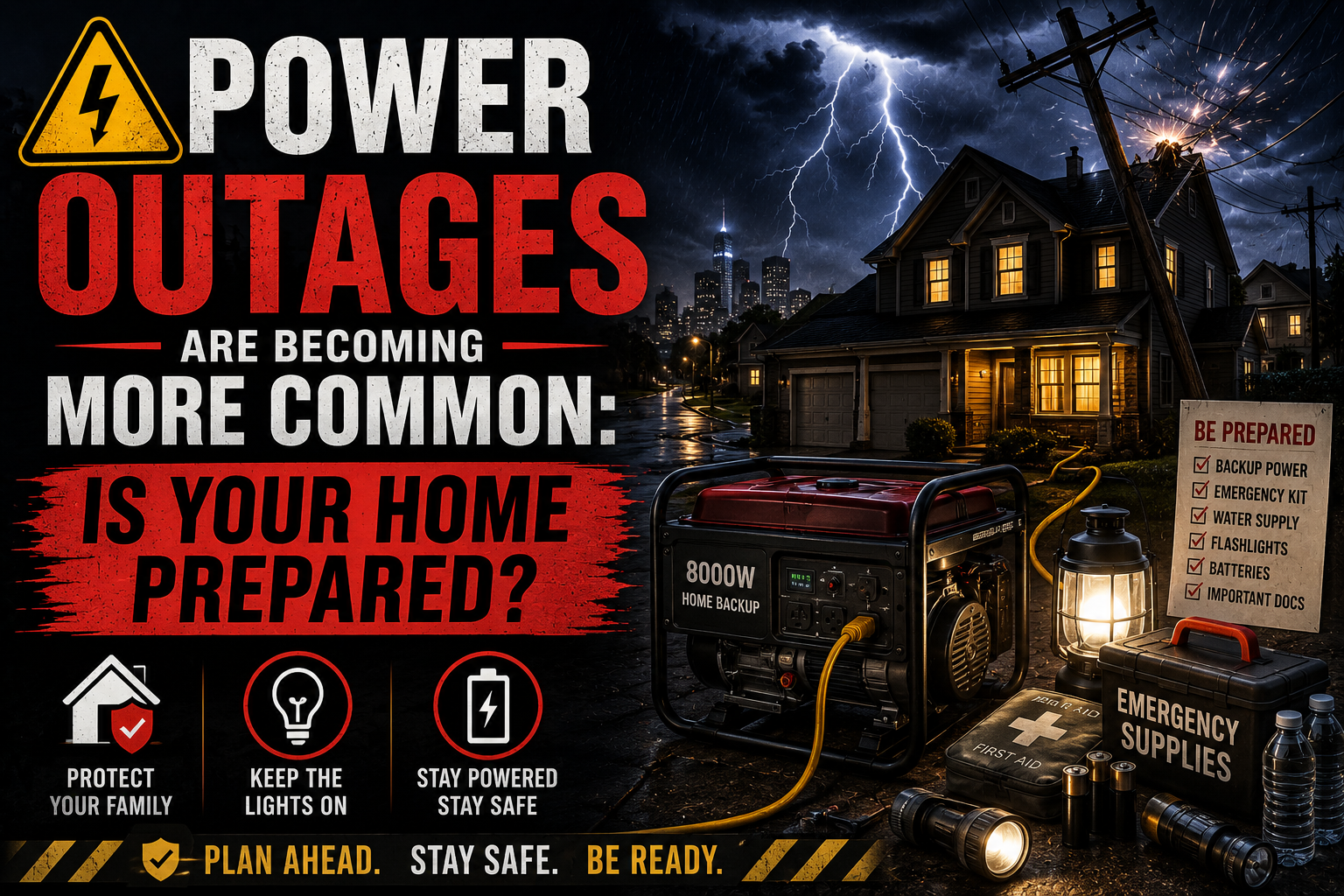
Across the country, homeowners are rethinking their relationship with grid power — not because they’ve lost faith in utilities entirely, but because the evidence of the past several years has made one thing unmistakably clear: power outages are becoming more frequent, longer in duration, and more consequential for households that have grown increasingly dependent on electrical systems for comfort, safety, and the operation of critical equipment. The grid that most homes were designed to rely on without question has revealed itself to be more vulnerable than the infrastructure it replaced — or so it feels to the millions of households that have experienced multi-day outages from storms, wildfires, extreme heat events, or aging transmission failures.
Backup generator installation has been one of the fastest-growing categories of residential electrical services for several years running, and the reasons are not difficult to understand. A home with reliable backup power is not merely more comfortable during an outage — it is genuinely more resilient, more safe, and increasingly more valuable as the backup power question becomes standard in real estate conversations. This guide covers the full landscape of home backup power options, the real differences between portable and standby generators, the electrical infrastructure required to make any backup system work safely, and how the emerging integration of generators with solar and battery storage systems is reshaping the conversation entirely.

Why Outage Risk Has Increased and Why It Matters
Grid Vulnerability in the Modern Context
The American electrical grid is a remarkable engineering achievement that is also, in significant portions, aging infrastructure. Transmission lines, substations, and distribution equipment that was installed in the mid-twentieth century was designed for the load patterns and weather conditions of that era. Neither the volume of current demand nor the frequency and intensity of weather events that now stress the system was fully anticipated in the design standards of that period.
Extreme heat events — which have become more frequent and more intense across the Southern and Western United States — create peak demand conditions that push transmission and distribution infrastructure to its limits precisely when that infrastructure is operating under thermal stress. The combination of maximum load and maximum temperature creates failure conditions that are difficult to engineer around without substantial capital investment that utilities across the country are undertaking at varying rates.
Wildfire risk has added another dimension to outage probability in California and much of the Western United States. Public Safety Power Shutoffs — the deliberate de-energization of transmission lines to prevent ignition during high-wind, low-humidity conditions — have become a regular feature of California utility operations. A homeowner in the Los Angeles area, Westlake Village, or any community near significant wildfire interface zones cannot treat grid power as unconditionally reliable during fire season.
Severe weather events — hurricanes, ice storms, derecho wind events, and flooding — affect different regions with varying frequency, but few areas of the country have been immune from significant weather-related outage events in recent years. The reasonable planning assumption for most homeowners is not whether a significant outage will occur but when and how their household will manage when it does.
What a Modern Household Stands to Lose
The consequences of an extended power outage have grown alongside the household’s dependence on electrical systems. A home that heated with wood and cooled by opening windows, preserved food in a root cellar, and drew water from a well with a hand pump could sustain an extended grid outage without catastrophic consequence. The modern home cannot.
Refrigerated and frozen food represents hundreds of dollars of immediate loss during an extended outage. Home medical equipment — oxygen concentrators, CPAP machines, infusion pumps, powered mobility equipment, home dialysis — represents genuine safety risk for the individuals who depend on it. Sump pumps that fail during a storm outage allow flooding that compounds storm damage significantly. Security systems that drop offline create vulnerability windows. Home offices and businesses that lose connectivity and computing capacity face operational disruption that translates directly to financial loss.
The home that takes backup power seriously is the one that has assessed these specific vulnerabilities honestly and decided that the cost of protection is justified by the cost of exposure. For most households that complete that assessment thoughtfully, the math favors investment in reliable backup power.
The Options: Understanding What’s Available
The residential backup power market offers more options in 2026 than at any previous point, ranging from portable gasoline generators to fully integrated whole-home systems that combine standby generators with battery storage and solar generation. Understanding where each option fits — and where its limitations matter — is the foundation for making the right choice for a specific household.
Portable Generators: Accessible but Limited
Portable generators are the most widely owned backup power solution, and for good reason: they are relatively inexpensive to purchase, require no installation, and can be stored until needed. A quality portable generator in the 5,000 to 10,000-watt range is capable of powering essential loads — refrigerator, a few lights, a window air conditioning unit, device charging — during an outage without a permanent electrical installation.
The limitations of portable generators are significant enough that they deserve honest treatment rather than the glossing-over they sometimes receive in promotional content. Portable generators run on gasoline or propane that must be stored and replenished — and that is frequently unavailable at local stations during precisely the regional outages that create the greatest need, because every other generator owner in the area is simultaneously seeking fuel. A generator that exhausts its fuel supply at 2 AM during the second night of an outage has failed at its core function at the worst possible time.
Portable generators also require manual operation. They must be brought out, started, monitored, and shut down by a person who is present and physically capable of performing those tasks. For elderly homeowners, for single-person households, for families in which the capable adult is away when the outage occurs, this operational requirement is a genuine limitation.
The safety concerns with portable generator operation are serious and cause preventable deaths every year. Carbon monoxide poisoning from generators operated in garages, on covered porches, or near open windows claims lives during every significant outage event. The rule is absolute: portable generators operate outdoors, well away from any building opening. No exceptions, no short-term compromises during uncomfortable weather.
Connecting a portable generator to the home’s electrical system requires a properly installed transfer switch. The improvised connection method sometimes called a “suicide cord” — a male-to-male cord plugged into a wall outlet to back-feed the home’s wiring — is genuinely dangerous, creating the risk of electrocution for utility workers on lines that the homeowner believes are de-energized. A transfer switch, installed by a licensed electrician, is the only safe method for using a generator with a home’s wiring system.
Standby Generators: The Professional Solution
A standby generator installation is a permanently installed, automatically operating backup power system. The generator is connected to the home’s electrical system through an automatic transfer switch that detects a utility outage, starts the generator, disconnects the home from the utility grid, and transfers the home’s loads to generator power — all within seconds and without any action required from the homeowner.
Standby generators run on natural gas or propane supplied through existing utility connections or on-site propane storage. Natural gas standby generators, which connect directly to the utility gas supply, can operate indefinitely during an outage as long as the gas supply remains available — eliminating the fuel management problem that makes portable generators unreliable for extended events.
The selection of a standby generator for a specific home requires matching the generator’s output capacity to the loads it will need to support. Whole house generator installation capable of supporting every load in the home simultaneously requires the largest generator capacity and involves the highest installation cost. Managed partial-load installations — which support critical circuits and allow the transfer switch to shed non-essential loads when generator capacity is constrained — can use smaller generators more efficiently while still protecting the loads that matter most.
Proper standby generator installation involves the generator unit itself, an automatic transfer switch, connection to the fuel source, connection to the home’s electrical panel or a dedicated generator sub-panel, and all associated permitting, inspection, and utility coordination. This is electrical work that requires a licensed electrical contractor — generator installation involves the home’s main panel, transfer switch integration, and potentially gas line work, all of which carry consequences if done incorrectly.
Battery Storage: Seamless but Finite
Home battery storage systems — typically lithium iron phosphate battery banks connected to a hybrid inverter — offer a backup power experience that standby generators cannot match in one important respect: seamlessness. Battery systems transition to backup mode in milliseconds when grid power fails, without any engine start sequence, without any noise, and without any fuel combustion. For households with sensitive electronics, medical equipment that cannot tolerate power interruption, or simply homeowners who want backup power that operates without thought or action, battery systems offer a quality of backup experience that generators cannot replicate.
The limitation of battery storage for backup power is capacity. A battery bank can hold a finite amount of energy. Without solar generation to recharge it during an extended outage, a battery system that starts an outage fully charged will eventually be depleted — typically within one to two days for a system sized for normal residential backup use. For short outages — the vast majority of outage events — battery storage is entirely sufficient. For multi-day events, battery storage alone may not be.
The integration of battery storage with solar panels addresses this limitation significantly. A home with solar generation and battery storage can theoretically sustain indefinite backup operation during a sunny outage — solar charges the batteries during the day, batteries carry the home overnight, and the cycle repeats as long as sunlight is available. For the majority of outage scenarios, including extended events that occur during California’s fire season when weather is typically clear and sunny, this combination provides genuinely robust backup coverage.
The Integrated Approach: Generator Plus Battery Plus Solar
The most capable residential backup power configuration combines a standby generator, battery storage, and solar generation into an integrated system managed by a whole-home energy management platform. In this configuration, battery storage provides the seamless transition and quiet operation for normal outage events. Solar generation recharges batteries during daylight hours. The standby generator provides unlimited runtime backup for extended events or periods when solar generation is insufficient.
This integrated approach is the direction that serious home energy resilience planning is moving, and the control systems required to manage it intelligently have matured significantly. Energy management platforms from established manufacturers can coordinate generator runtime, battery state of charge, solar generation, and household load in a single optimized system that maximizes battery life, minimizes generator runtime (and therefore fuel consumption and noise), and ensures critical loads are always prioritized.
The upfront investment in an integrated system is higher than any single-component approach. The value proposition is a home that is genuinely energy-resilient across a broad range of outage scenarios — short and long, cloudy and clear, moderate and extreme demand conditions.
The Electrical Infrastructure Behind Backup Power
Regardless of which backup power approach a homeowner chooses, the electrical infrastructure connecting that backup source to the home’s loads is what determines whether the system actually works when needed — and whether it works safely.
Transfer Switches: The Critical Safety Component
A transfer switch is the device that disconnects the home from the utility grid before connecting generator or battery power to the home’s circuits. This disconnection is not optional — it is the safety mechanism that prevents generator-generated power from back-feeding onto utility lines where it creates electrocution risk for utility workers and potentially damages the generator.
Manual transfer switches require the homeowner to physically move a switch before connecting generator power. They are less expensive than automatic switches but require the homeowner to be present and to remember to perform the switching operation before connecting the generator. For portable generator applications where the homeowner is managing the connection manually anyway, a manual transfer switch is often the appropriate choice.
Automatic transfer switches detect utility power loss and perform the switching sequence automatically. They are required for standby generator installations where the system is expected to operate without homeowner intervention. They are also appropriate for battery storage systems that need to transfer to island mode immediately upon utility power failure.
Transfer switch installation is panel-adjacent electrical work that requires a permit and should be performed by a licensed electrician. The connection must be made correctly, the switch must be rated appropriately for the loads it will control, and the installation must be inspected to confirm it meets code requirements.
Load Management and Critical Circuit Selection
A common and cost-effective approach to backup power is critical load management — identifying the circuits that support the household’s most important functions and configuring the backup system to prioritize those circuits. This approach allows a smaller generator or battery system to provide meaningful backup protection without needing to support every load in the home simultaneously.
Critical circuits typically include refrigeration, a portion of lighting, critical medical equipment, communications and device charging, and climate control for the household’s most important living areas. In a hot climate like Southern California, air conditioning or at minimum bedroom cooling during summer outages is a critical load consideration that drives generator sizing conversations in ways that wouldn’t apply in milder climates.
A licensed electrician with experience in backup power system design can help homeowners identify their critical loads, calculate the capacity needed to support them, and configure the transfer switch and panel arrangement to serve those loads selectively during an outage while shedding non-essential circuits.
Panel Considerations for Backup Power Integration
The home’s main electrical panel is the integration point for any backup power system, and its configuration directly affects what backup options are feasible and what electrical work is required before installation. Panels that are at service capacity, panels with no available breaker spaces, and older panels from manufacturers with documented reliability histories all create considerations that affect the backup power project scope.
A comprehensive backup power installation should always begin with a panel assessment. Homes that need panel upgrades to safely support backup power integration — whether because of service capacity limitations or physical configuration constraints — should factor that prerequisite work into the project timeline and budget. Discovering panel issues during generator or battery installation, rather than before, adds cost and delay at the worst possible time.
Sizing a Backup System for Your Home
The question of how much backup power capacity a home needs is the central design question for any backup power project, and the answer depends on variables specific to each household that cannot be determined from general guidelines alone.
The starting point is an honest inventory of the loads the household needs to sustain during an outage. For each load, the relevant numbers are the wattage during steady-state operation and the starting wattage — the higher current draw that motors and compressors require at startup. Generators and battery systems must be sized to handle starting loads, not just running loads, or they will fail to start major appliances even when they appear to have adequate capacity for the steady-state draw.
A whole house generator installation supporting all simultaneous loads in a typical single-family home generally requires a generator in the 16,000 to 22,000-watt range. Homes with multiple HVAC systems, electric water heaters, electric ranges, or EV chargers that will be operated during an outage may need larger capacity. Homes relying on critical-load management rather than whole-home backup may function adequately with 10,000 to 14,000-watt generator capacity.
Battery storage sizing for backup depends on both capacity and the duration of coverage desired. A 10-kilowated-hour battery bank supporting critical loads drawing 1,000 to 1,500 watts provides seven to ten hours of coverage. A 20-kilowatt-hour system provides proportionally more coverage and is better positioned to reach a solar recharge opportunity the following morning. For whole-home backup including air conditioning, 20 to 40 kilowatt-hours is typically needed for meaningful multi-hour coverage.
The sizing conversation is one that a qualified electrician or energy systems designer should lead, using your actual utility billing data, appliance inventory, and outage preparedness goals as inputs. Generic online calculators and rules of thumb are starting points, not substitutes for a proper assessment.
Maintenance: What Backup Systems Require to Stay Ready
A backup power system that has not been maintained is a backup power system that may not function during an actual outage. This point seems obvious but is responsible for a disproportionate share of backup power failures — homeowners install a generator or battery system, derive comfort from its presence, and then discover during an actual outage that years of deferred maintenance have left the system unable to perform.
Generator Maintenance Essentials
Standby generators require regular exercise — the manufacturer-recommended periodic test run that confirms the engine starts, the automatic transfer switch operates correctly, and all system functions are working. Most modern standby generators self-exercise on a programmed schedule, typically weekly, for a period of ten to twenty minutes. Homeowners should confirm their system’s exercise schedule is active and monitor the exercise run periodically to verify normal operation.
Annual professional maintenance for a standby generator includes oil and filter change, spark plug inspection and replacement on schedule, air filter service, battery check for the starting battery, fuel system inspection, and a load test that verifies the generator can perform under actual electrical load conditions. Skipping annual service is false economy — the service cost is modest compared to the cost of a service call during an outage when technician availability is constrained by the same event that caused every other generator owner in the area to need service simultaneously.
Propane-fueled standby generators require fuel level monitoring to ensure adequate propane supply is available for an anticipated demand event. Setting a minimum level and scheduling refills before that level is reached — rather than responding to low-level alerts — ensures that a major outage event doesn’t find the tank depleted.
Battery System Maintenance
Battery storage systems require less routine maintenance than generators but are not maintenance-free. Annual inspection of electrical connections, battery management system performance data review, thermal management verification, and confirmation that monitoring and alert systems are functioning correctly are appropriate annual tasks. Battery systems that show declining capacity relative to their rated performance, or that generate thermal alerts during normal operation, warrant professional assessment before the issue progresses.
Frequently Asked Questions
What size generator do I need for whole house backup?
Whole house generator installation for a typical single-family home generally requires 16,000 to 22,000 watts of generator capacity. The precise requirement depends on your home’s specific loads, including whether you have electric or gas appliances, the size of your HVAC system, and whether you intend to operate EV charging during an outage. A licensed electrician should perform a load calculation for your specific home before sizing is determined.
What is the difference between a standby generator and a portable generator?
A standby generator is permanently installed, runs on natural gas or propane, starts automatically when utility power fails, and requires no homeowner action during an outage. A portable generator is not permanently installed, runs on gasoline or propane that must be manually managed, requires manual connection and operation, and does not transfer automatically. Standby generators cost more to install but provide significantly more reliable and convenient backup power.
How long can a standby generator run continuously?
A natural gas standby generator connected to a utility gas supply can run indefinitely, as long as the gas supply remains uninterrupted. Propane standby generators run as long as the propane tank supply lasts. This is one of the primary advantages of standby generators over battery storage for extended outage scenarios — they are not limited by stored energy capacity.
Can I combine a generator with a battery storage system?
Yes, and this combination is increasingly common and capable. Battery storage provides seamless, quiet backup for normal outage events. The generator provides extended runtime capability for prolonged events. Energy management systems can coordinate the two, running the generator to recharge batteries rather than directly powering the home — which improves generator efficiency and reduces runtime. This integrated approach is the most capable residential backup power configuration available.
Do I need a permit for generator installation?
Yes. Standby generator installation requires permits in virtually all jurisdictions. The installation involves panel-adjacent electrical work, transfer switch installation, and often gas line connection — all of which require permits and inspection. Portable generator installations using a manual transfer switch also require permits for the transfer switch installation. Licensed electricians handle permitting as part of the installation process.
How much does a whole house generator installation cost?
Whole house generator installation including the generator unit, automatic transfer switch, electrical panel connection, and gas line connection typically runs $8,000 to $20,000 or more depending on generator size, local labor rates, installation complexity, and the specific equipment selected. Premium brands and larger capacity units fall at the higher end of this range. Federal tax credits and utility incentive programs are available in some jurisdictions and can reduce net cost.
What happens to a generator during an extended heat wave?
Generators operating in high ambient temperatures produce slightly less rated output and may require additional attention to cooling. Quality standby generators are designed with thermal management for high-temperature operation, but maintenance of air circulation around the unit is important. During an extended heat event, monitoring generator operating temperature and ensuring the unit has adequate airflow around it are appropriate additional precautions.
How does backup power interact with a solar installation?
A standard grid-tied solar installation without battery storage does not provide backup power — it shuts down when utility power fails, just like any grid-tied system. A solar installation paired with battery storage and a hybrid inverter provides backup power from stored solar energy. Adding a generator to this configuration creates a system capable of managing both short outages on battery power and extended outages with generator support and solar recharging.
Conclusion
The question of whether your home is prepared for a power outage is one that more homeowners are answering honestly in 2026 than at any previous point — and the honest answer, for most homes without backup power infrastructure, is no. The combination of increasing outage frequency, longer average outage durations, and a household inventory of electrical dependencies that has grown steadily over decades has changed the risk calculation in a way that is difficult to argue against.
Backup generator installation — whether a standby generator for whole-home coverage, a battery storage system for seamless short-term backup, or an integrated system combining both with solar generation — is not a luxury purchase for homeowners concerned about comfort. It is a resilience investment that protects food, equipment, safety, and the functionality of the modern home during the events that are now regularly testing the grid.
The homeowners who act before the next major outage are the ones who navigate that event on their own terms rather than managing consequences they could have prevented. The time to install backup power is never during an outage. It is always before one.
Volta Electric: Backup Power Installation Across Los Angeles
Volta Electric designs and installs backup power systems for residential and commercial properties throughout Los Angeles and surrounding communities — from standby generator installation with automatic transfer switches to integrated battery storage and solar backup systems sized for your home’s specific needs.
Our licensed electricians assess your panel, calculate your backup load requirements, and install systems that perform when the grid doesn’t. Every installation is permitted, inspected, and backed by the support that makes the difference when you actually need your backup system to work.
Contact Volta Electric today to discuss backup generator installation for your home.