Introduction
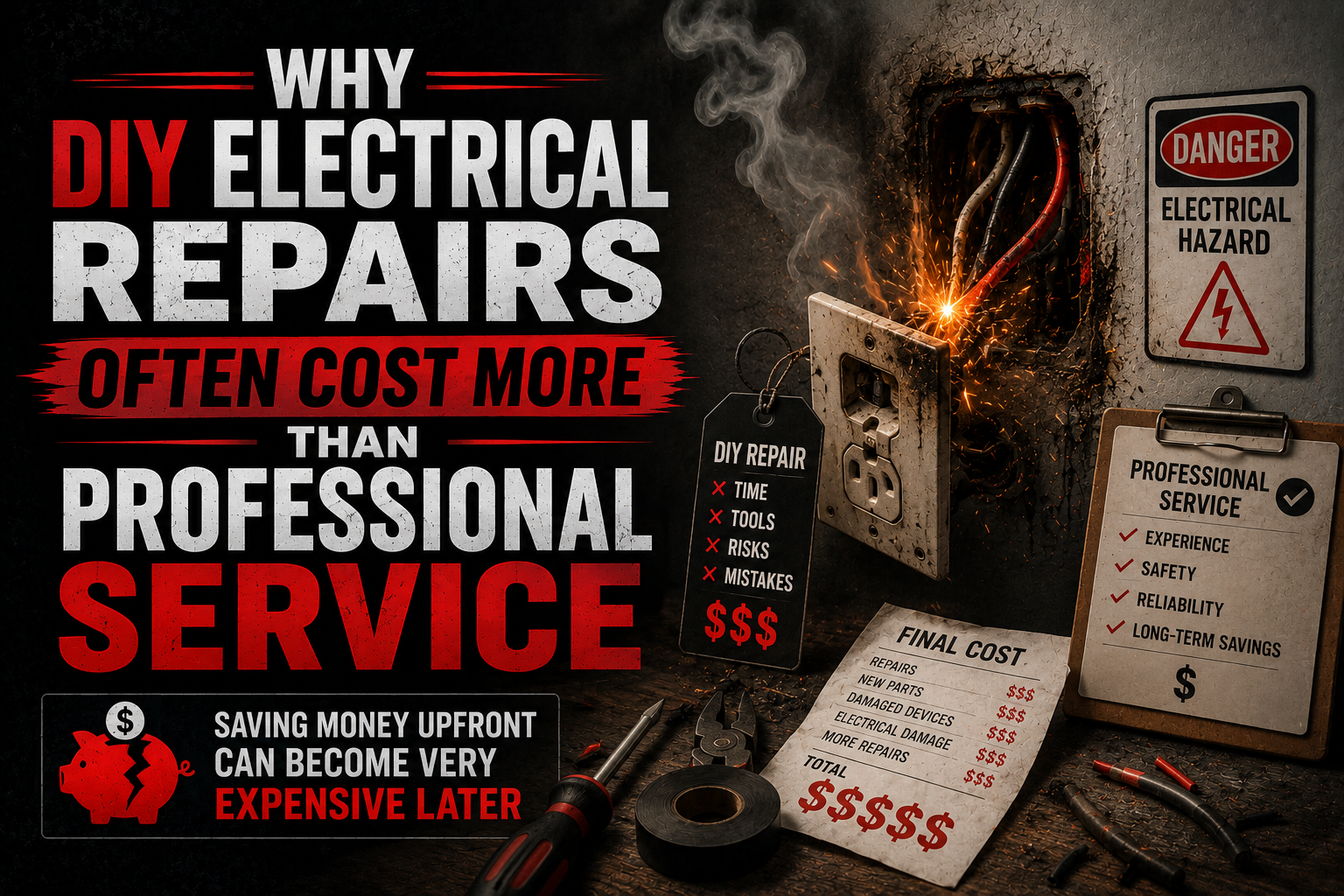
The logic seems airtight at first. The outlet stopped working. You watched a twelve-minute video online. The parts cost forty dollars at the hardware store. Why pay a licensed electrician several hundred dollars to do something you could handle yourself in an afternoon?
It is a calculation that millions of homeowners make every year, and it is a calculation that is often wrong — not because homeowners are careless or incompetent, but because the calculation leaves out most of the variables that actually determine what a DIY electrical repair costs. The forty-dollar part and the afternoon of labor are visible and immediate. The permit violation, the insurance implication, the failed connection behind the wall, the inspector’s flag during the home sale three years from now — these are invisible and deferred, which makes them easy to exclude from the math until they become impossible to ignore.
This is not an argument that homeowners should never touch their own electrical systems. Replacing a light switch on a circuit you understand, swapping a fixture you have correctly identified as a like-for-like replacement, resetting a tripped breaker after removing the overloading device — these are tasks that most homeowners can perform safely with basic knowledge and appropriate precautions. The electrical work that falls outside this narrow band, however — new circuits, panel work, outlet additions, wiring repairs, anything that requires opening the wall or touching the panel — is work where the gap between what the job appears to be and what it actually is tends to be widest, and where the consequences of that gap are most serious.
This guide is an honest accounting of what DIY electrical repairs actually cost — not the parts bill, but the full cost, including the items that do not show up on any receipt until something goes wrong. By the end of it, the calculation will look different than it did at the start.

The Hidden Costs That the Parts Bill Does Not Include
The Cost of Not Knowing What You Do Not Know
Professional electricians carry two distinct bodies of knowledge that most homeowners do not: technical knowledge of how electrical systems work, and diagnostic knowledge of how electrical systems fail. These are related but different, and the second one is the more valuable of the two in most repair contexts.
When a licensed electrician looks at a tripped breaker, they are not just seeing a tripped breaker. They are seeing a symptom and beginning a diagnostic process that considers what caused the trip, whether the cause represents a developing fault condition or simply an overloaded circuit, whether the circuit is sized correctly for its current use, and whether the trip is a breaker performing its function or a breaker beginning to fail. That diagnostic process draws on years of pattern recognition — the accumulated experience of having seen the same symptom originate from many different causes and having learned which presentations predict which underlying conditions.
A homeowner watching a twelve-minute video has access to the technical knowledge of how to reset a breaker or replace an outlet. They do not have the diagnostic knowledge to understand whether the symptom they observed is the complete picture or the visible tip of a developing problem. This is not a gap that can be closed by watching more videos, because diagnostic knowledge is not primarily conceptual — it is experiential. It comes from having done the work, in real buildings, with real electrical systems that behave in ways that no video fully anticipates.
The cost of not having this diagnostic knowledge is not always paid immediately. Sometimes it is paid months later, when the outlet that was replaced without investigating why it failed stops working again — or fails in a way that is no longer an inconvenience. Sometimes it is paid years later, when a connection that was made incorrectly has been generating heat behind the wall long enough to become a fire risk. The deferred nature of this cost is precisely what makes it easy to exclude from the initial calculation and precisely what makes it so consequential when it arrives.
The Cost of Incorrect Connections
The most common category of DIY electrical error is not dangerous ignorance of basic principles — most homeowners who attempt electrical work know enough not to touch live wires. It is incorrect connection — wiring that is electrically functional in the sense that things turn on and off, but that is mechanically inadequate, thermally stressed, or incorrectly configured in ways that create developing hazards.
A wire nut connection that is turned two fewer rotations than it should be is mechanically functional when first made. Under the thermal cycling of a circuit that heats slightly under load and cools when the load is removed — a cycle that repeats thousands of times over years of normal use — that marginally connected joint works loose progressively. A connection that was functional on the day it was made may be generating heat from resistive contact by the time the home sells three years later, and may be producing arcing conditions by the time the new owner has lived in the home for another two years.
A wire connected to the wrong terminal — the hot conductor landed on the neutral terminal, or the ground pigtailed to the neutral bar rather than the ground bar — is electrically functional in many configurations. Equipment operates. Lights illuminate. The error is invisible in normal use. It is also a configuration that creates shock hazards, degrades the function of protective devices, and in some configurations creates conditions that can damage sensitive electronics or bypass the protective function of GFCI devices.
The connection errors most common in DIY electrical work are not catastrophic in the moment they are made. They are seeds of future problems — conditions that require time, load, and thermal cycling to develop into failures. This developmental timeline is why DIY electrical work often appears to have succeeded when it has not, and why the cost of the failure arrives long after the cause has been forgotten.
The Cost of Using Wrong Materials
Professional electricians specify materials to the job — wire gauge sized to the circuit’s amperage, boxes with adequate volume for the conductors being landed, connectors rated for the specific wire types being joined, devices rated for the load they will carry. This matching of materials to application is second nature to someone who does this work daily. It is a source of error that is easy to underestimate for someone who does it occasionally.
The most consequential material errors in DIY electrical work tend to involve wire gauge and box fill. Using 14-gauge wire on a 20-amp circuit — rated for only 15 amps — means the circuit protection will allow the wire to carry more current than it is thermally rated for before the breaker trips. Using a standard single-gang box in a location that ends up with multiple conductors, connectors, and devices stuffed into inadequate volume creates mechanical stress on connections and the heat-retention conditions that contribute to connection degradation.
In older Los Angeles homes, material compatibility adds another layer of complexity. Connecting new copper wiring to existing aluminum branch circuit wiring without using connectors rated and listed for aluminum-to-copper connections creates a galvanic incompatibility that degrades the connection point over time, generating exactly the resistive heating conditions that make aluminum wiring dangerous. This is a detail that a licensed electrician knows automatically and that a homeowner relying on general online guidance may not encounter at all.
The Permit and Code Compliance Costs
What Requires a Permit and Why It Matters
In Los Angeles, electrical work that goes beyond simple fixture replacement and like-for-like device substitution requires a permit from the Department of Building and Safety, or from the applicable jurisdiction for properties in Pasadena, Glendale, Burbank, Long Beach, Torrance, and surrounding communities. Adding new circuits, installing new outlets, running new wiring, panel modifications — all of these require permits. The permit process includes a licensed electrical contractor submitting work plans, pulling the permit, completing the installation, and passing a final inspection by a city or county electrical inspector.
Homeowners who perform this category of electrical work without permits are not merely violating a bureaucratic technicality. They are taking on a set of specific, concrete liabilities that accumulate quietly and manifest at the worst possible moments.
The Real Estate Transaction Problem
The most immediate and financially painful way that unpermitted electrical work becomes expensive is in a real estate transaction. California’s disclosure requirements obligate sellers to disclose known material defects — including known unpermitted work. A seller who performed unpermitted electrical work and discloses it faces negotiation on remediation or price reduction. A seller who performed unpermitted electrical work and does not disclose it faces potential rescission of the sale and legal liability after closing if the work is discovered.
Real estate transactions involving older Los Angeles homes routinely include electrical inspection by the buyer’s inspector, and unpermitted work is frequently identified either by the inspector or by permit records research that buyers’ agents routinely perform. When it is identified, the seller’s options narrow rapidly — remediate before close, accept a price reduction, or walk away from the transaction.
The remediation of unpermitted electrical work is almost always more expensive than permitted work would have been in the first place, because it involves both correcting any deficiencies in the original work and obtaining retroactive permits where possible — a process that in some cases requires opening walls to allow inspection of work that was completed without inspection. The savings from avoiding the permit fee in the first place are typically measured in hundreds of dollars. The cost of remediation is typically measured in thousands.
The Insurance Implication
California homeowner’s insurance policies contain provisions about unpermitted modifications to the insured property. The specific language varies by policy, but the general principle is consistent: coverage for losses arising from or related to unpermitted modifications may be excluded or disputed. An electrical fire that originates in a circuit added without a permit — in a wall opened without permit, with materials that were never inspected — puts the homeowner in a position of arguing that the unpermitted work was not related to the fire’s origin. That is an argument that insurance adjusters are experienced at evaluating and that homeowners frequently lose.
The cost of an insurance coverage dispute over a fire loss is, in the worst case, the uncovered cost of rebuilding or replacing the home. It is also the displacement cost during rebuild, the contents replacement cost, and the legal cost of the dispute itself. These are not hypothetical risks. They are documented outcomes that arise from exactly the situation — DIY electrical work performed without permits — that appears financially rational before the loss event and catastrophic after it.
The Specific DIY Electrical Repairs That Most Often Become Expensive
Panel Work: The Highest-Risk DIY Category
Work inside the electrical panel is the category of DIY electrical repair with the highest probability of serious, immediate consequences and the highest probability of creating deferred hazards that are expensive to find and correct. The panel contains the full service amperage of the home’s electrical supply — in a 200-amp service, that is 200 amps available at the main breaker lugs, which represents enough current to cause severe injury or death from a single contact under the wrong conditions. Unlike a branch circuit, which is protected by a breaker that limits its current, the main service conductors entering the top of the panel are protected only by the utility’s overcurrent device — which is not accessible and is not sized to protect a person from contact.
Beyond the immediate safety risk of working in an energized panel, DIY panel work creates persistent problems with panel organization, connection integrity, and breaker seating that are expensive to identify and correct. A double-tapped breaker added by a homeowner who ran out of panel space is a finding that turns up in electrical inspections for years afterward. A breaker added without verifying the bus bar rating, or without confirming that the breaker is a listed replacement for that specific panel, is a finding that requires both identification and correction.
Panel upgrades — replacing a 100-amp panel with a 200-amp service — require utility coordination, permit and inspection, and in most cases service entrance conductor work that involves equipment that belongs, in part, to the utility. This is not work that a homeowner can perform safely or legally without a licensed electrical contractor.
Adding New Circuits and Outlets
Adding a new circuit — running wire from the panel to a new outlet location in a room that lacks adequate coverage, adding a dedicated circuit for a new appliance, installing an outlet in a garage or basement that has none — is among the most commonly attempted DIY electrical projects and among the most commonly done incorrectly.
The technical requirements for a correctly installed new circuit include: correct wire gauge for the circuit’s intended use and breaker size; correct box selection for the number of conductors, devices, and connectors being installed; correct conduit or cable assembly for the routing environment — outdoor, attic, through framing, through finished walls; correct connections at every termination point; correct breaker sizing and listing for the specific panel; and a permit and inspection confirming all of the above.
Missing any of these requirements produces a circuit that functions in normal operation but that has a specific deficiency that creates either a safety risk or a code violation — and usually both. The cost of finding and correcting these deficiencies after the walls are closed and finished is substantially higher than the cost of doing the work correctly in the first place. An electrician who opens a wall to investigate a failed circuit and finds undersized wiring, an overfilled junction box, and a double-tapped breaker is identifying work that will cost several times what a correct original installation would have cost.
Aluminum Wiring Repairs
In Los Angeles homes built between 1965 and 1973, the branch circuit wiring is frequently aluminum — a wiring type that requires specific connection approaches at every device to prevent the resistive heating and connection degradation that makes improperly managed aluminum wiring a fire risk. The correct approach is either aluminum-rated devices at every connection point or correctly installed copper pigtail connections — a specific technique using listed connectors of the correct type that transitions from the aluminum circuit conductor to a short copper conductor at the device terminal.
DIY repairs on aluminum wiring circuits that do not account for these requirements are not merely non-ideal. They are creating the specific conditions — aluminum conductors connected to standard copper-rated devices without proper transition — that make aluminum wiring hazardous. A homeowner who replaces an outlet on an aluminum wiring circuit with a standard outlet purchased at a hardware store has installed a device that is not rated for the wiring it is connected to, creating a connection point that will degrade on a predictable timeline and that may eventually fail in a way that involves heat and arcing.
The cost of correctly remediating aluminum wiring throughout a Los Angeles home — systematic pig-tailing at every device or replacement with aluminum-rated devices — is a known, bounded expenditure when done as a planned project by a licensed electrician. The cost of identifying and correcting piecemeal DIY aluminum wiring repairs that have been distributed throughout a home over years of intermittent owner work is substantially higher, because each incorrect connection point must be found, the extent of the incorrect work must be assessed, and the remediation must be planned around a system that may have been partially and inconsistently modified.
Outdoor and Landscape Electrical Work
Outdoor electrical work in Los Angeles — adding exterior outlets, running wiring for landscape lighting circuits, installing security lighting on dedicated circuits — involves wiring and connection requirements that differ from interior residential work in ways that are not always obvious from online guidance. Outdoor wiring must be in conduit rated for outdoor exposure or in cable assemblies rated for direct burial or outdoor use. All outdoor receptacles must have GFCI protection and weatherproof in-use covers. Junction boxes used outdoors must be rated for wet or damp locations as appropriate to their specific exposure. Near the coast — in La Jolla, Malibu, Santa Monica, and coastal communities throughout Southern California — equipment must be rated for salt air exposure.
DIY outdoor electrical work that uses indoor-rated materials in outdoor applications degrades rapidly. Standard indoor wire nuts in outdoor junction boxes corrode and fail. Standard indoor-rated wire used in exposed outdoor conduit degrades under UV exposure and thermal cycling. Standard indoor outlet boxes in outdoor locations admit moisture and corrode in ways that produce both shock hazards and arcing fault conditions. The cost of replacing a DIY outdoor electrical installation that used incorrect materials — digging up direct-buried cable that was not in conduit and cannot be accessed for repair, opening outdoor junction boxes that have corroded shut, replacing corroded outlets and covers throughout — is typically several times the cost of a correctly specified original installation.
The Safety Costs That Cannot Be Quantified
The financial costs of DIY electrical errors are real and concrete. The safety costs exist on a different dimension entirely — one where the consequences include outcomes that no financial accounting can adequately represent.
Electrical fires originating from improperly made connections, undersized wiring, and incorrect panel work are not abstractions. They happen in real homes, to real families, with real consequences that include property destruction, displacement, injury, and death. The electrical fault conditions that lead to these events develop over the timelines described throughout this guide — months or years of progressive connection degradation, insulation deterioration, and resistive heating that generates no symptom until it generates catastrophe.
The homeowner who performed the DIY wiring repair that started the fire is not typically aware, at the moment they made the incorrect connection, that they were creating a fire risk. They believed they had done the job correctly. The connection worked when they tested it. Everything was fine. Until, years later, it was not — and by then the cause was difficult to identify and the connection between the DIY work and the outcome was no longer something that could be easily traced.
Shock hazards from reversed polarity, open ground conditions, and incorrectly wired GFCI devices are similarly deferred — invisible in normal use, present and dangerous under the specific conditions that activate them. Children who insert objects into outlets with reversed polarity, homeowners who contact energized fixture shells, families who rely on GFCI devices that were incorrectly wired and do not actually provide the protection they appear to — these are not hypothetical risks. They are outcomes that arise from exactly the category of DIY electrical error that appears successful at the time it is made.
These costs cannot be put on a spreadsheet next to the electrician’s service call fee. But they belong in any honest accounting of what DIY electrical work actually costs.
What a Licensed Electrician Actually Provides That DIY Cannot
When a licensed electrician performs an electrical repair or installation, the homeowner is not just paying for the labor of someone who knows how to connect wires. They are paying for a specific set of things that DIY work cannot provide.
Diagnostic accuracy. A licensed electrician identifies not just the visible symptom but the underlying cause, and distinguishes between conditions that are isolated and conditions that indicate broader system issues. This is the gap between fixing the outlet that stopped working and understanding why it stopped working — and whether the reason suggests other outlets on the same circuit are developing the same condition.
Code compliance. Work performed by a licensed electrical contractor is performed to current code standards. The California Electrical Code, which adopts and modifies the National Electrical Code, sets the standards that licensed electrical work must meet. Code-compliant work is work that has been done to the standards that represent the industry’s current understanding of safe electrical installation. It is also work that can be permitted and inspected — giving the homeowner official confirmation that the work meets those standards.
Permit and inspection management. A licensed electrical contractor pulls the required permits, manages the inspection scheduling, and is responsible for ensuring the work passes final inspection. The permit and inspection process is not bureaucratic overhead — it is an independent verification that the work was done correctly by someone other than the person who did it. That verification is valuable both as a safety confirmation and as documentation that protects the homeowner in future transactions and insurance situations.
Warranty and accountability. Licensed electrical contractors stand behind their work. If a repair fails, if an installation develops a problem related to the original work, the contractor is accountable — financially, professionally, and in the context of their license. A DIY repair that develops a problem several years later has no such accountability. The homeowner absorbs the full cost of finding and correcting what went wrong, with no recourse.
Insurance and liability coverage. Licensed electrical contractors carry general liability insurance and workers’ compensation coverage. Work performed in your home by an unlicensed contractor, or by the homeowner, does not carry this coverage. An injury to an unlicensed worker performing electrical work in your home can create homeowner liability. An injury to a licensed contractor’s employee is covered by the contractor’s workers’ compensation policy.
The Right Line: What Homeowners Can Reasonably Do Themselves
None of this is an argument that homeowners should never perform any electrical task themselves. There is a category of work that falls within reasonable homeowner capability when the person involved has basic electrical knowledge and appropriate safety practices.
Replacing a like-for-like light fixture on an existing circuit — where the junction box, wiring, and switch are already in place and correctly sized — is within homeowner capability when the circuit is de-energized at the panel before any work begins and confirmed dead with a non-contact voltage tester before any wires are touched.
Replacing a switch or outlet with a device of the same type on an existing circuit — photographing the existing wiring configuration before disconnecting anything, connecting the new device to match the original, confirming the circuit is dead before touching any connection — is within homeowner capability for straightforward standard-voltage applications on copper wiring.
Resetting a tripped breaker after identifying and removing the overloading device is appropriate homeowner action, as is replacing a tripped GFCI device after testing and resetting it.
What is outside reasonable homeowner scope — and where the cost-benefit analysis consistently favors hiring a licensed electrician — is any work that involves adding new circuits, any work that requires opening or modifying the panel, any wiring repair that requires opening walls or accessing concealed conductors, any outdoor or landscape electrical installation, and any work on aluminum wiring circuits. These are the categories where the gap between what the work appears to involve and what it actually involves is widest, and where the consequences of errors are most likely to be serious and expensive.
The Los Angeles Context: Why Local Factors Amplify the Risk
The general arguments for professional electrical work apply everywhere. Several factors specific to Los Angeles amplify those arguments for homeowners in this region.
Los Angeles’s older housing stock — the craftsman homes of Highland Park and Eagle Rock, the Spanish Revival properties of Los Feliz and Hancock Park, the midcentury ranch homes of Glendale, Burbank, and the San Fernando Valley — contains a disproportionate amount of the wiring types and panel equipment that create the highest risk of serious DIY electrical error consequences. Aluminum wiring, knob-and-tube wiring, Federal Pacific and Zinsco panels, and service entrance equipment that has been in place for fifty or sixty years are not forgiving environments for inexperienced electrical work.
The real estate market in Los Angeles is one of the most active and highest-value residential markets in the country. The permit and disclosure implications of DIY electrical work are correspondingly significant — the financial exposure from unpermitted work in a Beverly Hills or Santa Monica transaction is substantially larger than in a lower-value market, and the scrutiny that buyers and their agents apply to permit history is correspondingly more thorough.
The coastal environment of properties in Malibu, Santa Monica, Pacific Palisades, Long Beach, and communities along the Southern California coast adds material specification requirements that are specific to salt air exposure and that are not reflected in most general electrical installation guidance. Outdoor electrical work performed with standard-specification materials in coastal locations degrades faster and fails in ways that create conditions — corroded connections, compromised insulation, moisture-infiltrated junction boxes — that are particularly expensive to find and correct.
And the permit and inspection requirements in Los Angeles, with their specific LADWP and Southern California Edison coordination requirements for service entrance work and panel upgrades, create a regulatory environment that amplifies the cost of unpermitted work beyond what a simpler permit structure would produce.
Frequently Asked Questions
Can I legally do my own electrical work in California?
California law permits homeowners to perform electrical work on their own primary residence without holding an electrical contractor’s license, provided they obtain the required permits and the work passes final inspection. The permit requirement is not waived for homeowner-performed work — it applies equally. Homeowners who pull their own permits are agreeing to be responsible for ensuring the work meets code, and the city inspector will verify this at final inspection. Work that does not pass inspection must be corrected before the permit can be finaled, and if walls have been closed before inspection, they may need to be opened.
What types of electrical work absolutely require a licensed electrician in Los Angeles?
Any work on the electrical panel, any new circuit addition, any service entrance work, any work coordinating with LADWP or Southern California Edison on service upgrades or new connections, and any work on the electrical systems of commercial properties all require a licensed electrical contractor in Los Angeles. From a practical standpoint, any work that requires a permit is work where hiring a licensed contractor is standard practice and is generally advisable even where homeowner permit-pulling is technically permitted.
How much does a licensed electrician actually cost for common repairs in Los Angeles?
Service call fees for a licensed electrician in Los Angeles typically range from $100 to $200, covering the visit and diagnostic assessment. Common repairs — outlet replacement, switch replacement, GFCI installation, fixture swap — typically cost $150 to $400 for labor and materials combined, depending on the complexity. New circuit installation ranges from $300 to $800 per circuit depending on the routing difficulty and panel conditions. These are costs that appear large relative to the parts bill of DIY work and modest relative to the cost of correcting DIY work that has created problems.
How do I verify that an electrician is licensed in California?
The California Contractors State License Board maintains a publicly accessible online verification tool at cslb.ca.gov. Searching by company name or license number returns the contractor’s current license status, license class, bonding information, insurance information, and any disciplinary history. A C-10 Electrical Contractor license is the relevant credential for residential and commercial electrical work in California. Verification takes under two minutes and should be routine before hiring any electrical contractor.
What should I do if a previous owner performed DIY electrical work in my home?
Schedule a professional electrical inspection. Identifying the extent and nature of DIY work in a home you have purchased requires systematic inspection by a licensed electrician — examining the panel, testing devices, and where there are specific concerns, assessing accessible wiring in attic and crawl space locations. The inspection findings give you a clear picture of what was done, whether it was done correctly, and what remediation — if any — is indicated. Discovering and addressing prior DIY electrical work proactively is substantially less expensive than discovering it during a sale or after it produces a failure.
Does unpermitted electrical work always have to be disclosed when selling a home in Los Angeles?
California’s seller disclosure obligations cover known material defects and known unpermitted work. If a seller knows that electrical work was performed without permits — either because they did it themselves or because they have documentation indicating prior unpermitted work — that knowledge triggers a disclosure obligation. Sellers who are uncertain about the permit history of modifications made by prior owners should consult a real estate attorney about their specific disclosure obligations. As a practical matter, having the electrical work assessed and, where necessary, permitted retroactively or corrected before listing is generally the cleanest path to a successful transaction.
Are there any DIY electrical repairs that are clearly safe for homeowners?
Yes. Resetting a tripped breaker after removing the overloading device is safe homeowner action. Replacing a burned-out bulb in any fixture is not an electrical repair at all. Replacing a like-for-like outlet or switch on an existing circuit — with the circuit confirmed dead at the panel and verified dead with a non-contact voltage tester before touching any wire — is within reasonable homeowner capability for standard copper wiring applications. Replacing a like-for-like light fixture on an existing junction box, with the circuit de-energized and confirmed, is similarly within homeowner scope. The boundary is: same type, same location, same circuit, copper wiring, confirmed dead before touching. Anything beyond that boundary benefits from professional involvement.
What is the cost difference between fixing a DIY electrical problem and paying for professional work upfront?
There is no universal answer, because DIY electrical problems range from a misconnected outlet that takes thirty minutes to correct to a years-old wiring modification that requires opening multiple walls, assessing the extent of the incorrect work, obtaining retroactive permits where possible, and correcting conditions throughout an affected area. What is consistent across the range is that the correction is more expensive than the original professional work would have been — because it involves both the labor of correct installation and the labor of finding, assessing, and undoing the incorrect work that preceded it. The ratio is typically two to four times the original professional cost for straightforward corrections, and higher for corrections that involve permit issues, insurance implications, or real estate transaction complications.
Conclusion
The argument for DIY electrical work is intuitively compelling and factually incomplete. The parts cost is real and immediate. The labor savings are real and immediate. What is not real and not immediate — until it is — are the permit implications, the insurance exposures, the developing hazard conditions from incorrect connections, the real estate transaction complications, and the safety risks that live quietly behind finished walls for years before they produce consequences.
A licensed electrician in Los Angeles is not an expensive alternative to doing the work yourself. They are the person who knows what the work actually involves — the diagnostic piece that determines whether the outlet that stopped working is an isolated device failure or a symptom of a circuit condition; the code knowledge that ensures the work is compliant; the permit management that produces official documentation that protects you in every future context where that documentation matters; and the connection quality that ensures the work still functions correctly in five years, ten years, and twenty years without generating heat in the walls.
That comprehensive value — diagnostic, technical, compliance, documentation, and durability — is what professional electrical service provides. It is worth what it costs. And the alternative, when things go wrong, consistently costs more.
Trust Volta Electric to Do the Job Right the First Time
Volta Electric Inc. is fully licensed, bonded, and insured, serving Los Angeles, Pasadena, Glendale, Burbank, Beverly Hills, Santa Monica, Westlake Village, Culver City, Long Beach, Torrance, and all of Los Angeles County with professional electrical repair services, outlet and GFCI outlet installation, circuit breaker replacement, electrical panel upgrades, electrical panel replacement, wiring and rewiring services, EV charger installation, electrical troubleshooting, and the complete range of residential and commercial electrical services.
We do the work correctly, completely, and to a standard that holds up over time. We pull the permits, pass the inspections, explain every finding, and stand behind everything we do.
Free estimates on all projects. Same-day appointments available for situations that require immediate attention.
Contact Volta Electric Inc. today. Do it once. Do it right.
Volta Electric Inc. | Licensed Electrical Contractor | C-10 License | Serving Los Angeles, Pasadena, Glendale, Burbank, Beverly Hills, Santa Monica, Westlake Village, Culver City, Long Beach, Torrance & All of Los Angeles County | Free Estimates | Same-Day Appointments Available