Introduction
The average American home in 2026 runs more electricity than at any point in residential history. Electric vehicles charge overnight in the garage. Battery storage systems manage energy flows around the clock. Smart home devices stay connected and drawing power continuously. Heat pumps have replaced gas appliances in millions of households. Induction ranges, high-efficiency HVAC systems, and home office equipment have transformed what a typical household’s electrical load looks like — and what it demands from the infrastructure carrying that load.
The electrical safety challenges facing homeowners have evolved alongside this transformation. The foundational risks — overloaded circuits, aging wiring, failing panels, improper modifications — have not gone away. But they now share space with a new category of safety considerations specific to the technology that defines modern residential energy use. A homeowner who understands electrical safety as it was taught a generation ago is working with an incomplete picture.
This guide is comprehensive by design. It covers the timeless fundamentals that every homeowner should understand regardless of how old or new their home is, and it covers the technology-specific safety considerations that 2026 homeowners face with solar installations, battery storage systems, EV charging infrastructure, and the smart devices that now populate nearly every room. The goal is a single authoritative reference that gives homeowners the knowledge to assess their own situation, recognize developing problems, and make informed decisions about when professional intervention is needed.
Electrical safety tips that reflect the reality of how homes actually operate today — not how they operated twenty years ago — are the only one’s worth following.
Section One: Understanding Your Home’s Electrical System
Before any meaningful conversation about electrical safety can happen, a homeowner needs a working understanding of what their home’s electrical system actually consists of and how its components relate to each other. This is not about developing technical expertise — it is about having enough conceptual understanding to recognize when something is behaving abnormally.
The Service Panel: Your System’s Central Control Point
The electrical service panel — variously called the breaker box, load center, or distribution board — is where utility power enters your home and distributes to individual circuits. The main breaker controls total power flow to the home. Individual circuit breakers protect specific circuits serving different areas and appliances throughout the house.
Understanding your panel means knowing its service amperage, which circuits serve which areas of your home, and where the panel is physically located so you can reach it quickly in an emergency. Every homeowner should be able to walk to their panel and turn off the main breaker without hesitation. In a situation where you smell burning, hear arcing sounds, or see smoke from an electrical source, the ability to de-energize the home quickly is the most important first-response capability you have.
If you don’t know your panel’s service amperage, open the panel door and look at the number on the main breaker. 100, 150, and 200 are common residential ratings. If your home was built before 1980 and the panel has never been upgraded, the service amperage is particularly worth knowing, as many homes of that era still operate on 100-amp or lower service that is insufficient for modern electrical loads.
Circuits, Breakers, and What They Protect
Each circuit breaker in your panel corresponds to a specific circuit in your home. The breaker’s amperage rating — typically 15 or 20 amps for general household circuits, with higher ratings for appliance circuits and HVAC equipment — represents the maximum current that circuit is designed to carry. When current exceeds that rating, the breaker trips, interrupting power to the circuit and preventing the wiring from overheating.
This protective function is essential, but it only works when the electrical system is wired and loaded correctly. A circuit carrying more load than its wiring is rated for — regardless of whether the breaker has tripped — generates heat in the conductors that the breaker may not detect until the overheating has been occurring for some time. This is why overloaded circuits are a fire risk even in systems where breakers appear to be functioning normally.
Dedicated circuits — circuits that serve a single appliance or load without sharing capacity with other devices — are required by electrical code for major appliances including refrigerators, dishwashers, microwave ovens, electric ranges, dryers, HVAC equipment, and, increasingly, EV chargers and battery storage systems. Homes where dedicated appliance circuits were added informally, without following code, or where appliances have been plugged into circuits not designed for them represent a common category of electrical safety risk.
Grounding and Bonding: The Safety Infrastructure You Never See
Electrical grounding and bonding are the components of your home’s electrical system specifically designed to protect people from shock and to provide a controlled path for fault currents. A properly grounded outlet provides a return path for electricity in the event of a fault — meaning that if a device develops an internal short circuit, the fault current travels through the ground conductor to the panel rather than through a person who touches the device.
Homes built before grounded outlets became standard — roughly before 1962 — may have two-prong outlets throughout. Two-prong outlets provide no grounding, which means devices plugged into them lack this shock protection. The presence of two-prong outlets in a home is an indicator that the electrical system may not have been updated to modern safety standards, and a professional evaluation is appropriate.
Section Two: The Electrical Safety Tips Every Homeowner Needs
With that foundation in place, the following electrical safety practices address the most common and consequential risk categories in residential electrical systems.
Know When Your Wiring Was Installed — and What Type It Is
The age and type of wiring in your home is one of the most important electrical safety facts you can know. Homes built through the 1940s may have knob-and-tube wiring. Homes built between roughly 1965 and 1973 may have aluminum branch circuit wiring. Homes built from the 1950s onward and renovated over subsequent decades may have a mix of wiring types from different eras.
Each of these wiring types carries specific considerations. Knob-and-tube wiring requires air circulation to dissipate heat during operation — a condition that is compromised when insulation materials have been packed against it in attics or wall cavities during subsequent renovations. Aluminum branch circuit wiring is prone to connection loosening over time due to the different thermal expansion characteristics of aluminum compared to the copper connections it terminates at. Mixed wiring systems from multiple eras can create compatibility issues at connection points where different wire types meet.
If you don’t know what type of wiring your home has, a licensed electrician can identify it during a professional inspection. This is foundational information for any homeowner making decisions about electrical upgrades, renovations, or the addition of new electrical loads.
Never Ignore a Repeatedly Tripping Breaker
A circuit breaker that trips and does not trip again after the obvious cause is removed has done its job. A breaker that trips repeatedly, or that trips when no obvious overload is present, is indicating a persistent condition — overloaded circuit, wiring fault, failing device, or failing breaker — that needs professional evaluation rather than repeated resets.
The specific risk in resetting a tripping breaker without investigation is that the reset restores power to a circuit that may be experiencing a wiring fault generating heat inside the wall. Each reset and subsequent trip cycle may be allowing the fault to progress further before the protective trip occurs. Over time, repeated heat exposure degrades wiring insulation and increases arcing risk.
The correct response to a repeatedly tripping breaker is to reduce the load on that circuit, avoid using it until it can be evaluated, and contact a licensed electrician for electrical troubleshooting. Not next month. Within days.
Respect Extension Cords as Temporary Solutions Only
Extension cords are one of the most consistently misused electrical safety items in residential environments. They are designed and rated for temporary use — running a device across a room for a limited period when a nearby outlet is unavailable. They are not rated for continuous use, and they are not a substitute for an installed electrical outlet.
An extension cord used as a permanent power solution creates multiple safety risks. Extension cords are not protected by a circuit breaker in the same way that installed wiring is — if the cord is damaged, frayed, or overloaded, the breaker protecting the circuit it’s plugged into may not respond until the cord itself has already reached ignition temperature. Extension cords run under rugs, through doorways, or against heated surfaces develop damage that is not always visible until it has created a hazard.
Homeowners who consistently rely on extension cords for permanent device placement should have additional outlets installed by a licensed electrician. Electrical outlet installation is a straightforward project that eliminates an ongoing safety risk while also improving the practical functionality of the space.
Test GFCI Outlets and Breakers Regularly
Ground fault circuit interrupters — both the outlet-type GFCIs found in bathrooms, kitchens, garages, and outdoor locations, and the GFCI breakers that protect entire circuits — require periodic testing to confirm that their protective function is operational. A GFCI that has failed can appear normal — the outlet accepts plugs and provides power — while its ground fault detection function has stopped working.
Testing a GFCI outlet takes seconds. Press the test button. The outlet should go dead. Press the reset button. Power should restore. If the outlet fails either step, it requires replacement. Testing should be performed monthly in locations where GFCI protection is critical — bathroom, kitchen, garage, and outdoor outlets — and any GFCI that fails its test should be replaced promptly by a licensed electrician.
Homes that lack GFCI protection in required locations represent an ongoing shock hazard. GFCI outlet installation in bathrooms, kitchens, garages, and exterior locations brings the home into compliance with current electrical code and addresses a real safety gap that costs relatively little to close.
Never Exceed Panel Capacity with DIY Circuit Additions
Adding circuits to a home’s electrical panel is one of the most common DIY electrical projects that homeowners undertake and one of the most consistently problematic from a safety standpoint. The consequences of panel work done incorrectly range from failed permit inspections to breakers that do not trip correctly under overload conditions to, in serious cases, wiring faults that create fire risk inside the panel itself.
Electrical panel work in California — and throughout most of the country — requires a permit and must be performed or supervised by a licensed electrical contractor. This is not a bureaucratic requirement divorced from safety considerations; it is a safety requirement that reflects the consequences of panel work done incorrectly. The permit inspection process provides independent verification that the work meets code requirements, which a DIY installation without permit lacks.
For homeowners who need additional circuits — for an EV charger, for a workshop, for any significant new load — the correct path is a licensed electrician who pulls permits and completes inspections. The cost difference between a properly permitted, professionally installed circuit and a DIY addition is modest; the safety difference is not.
Section Three: Electrical Safety for Modern Home Technology
The technology that has become standard in homes across Los Angeles and throughout California in recent years creates safety considerations that extend beyond the traditional residential electrical safety framework.
Solar Panel Systems: Safety Beyond the Roof
A rooftop solar installation is an electrical generation system operating on your home around the clock. The DC voltage at which solar panels operate — often exceeding 300 to 600 volts in a typical residential string configuration — is substantially higher than the 120 and 240-volt AC power used within the home. Safety considerations specific to solar systems deserve attention from any homeowner with panels installed.
Rapid shutdown capability has been required on new solar installations by the National Electrical Code since 2017. Rapid shutdown systems allow first responders to de-energize the panels quickly in an emergency, preventing the conductors on the roof from remaining energized during fire suppression or rescue operations. Homeowners with solar systems installed before 2017 should verify with their installer whether rapid shutdown capability is present, and if not, whether a retrofit is feasible for their system.
Inverters — the devices that convert DC power from the panels to AC power for home use — should be installed in locations with adequate ventilation and protected from direct weather exposure. Inverters generate heat during operation and require airflow to manage thermal load. An inverter installed in a confined space without adequate ventilation runs hotter than its design allows and will degrade faster and potentially create heat-related safety concerns.
Annual inspection of solar installation connections, conduit integrity, and inverter performance is appropriate preventive maintenance for any residential solar system. A solar system that has not been professionally inspected since installation may have developed connection degradation or other issues that affect both safety and performance.
Battery Storage Systems: Stored Energy Safety
Home battery storage systems represent a category of stored energy that creates specific safety considerations beyond those associated with conventional electrical systems. A lithium battery bank holding 10 to 20 kilowatt-hours of stored energy contains substantial potential energy that, under fault conditions — thermal runaway, physical damage, improper installation — can release that energy in a dangerous and difficult-to-control manner.
Thermal runaway is the failure mode that battery system manufacturers and installers take most seriously. It occurs when a cell within a battery pack overheats to the point where the heat itself drives further chemical reactions that generate more heat — a self-sustaining process that can result in fire or explosion if not arrested. Quality battery management systems in modern residential storage products are designed to prevent thermal runaway through active cell monitoring, temperature management, and automatic disconnection if cells approach dangerous conditions. But the quality of that protection varies across products and depends on proper installation.
Battery storage systems should be installed in locations with adequate ventilation, appropriate temperature range, and no exposure to physical damage from vehicles, flooding, or other hazards. Battery enclosures should not be modified. The manufacturer’s installation specifications regarding minimum clearances, ventilation requirements, and ambient temperature limits are not suggestions — they are the conditions under which the battery management system’s safety protocols are designed to function. Installing a battery outside those parameters degrades the safety margin the system was designed to provide.
The electrical connections between a battery storage system and the home’s main panel are high-current connections that should be inspected periodically for signs of heat, corrosion, or loosening. Any evidence of heat damage at battery system connections — discoloration, melting at terminal covers, unusual odors near the battery enclosure — warrants immediate shutdown of the system and professional inspection before it is returned to service.
EV Charging Infrastructure: Daily High-Current Operation
A Level 2 EV charger draws 32 to 50 amps continuously for four to eight hours every night in a household that charges daily. This is one of the most sustained high-current loads in any residential electrical system, and the connections and wiring that support it experience thermal cycling — the expansion and contraction that accompanies heating and cooling under load — more consistently than most other circuits in the home.
Annual inspection of the EV charger circuit — the outlet or hardwired connection at the charger, the conduit and wiring from the charger location to the panel, and the breaker connection at the panel — is appropriate preventive maintenance for any household that charges daily. Loose connections that might go undetected for years on a circuit used occasionally can develop significantly faster on a circuit that sees sustained high-current operation every day.
Smart EV chargers with built-in monitoring can alert homeowners to anomalies in charging performance that may indicate developing issues in the charging circuit. Unexpected reductions in charging speed, connection errors, or temperature alerts from a smart charger’s monitoring system warrant electrician inspection before the condition progresses.
Smart Home Devices and Continuous Low-Level Loads
Smart home devices — connected thermostats, smart speakers, security cameras, hub devices, and the growing category of always-on IoT equipment — draw small amounts of power continuously. Individually, these loads are trivial. Collectively, in a home with dozens of connected devices, they represent a meaningful baseline electrical load that operates around the clock.
The safety consideration specific to always-on devices is not their aggregate current draw but rather the quality of their power supplies and the conditions under which they operate. Low-quality smart home devices with inexpensive internal power supplies can develop faults that, while rarely causing fires in isolation, contribute to outlet and circuit loading that interacts with other safety factors. Devices that run warm to the touch, that have shown inconsistent operation, or that are from manufacturers without established safety testing certifications warrant replacement with quality alternatives.
The proliferation of USB charging equipment — phone chargers, tablet chargers, laptop chargers, and multi-port charging stations left plugged in continuously — presents a similar consideration. Charging adapters and power supplies left plugged in indefinitely are often at the lower end of the quality spectrum for residential electrical equipment. Replacing aging or low-quality charging equipment periodically and avoiding the practice of leaving high-heat charging equipment plugged into outlets buried under furniture or in confined spaces reduces a category of risk that is easy to overlook because the individual devices seem small.
Section Four: Seasonal and Situational Electrical Safety
Before and After Major Storms
The electrical system is one of the first things to assess before and after significant storm events. Before a major storm that may bring wind, flooding, or the risk of downed lines, verify that your home has a clear path to the main breaker for quick de-energization and that you know how to shut off individual circuits for areas most vulnerable to weather-related water intrusion.
After a flood event that has brought water into contact with any portion of your home’s electrical system — outlets, wiring runs in wet areas, the panel if it is in a location that experienced water intrusion — do not restore power to affected areas until a licensed electrician has inspected the system. Water intrusion in electrical components can damage insulation in ways that are not immediately apparent and that create shock and fire risk when the system is energized.
Before Home Renovations
Any renovation project that involves opening walls, relocating outlets, adding circuits, or working in areas where the location of existing wiring is unknown requires careful attention to electrical safety before and during construction. Nails and screws penetrating wiring inside walls are a significant and common cause of electrical damage during renovation projects.
Before any renovation work, identify the circuits that serve the area being renovated and map their routing as well as possible. Have a licensed electrician assess the area if the wiring routing is uncertain. Power to circuits in the renovation area should be off during work that involves penetrating walls or ceilings, not merely during the moment of penetration.
The Generator Safety Rules That Save Lives
Portable generators used during power outages introduce a specific and serious safety risk: carbon monoxide poisoning from operating a combustion engine in or near enclosed spaces. Generator-related carbon monoxide deaths occur every year, and they occur with regularity because homeowners who are managing a stressful outage situation make the decision to operate a generator in a garage, on a covered porch, or near an open window in conditions that allow exhaust to infiltrate the living space.
A portable generator must be operated outdoors, well away from any opening to the home. Twenty feet is a reasonable minimum distance from doors, windows, and vent openings. Carbon monoxide detectors on every level of the home — particularly near sleeping areas — provide a critical early warning if exhaust does migrate indoors.
The other generator safety rule that saves lives is the prohibition against back-feeding a generator into the home’s main electrical system by connecting it to an outlet with a male-to-male adapter cord — a practice sometimes called a suicide cord. Back-feeding a generator into the home’s wiring energizes the utility lines outside the home, creating an electrocution hazard for utility workers who may be servicing those lines. A properly installed transfer switch isolates the home from the utility grid before generator power is applied, which is the only safe way to use a generator with the home’s electrical system.
Standby generator installation — a permanently installed generator connected to the home through a proper automatic transfer switch — eliminates all of these risks while providing seamless backup power. For homeowners in areas with meaningful grid reliability challenges, a properly installed standby generator paired with whole-house generator installation performed by a licensed electrician is the safe and reliable alternative to the risks that portable generator use introduces.
Section Five: Building a Long-Term Electrical Safety Practice
Electrical safety is not a one-time project. It is an ongoing practice that involves regular attention to your home’s electrical system, prompt response to developing symptoms, and periodic professional evaluation of the system as a whole.
Create a Basic Electrical Safety Reference for Your Home
Every homeowner should have a basic written reference for their home’s electrical system that covers the panel location, the main breaker location and operation, a circuit directory that maps breakers to the areas they serve, the location of any sub-panels, and the contact information for a licensed electrician they trust. This reference should be accessible to every adult in the household, not stored only in one person’s memory.
Circuit directories — the labels on the inside of the panel door that identify what each breaker controls — are often incomplete, inaccurate, or blank in homes that have had electrical work done over the years without corresponding label updates. Having a licensed electrician verify and update the circuit directory during a service call is a low-cost step that pays dividends in emergency situations when you need to de-energize a specific area quickly.
Schedule Professional Inspections Proactively
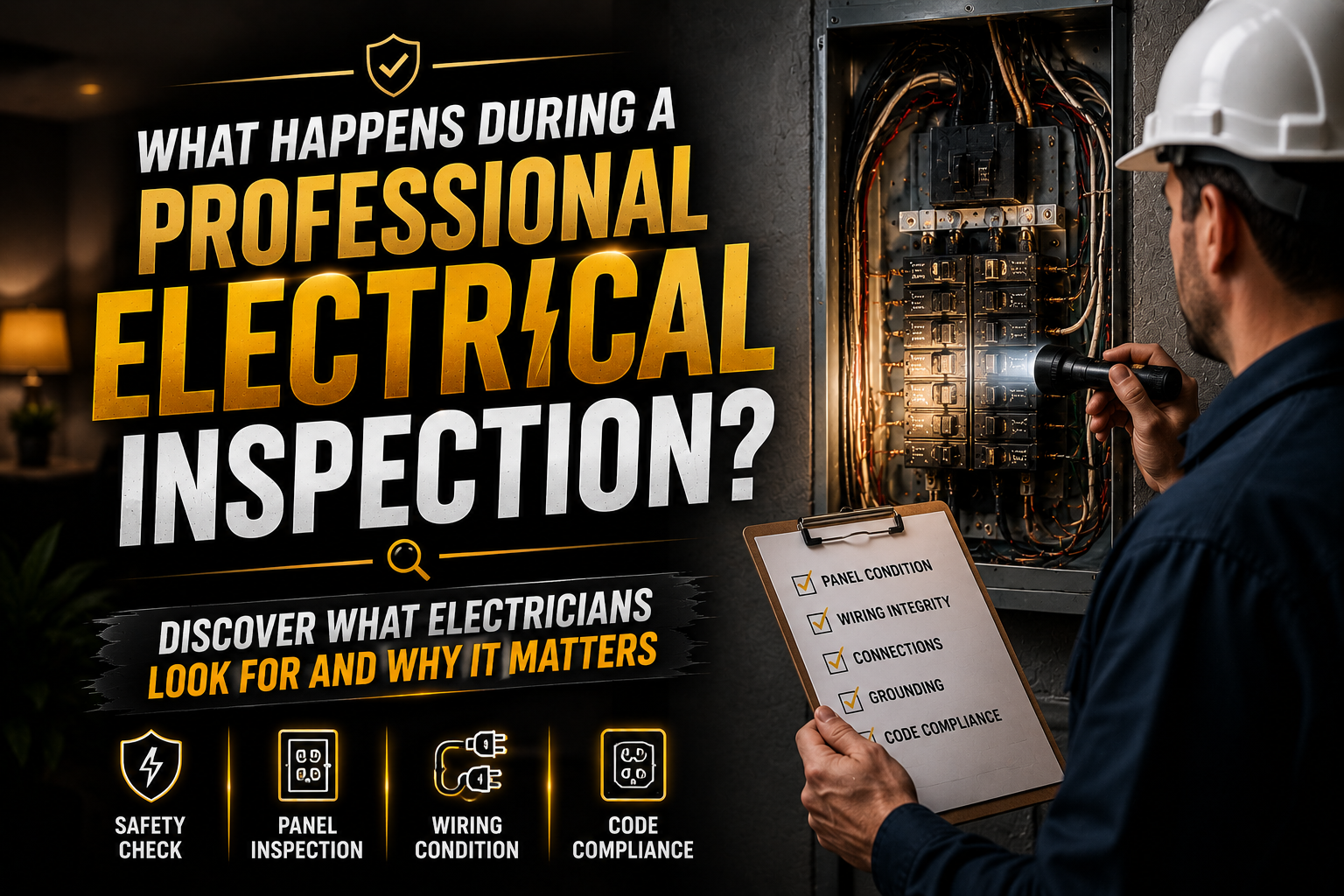
The inspection intervals worth establishing are: a full electrical inspection when purchasing a home, particularly if the home is more than 20 years old or has not had documented electrical work in recent years; a targeted inspection any time a new high-draw electrical system is added; an inspection every three to five years for homes over 25 years old as preventive maintenance; and an immediate inspection any time observable warning signs appear.
An electrician’s inspection of an existing system is a diagnostic service, not a sales call. A reputable electrician documents findings honestly, prioritizes them by urgency and risk level, and allows the homeowner to make informed decisions about what to address and when. Homeowners who defer professional inspection because they’re concerned about being sold unnecessary work are forgoing the primary tool available for identifying developing electrical hazards before they become emergencies.
Frequently Asked Questions
What are the most important electrical safety tips for a homeowner with an older home?
For homes over 30 years old, the priorities are knowing what type of wiring the home has, identifying the panel brand and confirming it is not Federal Pacific or Zinsco equipment, verifying GFCI protection in required locations, and scheduling a professional electrical inspection if one has not been done in the past five years. Older homes carry more electrical fire risk on average, but the specific risks depend on factors that only an inspection can reliably identify.
How do I know if my home has enough electrical capacity for modern appliances and technology?
The starting point is your panel’s service amperage. A 100-amp panel serving a modern home with significant electrical load — EV charging, heat pump systems, multiple high-draw appliances — is typically insufficient and warrants a load assessment. A licensed electrician can perform a formal load calculation that compares your home’s actual load to your service capacity and identifies whether an upgrade is needed.
Is it safe to use smart plugs and power strips with multiple devices plugged in?
Smart plugs and power strips with built-in surge protection and circuit breakers are generally safe when used within their rated capacity. Problems arise when multiple high-draw devices are connected through a single power strip in a way that exceeds the strip’s rating, or when power strips are daisy-chained. Use power strips only for devices they are rated for, and never use a standard power strip as a substitute for an additional permanent outlet in a location that consistently needs more power than the existing outlets can provide.
What should I do if I see sparks at an outlet or switch?
A brief, small spark when plugging in a device can be normal. A large spark, a persistent spark, sparking when no device is being connected, or sparking at a switch during normal operation are not normal. Stop using the affected outlet or switch. Turn off the circuit at the breaker. Contact a licensed electrician for same-day assessment. Do not use the circuit until the cause is identified and resolved.
How can I tell if my home’s electrical system is overloaded?
Common indicators include breakers that trip frequently, dimming lights when large appliances start their cycles, outlets that are warm to the touch, and a panel that feels warm or makes sounds during periods of high load. Any of these symptoms in combination are particularly significant. A load calculation by a licensed electrician provides a definitive assessment of whether your service capacity is adequate for your home’s actual electrical demand.
What is the safest way to use a portable generator during a power outage?
Operate the generator outdoors, at least 20 feet from any door, window, or vent. Never operate it in a garage, on a covered porch, or anywhere that exhaust can enter the living space. Use a properly rated outdoor extension cord to connect devices directly to the generator rather than back-feeding the home’s wiring. Install carbon monoxide detectors on every level of the home. For regular or extended backup power needs, a permanently installed standby generator with a proper transfer switch is significantly safer than portable generator use.
Should I be concerned about the electrical safety of my battery storage system?
Quality battery storage systems from established manufacturers with proper installation include multiple layers of protection against the safety risks specific to lithium battery chemistry. The key safety practices are ensuring the system is installed in accordance with manufacturer specifications — particularly regarding ventilation, temperature range, and clearances — inspecting connections annually for heat damage or corrosion, and taking any unusual odors, heat, or system alerts seriously. A battery system that has experienced physical damage should be inspected before being returned to service.
What permits are required for electrical work in California?
California requires permits for virtually all substantial electrical work, including new circuit installation, panel upgrades, EV charger installation, solar and battery storage interconnection, generator transfer switch installation, and home rewiring. Work performed without required permits creates insurance complications, disclosure obligations during property sales, and leaves the work without the independent safety verification that inspection provides. Licensed electrical contractors handle permitting as part of their professional responsibility — any contractor who proposes to skip required permits should not be hired.
Conclusion
The complete picture of electrical safety in 2026 is broader than it has ever been. The foundational knowledge — understanding your panel, respecting circuit capacity, testing GFCI protection, recognizing warning signs — remains as relevant as it ever was. Layered on top of that foundation are the technology-specific safety considerations that come with solar installations, battery storage systems, EV charging infrastructure, and the continuous-draw smart devices that now populate modern homes in Los Angeles and throughout California.
What unites all of these electrical safety tips is the same underlying principle: electrical systems operate safely when they are properly designed, correctly installed, and regularly maintained. When any of those elements is missing — when loads exceed design capacity, when installation corners were cut, when warning signs are ignored rather than investigated — the consequences accumulate quietly, inside walls and behind panels, until they become impossible to ignore.
The homeowners who avoid electrical emergencies are not the ones who got lucky. They are the ones who paid attention to the warning signs their systems were sending, treated recurring symptoms as the professional-attention items they are, and built a relationship with a licensed electrician they trust to assess their home honestly. That combination — attention, prompt response, and professional partnership — is the complete foundation of residential electrical safety in 2026.
Volta Electric: Your Electrical Safety Partner in Los Angeles
Volta Electric provides comprehensive electrical safety inspections, electrical troubleshooting, panel upgrades, GFCI outlet installation, EV charger installation, generator installation, and complete electrical repair services for residential and commercial properties throughout Los Angeles and surrounding communities.
Whether you’re concerned about a specific symptom, planning a major electrical addition, or simply overdue for a professional assessment of your home’s electrical system, Volta Electric’s licensed electricians deliver honest evaluations and quality work you can rely on.
Contact Volta Electric today to schedule your electrical safety inspection.